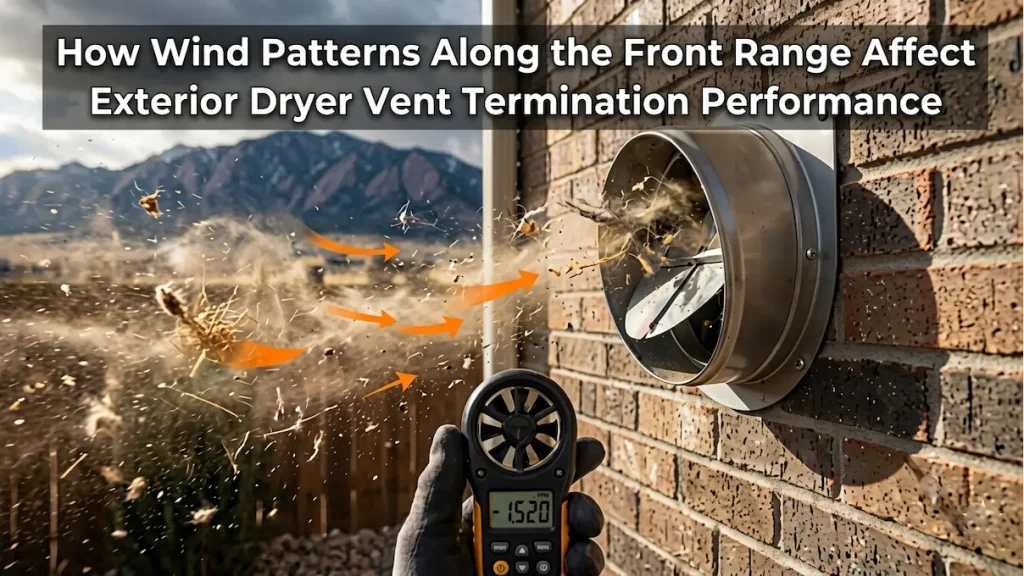
Wind patterns along the Front Range affect exterior dryer vent termination performance by interfering with the backdraft damper’s ability to open and close properly, forcing cold outside air and debris into the duct system, and in some cases creating enough negative pressure at the termination point to slow or reverse the dryer’s exhaust airflow entirely. This is not a minor inconvenience. The Front Range experiences some of the most distinctive and well-studied wind events in the country, and Littleton sits close enough to the foothills to feel their effects on home systems—effects that often go unnoticed until your system requires professional dryer vent cleaning to clear out the accumulated debris.
If you have ever noticed your dryer running long on a windy day, heard a rattling or whistling sound from your vent cap during a storm, or wondered why your laundry room suddenly feels drafty when the wind picks up, this article explains exactly what is happening and why residents here rely on regular dryer vent cleaning more than in most other parts of the country.
Why the Front Range Has Unusual Wind, Not Just Windy Weather
Most regions of the country experience wind as a fairly generic weather variable. The Front Range is different. Littleton sits in a transition zone between the Rocky Mountains and the High Plains, and that geography produces specific, named, scientifically documented wind events that behave very differently from a normal breezy day.
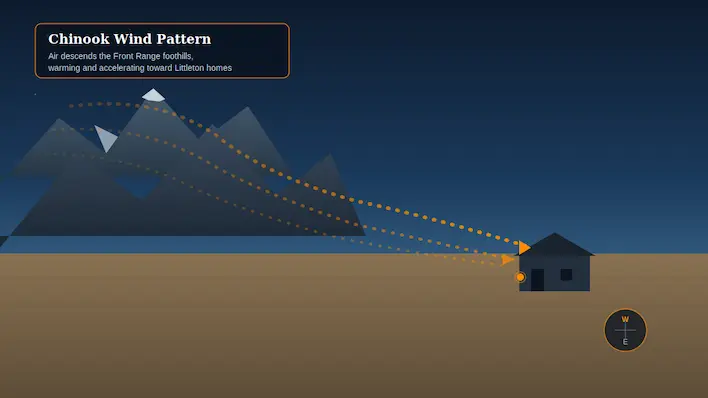
The most significant of these is the chinook wind, sometimes called a foehn wind in broader meteorological terms. A chinook forms when air moving from the west rises over the Rocky Mountains, cools and drops its moisture on the western slopes, then descends rapidly down the eastern side toward the plains. As that air drops in elevation, it compresses and warms dramatically, often producing temperature swings of 20 to 40 degrees in a matter of hours along with sustained high winds.
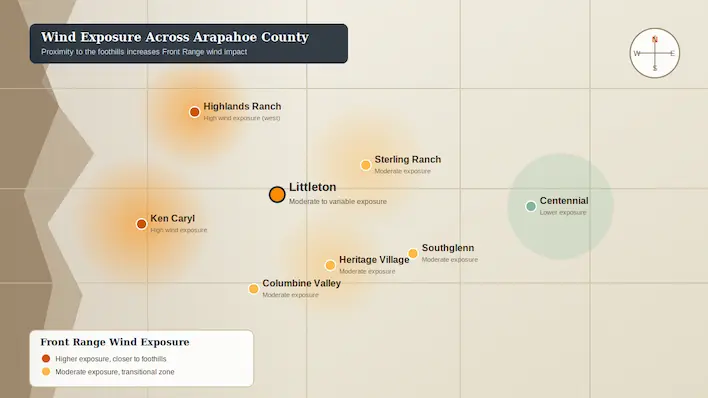
The Front Range also experiences downslope windstorms, a related but distinct phenomenon where strong winds aloft are forced down the mountain slopes by pressure gradients, accelerating dramatically as they reach the foothills and the adjacent plains. Boulder, just north of the Denver metro area, is internationally known among meteorologists for this effect, with documented gusts exceeding 140 miles per hour recorded at research facilities in the foothills. While Littleton typically experiences less extreme intensity than Boulder due to its position relative to the terrain, the same downslope mechanism affects communities throughout the metro area, including Highlands Ranch, Ken Caryl, and the rest of Arapahoe County.
A third pattern, the bora wind, occurs when a strong cold front pushes in from the northwest. Unlike a chinook, a bora remains cold rather than warming as it descends, but it produces the same kind of sudden, sustained high wind event, often in the 50 to 60 mile per hour range immediately after a frontal passage.
What all three of these patterns share is suddenness and intensity that a standard exterior vent cap, designed for generic weather resistance, was never specifically engineered to handle on a recurring basis.
How Wind Interferes With the Backdraft Damper
Every code compliant dryer vent termination is required to have a backdraft damper, which is the spring loaded flap inside the exterior vent cap that opens under the pressure of the dryer’s exhaust airflow and closes when the dryer is not running. This damper is a simple mechanical device, and it is calibrated to respond to the airflow pressure a typical residential dryer produces, generally in the range of needing roughly 1,500 feet per minute of exit velocity to function as intended.
Under normal, calm conditions, that calibration works exactly as designed. The problem arises when sustained exterior wind pressure works against the damper from the outside.
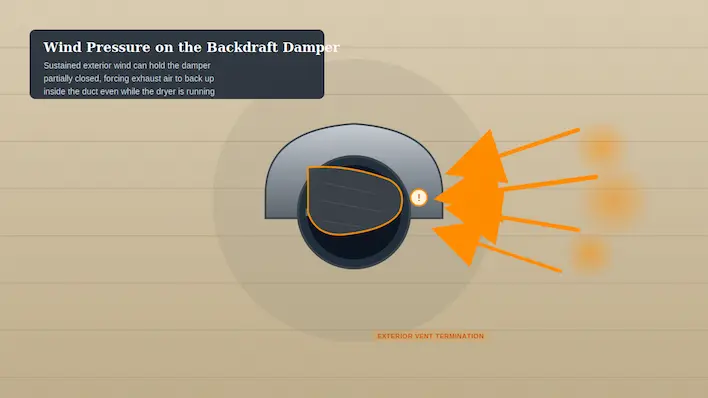
If wind is blowing directly into the vent termination, the external pressure can hold the damper partially or fully closed even while the dryer is actively running and trying to push air out. This creates immediate back pressure inside the duct system. The dryer’s exhaust air, unable to exit at its intended rate, backs up inside the duct, which raises both temperature and humidity levels within the system. This is functionally similar to having a partially blocked vent from lint accumulation, except the obstruction is external wind pressure rather than internal debris.
If wind is blowing parallel to or away from the termination, it can create the opposite effect: a venturi style negative pressure zone right at the vent opening that pulls the damper open even when the dryer is not running. An open damper during high wind conditions allows cold exterior air, dust, and fine debris carried on Front Range wind events to enter the duct system directly. Over time, this introduces debris into the duct interior between dryer cycles, which becomes additional material for lint to adhere to during future use, particularly given the static electricity dynamics already common in Colorado’s dry climate.
Either scenario, pressure holding the damper shut or suction pulling it open, represents the termination point not functioning as its engineering intended, and both are direct consequences of wind interaction rather than anything related to cleaning or maintenance frequency.
Why Termination Wall Orientation Matters More Than Most Homeowners Realize
Because chinook and downslope wind events along the Front Range predominantly move from the west and northwest, the orientation of your home’s dryer vent termination relative to that prevailing direction has a real, measurable effect on how often and how severely these wind interference issues occur.
A vent terminating on the west facing wall of a home sits directly in the path of the most intense and most frequent high wind events the Front Range produces. A vent terminating on an east or south facing wall, sheltered by the structure of the home itself during a west or northwest wind event, experiences meaningfully less direct pressure interference.
This is rarely something a builder considers during original construction, since vent placement is typically determined by the most convenient routing path from the laundry room to an exterior wall rather than by prevailing wind exposure. For homes in west facing positions throughout Ken Caryl, where terrain sits closer to the foothills, or in elevated sections of Highlands Ranch and Sterling Ranch with more open exposure, this orientation factor can be a genuine contributor to vent performance issues that cleaning alone will not fully resolve.
If your home’s dryer vent terminates on a wall facing the prevailing wind direction and you notice recurring symptoms during windy periods, a professional evaluation can determine whether rerouting the termination to a more sheltered wall, where structurally feasible, would meaningfully reduce the problem. Our Professional Vent Repair and Rerouting service evaluates these orientation factors alongside the standard length and material assessment when a wind related performance issue is suspected.
The Debris Infiltration Problem
Beyond the damper mechanics, Front Range wind events carry a specific kind of airborne debris that differs from what homeowners in calmer climates typically deal with.
High wind days along the Front Range frequently coincide with dry conditions, since the same chinook and downslope patterns that produce strong wind also rapidly dry out soil and vegetation in their path, a dynamic well documented in relation to wildfire risk events in the region. This combination means Front Range wind often carries dust, dried plant material, and fine particulate matter at higher concentrations than wind events in more humid parts of the country.
When this debris laden wind interacts with a vent termination, whether through a damper held open by suction or through gaps around an aging or poorly sealed vent cap housing, fine particulate matter can work its way into the duct system. Combined with the lint already present from normal dryer use, this creates a denser, more compacted accumulation than lint alone would produce, since fine dust and plant fiber tend to bind with lint fibers rather than passing through the system independently.
This is one of the less visible reasons why homes in more exposed parts of Littleton and the surrounding communities sometimes show faster than average vent restriction even with otherwise typical laundry habits. The wind itself is contributing material to the blockage, not just affecting airflow mechanics.
Seasonal Wind Patterns and What They Mean for Your Vent
Front Range wind activity is not evenly distributed throughout the year, and understanding the seasonal pattern helps explain when vent performance issues related to wind are most likely to show up.
Chinook events are most common during the colder months, roughly November through March, when the temperature and pressure differentials that drive the phenomenon are strongest. This is also, not coincidentally, the season when homeowners are running their dryers most heavily and when the winter condensation clogging issue already discussed in other Colorado climate articles compounds with wind interference to create the most challenging conditions of the year for vent performance.
Spring, particularly March through May, brings its own elevated wind activity along the Front Range as transitional weather patterns move through the region more frequently. This is also peak bird nesting season in Colorado, and the combination of a partially compromised damper mechanism from wind exposure with active nesting behavior from house sparrows and starlings creates a period where exterior vent caps deserve particular attention. Our Bird Nest Removal and Guard Installation service addresses both the wildlife and the mechanical aspects of these spring vent issues together.
Summer tends to bring comparatively calmer average wind conditions along the Front Range relative to the rest of the year, though isolated severe thunderstorm outflow events can still produce short duration high wind impacts.
How to Tell If Wind Is Affecting Your Dryer Vent Performance
Several practical signs distinguish a wind related vent issue from a straightforward lint accumulation problem, though the two frequently occur together over time.
A dryer that runs noticeably longer specifically on windy days, with more normal performance during calm weather, points toward wind interference rather than a purely material based blockage, since lint accumulation does not fluctuate with daily weather conditions. A rattling, whistling, or flapping sound coming from the exterior vent cap during windy periods, even when the dryer is not running, suggests the damper is being pushed by wind pressure rather than sitting properly closed. A noticeable draft or cold air sensation near the dryer or the duct routing path inside the home during high wind events suggests the damper is being held open by external pressure and allowing outside air to travel back through the system. Visible accumulation of dust or fine debris around the interior dryer outlet that seems disproportionate to your laundry volume can indicate wind driven particulate infiltration rather than purely lint based buildup.
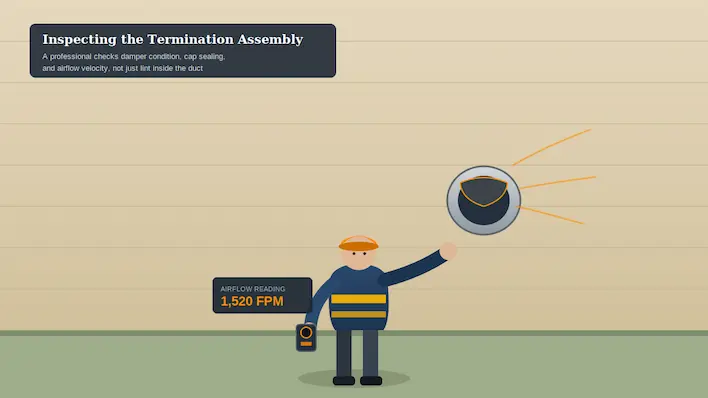
If you notice any of these signs, a professional inspection that includes a check of the damper mechanism’s condition and seal, not just a standard lint cleaning, is the appropriate next step. Our Comprehensive Safety Inspection and Diagnostics service evaluates the full termination assembly, including damper function, as part of every assessment, which is particularly relevant for homes in wind exposed areas of Highlands Ranch, Parker CO, Castle Rock CO, Lone Tree CO and Ken Caryl.
What a Properly Functioning Termination Should Withstand
A correctly installed, code compliant exterior vent cap with a functioning backdraft damper is designed to resist moderate wind pressure without significant performance impact. The damper spring tension is calibrated against typical dryer exhaust pressure, and a well sealed cap housing should prevent debris infiltration even during sustained wind events of normal intensity.
The issues described in this article tend to arise from a combination of factors: aging damper mechanisms with weakened spring tension that lose their resistance to external pressure over time, vent caps installed with gaps or inadequate sealing around the housing, termination points oriented directly into prevailing wind paths without any structural shielding, and accumulated lint or debris that has already reduced the duct’s internal airflow capacity, making the system more susceptible to external pressure interference because it has less of its own exhaust force to counteract incoming wind.
This is part of why addressing wind related vent issues often involves more than one corrective step. A professional assessment typically considers damper condition, cap housing integrity, termination orientation, and underlying duct cleanliness together rather than treating wind interference as an isolated problem.
For homes throughout Southglenn, Sterling Ranch, and Heritage Village, our Residential Dryer Vent Cleaning service includes an evaluation of the exterior termination hardware as a standard part of every visit, since a clean duct behind a poorly functioning damper still leaves the underlying wind exposure issue unaddressed.
Frequently Asked Questions
Can wind alone cause a dryer fire?
Wind itself is not a direct ignition source, but wind interference that causes a damper to stay closed and traps hot exhaust air inside the duct raises internal temperature and moisture levels in ways that can accelerate the conditions that lead to lint related fires over time. Wind driven debris infiltration also adds combustible material to the duct system that would not otherwise be present.
Should I install a different style of vent cap to deal with Front Range wind?
Some vent cap designs are more wind resistant than others, particularly louvered or hooded styles versus simple flap style caps. A professional assessment of your specific termination orientation and exposure level is the best way to determine whether a different cap style would meaningfully improve performance for your home’s particular situation.
Does this wind issue apply to roof terminated vents differently than wall terminated vents?
Yes. Roof terminated vents are generally more exposed to wind from multiple directions since rooflines do not provide the same directional shielding that an exterior wall can offer depending on home orientation. Roof terminations along the Front Range tend to experience more consistent wind interference regardless of prevailing direction.
How often should I have my vent cap and damper inspected given these wind factors?
An inspection of the damper mechanism and cap housing as part of your regular annual professional cleaning is sufficient for most homes. Homes in particularly exposed locations, such as elevated lots or west facing terminations near the foothills, may benefit from a mid year check, especially heading into the high wind months of late fall and winter.
Is this a problem unique to Littleton, or does it affect the whole Denver metro area?
The chinook, downslope, and bora wind patterns described in this article affect the entire Front Range corridor, though intensity varies by proximity to the foothills and local terrain. Communities closer to the mountains, including parts of Ken Caryl and western Highlands Ranch, tend to experience more frequent and intense wind events than areas further out on the plains, though the entire Arapahoe County region experiences these patterns to some degree throughout the year.
Wind is one of the more overlooked factors in dryer vent performance, largely because it is intermittent and easy to mistake for a simple maintenance issue rather than a structural and mechanical interaction with your home’s specific termination setup. Along the Front Range, where chinook winds, downslope windstorms, and bora events are a documented, recurring part of the regional climate, this is not a hypothetical concern. It is a real factor that affects how well your dryer vent performs, particularly during the fall and winter months when both wind activity and dryer use peak together.
If you suspect wind is affecting your vent’s performance, or if it has simply been a while since your termination hardware was professionally inspected, you can reach us through our contact page or explore our full range of services at our services overview.