A property manager I work with in Southglenn called me last spring — not because of a fire, but because of a letter. Her tenant had mailed a written notice stating the dryer was taking over two hours to finish a load, they had documented it three times over six weeks, and they were prepared to exercise their rights under Colorado’s warranty of habitability statute if the landlord didn’t respond within ten days.
She called me the same afternoon she got the letter.
We serviced the unit. The vent had never been cleaned since the property was built — eleven years. The invoice I gave her became the document she needed. The tenant got their properly functioning dryer back. The written response and service record closed the issue.
That story ended well because she acted quickly. Many landlords don’t realize the situation has legal dimensions until after something more serious happens. This guide is for those who want to understand the full picture before they need it.
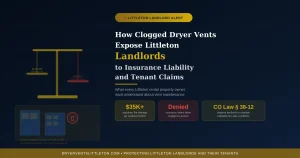
| $35,000+ average residential dryer fire damage per incident — USFA data. If a fire is traced to landlord negligence and no maintenance records exist, insurance coverage can be denied in full. Legal liability for tenant injury or displacement compounds the loss significantly. |
What Colorado Law Actually Requires of Landlords
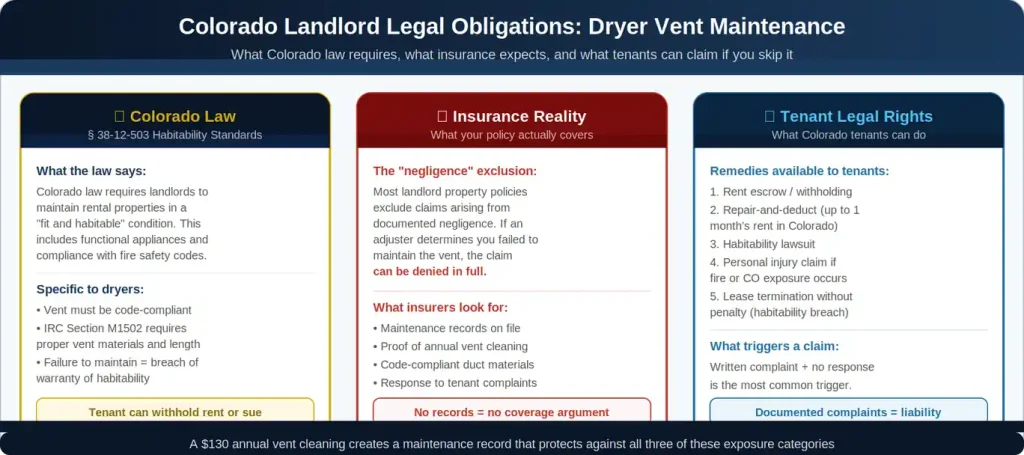
Colorado’s landlord-tenant law is more specific about habitability than many property owners realize. Colorado Revised Statutes Section 38-12-503 establishes the “warranty of habitability” — a legal standard that rental units must meet throughout a tenancy, not just at move-in.
The warranty requires, among other things, that the property be maintained in compliance with applicable building codes affecting health and safety, that all facilities and appliances supplied by the landlord be kept in good working condition, and that the property be free from conditions that pose a material risk to the tenant’s health or safety.
A dryer vent that creates a fire risk falls squarely within that last category. And if a tenant can show they notified the landlord in writing of the problem — through a text, an email, or a formal letter — and the landlord failed to respond promptly, the legal exposure becomes significant.
The Written Complaint Problem
Most landlords understand that they need to respond to maintenance requests. What they sometimes underestimate is the legal significance of a written complaint specifically.
In Colorado, a tenant’s written notice of a habitability issue — and the landlord’s failure to address it within a reasonable time — is the foundational element of most habitability claims. The statute doesn’t require a disaster to have occurred. It requires that the landlord knew about a problem and didn’t fix it. A text message saying “the dryer takes forever and smells like something burning” is, legally, a written notice. That text starts a clock.
The property manager in Southglenn had received three of these over six weeks and hadn’t connected them to a legal timeline. Many landlords are in the same position without knowing it.
The International Residential Code Angle
Beyond the general habitability standard, IRC Section M1502 establishes specific technical requirements for dryer venting: maximum duct length, required materials (rigid metal — foil accordion duct is specifically excluded), minimum bend radius, and exterior termination requirements. When a landlord’s property has a non-compliant duct — foil accordion duct still installed from original construction, for example — that’s not just a maintenance issue. It’s a code violation. And a code violation in a rental property that causes damage or injury is a straightforward path to findings of negligence.
| ⚠️ Practical note: If you own rental property in Littleton or the South Denver metro and you are not certain what duct material is installed behind the dryer in each unit — that uncertainty is itself a risk. Foil accordion duct was standard construction practice through the mid-1990s and is still present in many older units. Having it identified and replaced as part of a vent service call is both a safety measure and a liability protection. |
The Insurance Coverage Problem
The liability exposure from a clogged dryer vent isn’t limited to tenant claims. The insurance dimension is equally significant — and often more immediately costly.
Standard landlord property insurance policies cover fire damage. What many landlords don’t read carefully enough is the negligence exclusion. Most policies exclude or limit coverage for losses arising from the insured’s failure to exercise reasonable care in property maintenance. When a fire occurs and an insurance adjuster investigates, one of the first questions is whether the property was being properly maintained. A dryer fire investigation almost always involves examining the vent system.
What Adjusters Look For
In a post-fire claim involving a dryer, an adjuster will typically look at several things: the condition of the duct materials, whether the duct was an appropriate type for residential use, how much lint was present in the system at the time of the fire, and whether any maintenance records exist showing the system had been professionally serviced.
A landlord with a folder of annual cleaning invoices is in a fundamentally different position than a landlord with no records. The first landlord has documented evidence of reasonable care. The second landlord has no defense against a finding of negligence — and once negligence is established, coverage exclusions kick in.
I have given service invoices to landlords who explicitly told me they wanted them for their files. That’s not an unusual request. It’s a reasonable one.
| 💡 Recommendation: When you schedule a vent cleaning, ask your service provider to include the CFM airflow measurement — before and after — on the invoice. This is the objective, measurable record of vent condition. An invoice that simply says “cleaned dryer vent” is good. An invoice that says “pre-service CFM: 14, post-service CFM: 78 — fully cleared” is significantly better documentation. |
The Real Cost Comparison
The financial argument for regular vent maintenance in rental properties is straightforward, but it’s worth making explicitly because the numbers are stark.
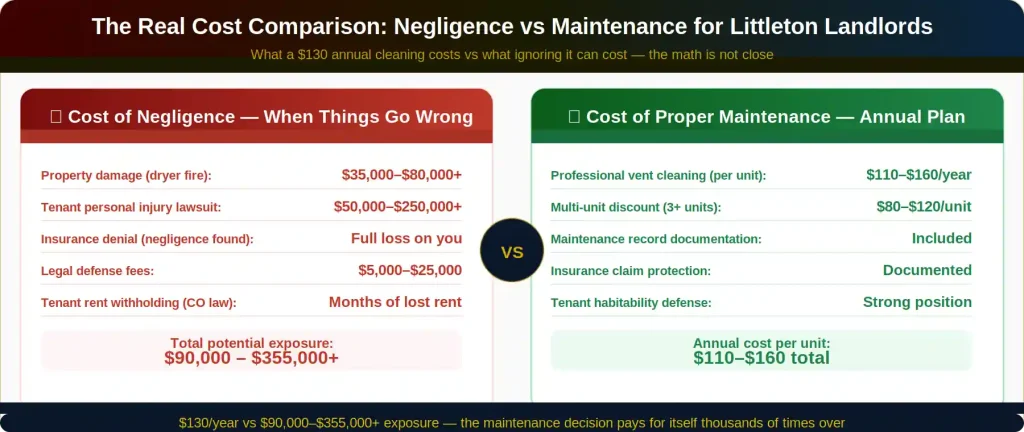
A professional vent cleaning for a single residential unit in the Littleton and South Denver metro area runs between $110 and $160. For landlords with multiple units, the per-unit cost is lower with bundled service. The cleaning produces a dated invoice, documents the property’s maintenance history, and creates the paper trail that matters if anything ever goes wrong.
The alternative — an insurance claim denied for negligence, a tenant personal injury lawsuit, or extended vacancy while fire damage is repaired — involves numbers that make the cleaning cost look trivial. The math isn’t close. It isn’t even in the same conversation.
What surprises landlords is that the documentation purpose of the cleaning is almost as valuable as the fire-prevention purpose. Most landlord-tenant disputes and insurance investigations turn on records, not intentions. A landlord who intended to maintain the property but didn’t document it has a weak position. A landlord with three years of annual cleaning invoices has a strong one.
What to Do: The Landlord Compliance Checklist
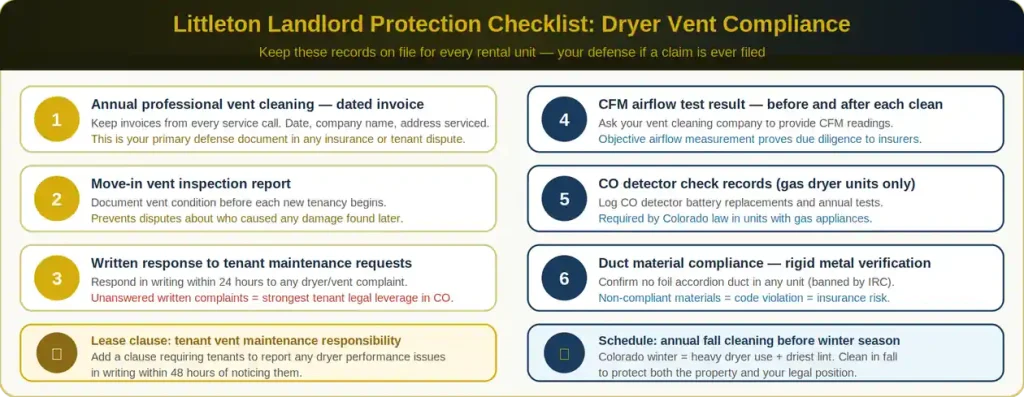
Annual Cleaning — The Non-Negotiable Minimum
For every unit with a dryer in Littleton and the surrounding South Denver metro, professional vent cleaning once a year is the minimum maintenance standard. Colorado’s dry climate means lint accumulates faster and becomes more flammable than in humid-climate states. A national once-a-year recommendation becomes an even more important minimum here because the consequences of skipping are more severe.
Schedule the cleaning in the fall, before the winter season when dryer use is heaviest and Colorado’s Chinook winds make indoor humidity conditions worst for lint flammability. This timing is both practically and legally optimal — it means the highest-risk months are entered with a freshly documented clean system.
Multi-Unit Properties: The Scheduling Challenge
Managing vent cleaning across multiple rental units requires a system. The simplest approach: schedule all units in the same property on the same fall date, once a year, and keep a single binder with all the invoices organized by unit and date. When a tenant complaint comes in, you can pull the most recent service record in seconds. When an insurance adjuster calls, you have the complete history.
For properties with high tenant turnover, adding a vent inspection to the move-in checklist — alongside the standard appliance checks — catches problems that a previous tenant may have created or failed to report. It also documents that the unit was in proper condition at the start of the tenancy, which matters if damage is found later.
Responding to Tenant Complaints
When a tenant reports a dryer performance issue in writing — even informally, by text — respond in writing the same day and schedule an inspection within 72 hours. This response timing isn’t arbitrary. Colorado courts look at the promptness of a landlord’s response to habitability complaints as a key factor in determining whether the landlord met their obligations.
Document everything. The date of the complaint, the date of your response, the date of the service call, the result of the inspection, and any follow-up action taken. This paper trail is what separates a resolved complaint from a legal filing.
Book Commercial Vent Service for Your Littleton Rental Properties
Littleton Vent Guard provides commercial vent cleaning service for landlords and property managers throughout the South Denver metro. We provide dated invoices with before-and-after CFM airflow measurements — the documentation that matters for both insurance and tenant records. Multi-unit discounts available. Same-day service available throughout our coverage area.
👉 Book commercial dryer vent cleaning:
Commercial Dryer Vent Cleaning — Littleton Rental Properties
About Littleton Vent Guard
We are locally owned and serve only the South Denver metro. We work with landlords and property managers throughout Littleton, Southglenn, Ken Caryl, Highlands Ranch, Columbine, and the surrounding communities. Every service call includes a dated invoice with airflow measurements — the record that protects both the property and the people in it.
🏠 Homepage and multi-unit quote:
Littleton Vent Guard — Colorado Dryer Vent Specialists
Landlord Questions About Dryer Vent Liability
Am I legally required to clean the dryer vent in my rental unit?
Colorado law does not have a statute that specifically mandates annual dryer vent cleaning. What it does require — under the warranty of habitability — is that landlords maintain rental properties in a condition that complies with health and safety codes and doesn’t pose a material risk to tenants. A dryer vent that creates a fire risk, or a gas dryer vent that creates CO exposure, falls under both standards. The cleaning isn’t mandated by name, but the underlying obligation it satisfies clearly is.
My tenant has been running the dryer for years without complaints. Does that protect me?
No. The absence of complaints doesn’t create a maintenance record. If a fire occurs and the investigation shows the vent was never professionally cleaned, the lack of complaints doesn’t change the negligence analysis. What protects a landlord is evidence of positive action — regular maintenance, documented inspections, prompt responses to any complaints that did occur. Silence from the tenant is not a defense.
What if my tenant caused the blockage — for example, by stuffing the vent with something?
Tenant-caused damage is a legitimate defense, but it requires documentation to be useful. If you have a move-in condition report showing the vent was clear, a cleaning invoice showing it was serviced before the tenancy, and evidence that the condition developed after the tenant moved in, you have a strong argument. Without that documentation chain, distinguishing landlord neglect from tenant damage becomes much harder.
Does a cleaning service invoice actually protect me legally?
It’s not a blanket protection — nothing is. But a dated service invoice showing regular professional maintenance is significant evidence that you exercised reasonable care. In a negligence claim, reasonable care is the standard. A landlord who can show annual professional service, prompt responses to complaints, and code-compliant duct materials has a substantially stronger legal position than one who cannot. The invoice doesn’t eliminate risk. It demonstrates that you took the risk seriously.
I have units in Southglenn and older buildings in downtown Littleton. Should I treat them differently?
Yes. Older buildings — particularly anything built before 1990 — are more likely to have foil accordion duct that doesn’t meet current code. These units should be inspected specifically for duct material compliance, not just cleaned. Replacing non-compliant duct with rigid metal is a one-time cost that eliminates both the fire risk and the code-violation liability exposure that comes with keeping a banned material in place.
Serving Southglenn, Littleton and the South Denver Metro Rental Market
We service rental properties across the South Denver metro — from Southglenn and Centennial to downtown Littleton, Ken Caryl, Columbine, and beyond. Property managers and independent landlords alike use our service to maintain their maintenance records. Same-day inspection available throughout our coverage area.
📍 Serving Southglenn rental properties: