My neighbor Marco called me frustrated last spring. His dryer had been running two cycles on everything for about six months. He figured it was just getting old — the machine had been in his Greenwood Village home since he moved in seven years ago. A technician came out, quoted him $900 for a new heating element, and that’s when Marco finally called a dryer vent specialist instead.
The vent was packed solid. After a $140 cleaning, the dryer worked like new. The heating element was fine.
Marco lost roughly $180 in wasted electricity over those six months — that’s on top of the time, the frustration, and the near-miss with a $900 repair bill he didn’t need.
That story sums up why this question deserves a real answer. Does dryer vent cleaning actually pay for itself? Not as a sales pitch — as math. Here’s the honest Colorado homeowner’s breakdown.
What Dryer Vent Cleaning Actually Costs in Colorado
Professional dryer vent cleaning in the Denver metro area typically runs between $100 and $175 for a standard residential job. Factors that push the price higher include:
- Vent runs longer than 15 feet
- Multiple bends or elbows in the duct
- Roof or exterior wall exit points
- Rooftop cap that needs inspection or replacement
- Flexible foil duct that needs replacement with rigid metal
Most homes in Littleton, Centennial, and Greenwood Village fall in the $120–$150 range for a straightforward job. Homes with complex layouts or second-floor laundry rooms sometimes reach $175–$200.
Annual cleaning is the standard recommendation for most households. Heavy-use households — families with children, pet owners, or anyone washing large items like bedding frequently — may benefit from cleaning every six to eight months.
At $140 per year, you’re looking at less than $12 a month to keep your dryer operating at full efficiency. The question is what you get back for that $12.
The Energy Savings Side of the Equation

This is where most people underestimate the return. A dryer with a partially clogged vent doesn’t just run longer — it works harder the entire time. The motor runs hotter. The heating element cycles more frequently. The drum takes more time to reach drying temperature.
Xcel Energy rates for Colorado residential customers put electricity at roughly 12–14 cents per kilowatt-hour depending on your rate plan and usage tier. A standard electric dryer pulls about 5,000 watts per cycle. That’s roughly 60 cents per load at average Colorado rates.
Here’s what a clogged vent does to that number:
- Partially clogged (lint coating inside duct): Drying time increases 15–25%. A 45-minute cycle becomes 53–56 minutes.
- Moderately clogged (airflow restricted 40–60%): Two cycles become necessary for thick items. Energy use roughly doubles on those loads.
- Severely clogged (near-complete blockage): The dryer can’t complete a cycle. Clothes come out damp. Multiple full cycles run back-to-back.
For a household doing six loads per week, a 20% increase in drying time adds up to roughly $75–$100 in wasted electricity annually. At the severe end, that figure can reach $200 or more.
Colorado’s altitude compounds this. At 5,400 feet in the Denver metro, air is thinner and carries less moisture per cubic foot. Dryers that rely on hot moist air being expelled quickly already work at a slight disadvantage — a clogged vent makes that worse.
Conservative estimate: a household averaging six loads per week with a moderately clogged vent loses $80–$110 per year in electricity alone. That’s the cleaning cost right there.
Appliance Lifespan: The Bigger ROI Nobody Talks About
A new mid-range dryer in the Denver metro costs $700–$1,100 installed. Premium models run $1,400–$1,800. Proper maintenance is what separates a machine that lasts 18 years from one that dies at 10.
The component most often killed by restricted airflow is the thermal fuse. It’s a safety device designed to blow before the dryer overheats. When the vent is clogged, heat can’t escape, internal temperatures climb, and the thermal fuse trips. The part itself costs $5–$15. The service call to diagnose and replace it runs $100–$200.
Repeat that two or three times and you’ve spent $250–$600 on a problem that cleaning would have prevented entirely.
The heating element is the next casualty. Running continuously at elevated temperatures causes premature failure. Replacement parts run $30–$80. Labor is another $100–$150. Total repair: $150–$250 each time it happens.
The Realistic Appliance Math
Assume a dryer that would last 18 years with proper maintenance is instead run with a chronically restricted vent:
- Thermal fuse replacement at year 4 and again at year 8: $400
- Heating element replacement at year 7: $200
- Early machine replacement at year 12 instead of year 18: $900 (cost of new machine minus trade-in value of the old one)
That’s $1,500 in preventable costs spread over 12 years. Even discounting for the time value of money, that’s more than 10 years of annual cleaning costs.
The honest ROI summary: Annual cleaning at $140 returns $80–$110 in electricity savings plus a proportional share of avoided repairs and extended machine life. Most Colorado homeowners see full payback within the first year, with additional return accumulating every year after.
The Fire Risk Variable — Hard to Quantify, Impossible to Ignore
There’s a cost-benefit element to dryer vent cleaning that doesn’t fit neatly into an ROI spreadsheet: fire risk.
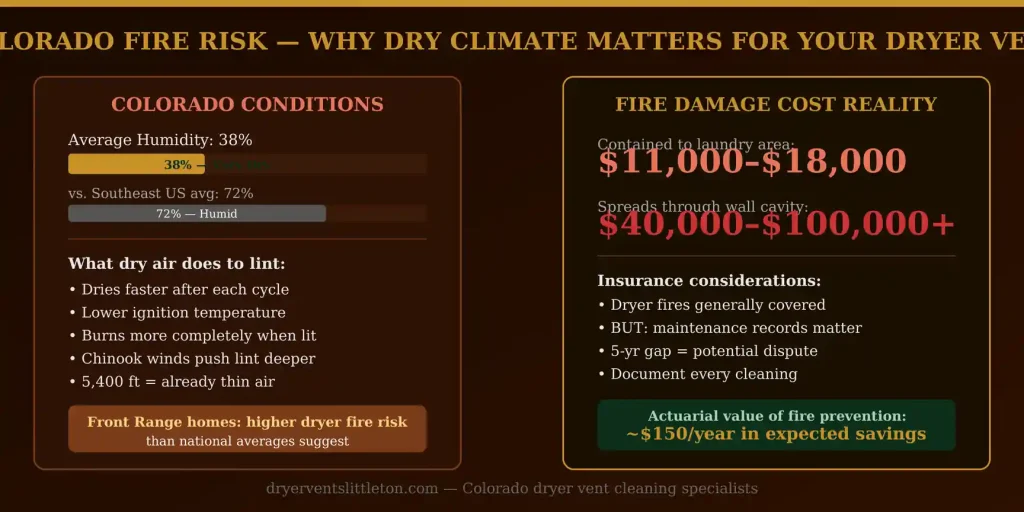
Lint is combustible. At Colorado’s altitude and average humidity — around 38% in the Denver metro — lint dries faster and ignites at lower temperatures than in humid climates. Dryer fires are more common here than in the Southeast or Pacific Northwest precisely because of that dryness.
The average dryer fire causes $11,000–$18,000 in property damage when it stays contained to the laundry area. When it spreads — and with an open vent duct running through a wall cavity, it can spread quickly — losses escalate into the $40,000–$100,000+ range.
Homeowner’s insurance typically covers dryer fires when they’re accidental. But there’s a documented pattern of insurers scrutinizing maintenance records after a claim. A vent that hasn’t been cleaned in five years, combined with manufacturer recommendations for annual service, can create coverage disputes.
This risk can’t be assigned a precise annual dollar value, but it factors into the ROI calculation. Even a 1-in-100 annual probability of a $15,000 fire represents a $150 expected annual cost in actuarial terms — more than the cost of cleaning itself.
Colorado-Specific Factors That Affect Your Numbers
Colorado’s climate and housing stock create a few specific conditions that influence the ROI calculation:
Chinook Winds and Pressure Events
Colorado’s Front Range experiences Chinook winds — warm, dry downslope winds that can gust to 60–80 mph. These pressure events push air back through exterior vent caps, sometimes displacing lint deeper into the duct. Homes on the western edge of Littleton, Greenwood Village, and Centennial are particularly exposed. More wind events mean faster accumulation — which means the timeline to a problematic clog is shorter here than the national average suggests.
Altitude and Dryer Performance
At 5,400 feet, manufacturers’ cycle time estimates are calibrated for sea level. Your dryer already works slightly harder than it would in a coastal city. A partially restricted vent at altitude effectively doubles the disadvantage. This amplifies the energy waste calculation — the numbers I cited above are conservative for Front Range conditions.
Hard Water and Mineral Deposits
Denver metro water is notoriously hard — around 15 grains per gallon in many areas. Hard water leaves mineral deposits in washing machine components that affect how clothes rinse. Residue on fabric can make lint stickier and denser, accelerating buildup in the vent duct. If you have hard water and don’t use a softener, factor in slightly more frequent cleaning.
New Construction Duct Routing
Newer homes in the South Denver suburbs often have longer vent runs than older properties — some reaching 20–30 feet when the laundry room is interior and the exterior wall is far away. Longer runs mean more surface area for lint accumulation and more friction restricting airflow. New construction dryer vent cleaning is worth factoring in separately from standard residential cleaning when your run exceeds 15 feet.
Who Gets the Best ROI — and Who Needs to Think Harder

Not every household has the same cost-benefit profile. Here’s an honest breakdown:
High ROI Households
- Large families (4+ people): Six or more loads per week accelerates lint buildup and means energy waste compounds faster. Annual ROI is strongly positive.
- Pet owners: Pet dander and fur create denser lint that clogs vents faster. Many pet households need cleaning every 8–10 months rather than annually.
- Homes with long duct runs: Any home with a run exceeding 15 feet or multiple bends sees proportionally more restriction from partial buildup. ROI on cleaning is higher.
- Gas dryers: Gas appliances running with restricted airflow face incomplete combustion risks in addition to efficiency losses. The safety component raises the ROI case significantly.
Moderate ROI Households
- Single or two-person households: Fewer loads per week means slower buildup. Annual cleaning may be fine, but energy savings are more modest. ROI is still positive over 2–3 years when appliance life factors in.
- Homes with newer, efficient dryers: Modern heat-pump dryers use 40–50% less energy than resistance models. The energy waste component is smaller, but fire risk and appliance life considerations remain.
When to Think About Timing
If your dryer was professionally cleaned within the past 12 months and is running normally, you don’t need an emergency cleaning. But if you’ve purchased a home, rented a property, or simply can’t remember the last time it was done — the ROI case for getting it done now is strong regardless of where you are in the calendar year.
What the Numbers Add Up To
Let me put a conservative whole-household number together for a typical Colorado family:
| Cost Category | Without Cleaning | With Annual Cleaning |
| Annual electricity (6 loads/week, moderate clog) | $680–$760 | $580–$640 |
| Thermal fuse replacements (over 10 years) | $400 | $0 |
| Heating element replacement (over 10 years) | $200 | $0 |
| Early appliance replacement premium | $900+ | $0 |
| Annual cleaning cost | $0 | $140 |
| Total 10-year cost estimate | $2,180–$2,260 | $1,980–$2,040 |
The cleaning scenario comes out ahead — and that’s before accounting for fire risk, which could make the gap dramatically larger in a worst-case scenario.
The Honest Answer
Yes. Dryer vent cleaning pays for itself for the majority of Colorado households.
For high-use households — families, pet owners, long duct runs — it pays back within the first year on energy savings alone. For smaller households, payback happens over two to three years, with appliance longevity and fire risk making the case even stronger.
The one scenario where the ROI is marginal: a single-person household, heat-pump dryer, short duct run, low annual usage. Even there, the fire risk component and the cost of one avoidable repair tip the math in favor of cleaning. There’s no realistic scenario in Colorado where regular vent cleaning is a bad financial decision.
If you’re in the Greenwood Village area and want to see where your vent stands, Greenwood Village dryer vent cleaning service covers your neighborhood. And if you’ve been putting it off because you weren’t sure it was worth it — now you have the numbers.
Bottom line: A $140 annual cleaning protects a $1,000+ appliance, saves $80–$110 in electricity, and reduces fire risk in a state where dry air makes lint especially dangerous. The ROI is real — and it compounds every year you maintain the habit.
Frequently Asked Questions
How often should Colorado homeowners clean their dryer vent?
Most households: once per year. Families with children, pet owners, or anyone doing more than six loads per week: every 8–10 months. If you notice drying times increasing or the dryer feels hotter than usual, don’t wait for the calendar — schedule it.
Can I clean the dryer vent myself to save money?
You can purchase a dryer vent cleaning kit for $25–$40 and clean the first few feet yourself. The limitation is reach and suction. A professional service uses commercial rotary brushes and high-powered vacuums that clear the full length of the duct, including bends and the exterior cap. DIY cleaning addresses partial buildup near the machine; it rarely fully clears a duct with significant accumulation.
Does cleaning help if my dryer is already running slowly?
Often yes — especially if the performance has degraded gradually. A dryer that was working well a year ago and now struggles is a strong candidate for a vent cleaning before any repair diagnosis. Many “failing” dryers are actually running fine; the vent is the problem.
What’s the difference between cleaning and rerouting?
Cleaning removes lint from an existing duct. Dryer vent rerouting is a structural change — shortening a duct run, replacing flexible foil with rigid metal, or changing the exit point. Rerouting is a one-time investment (typically $200–$400) that can permanently improve airflow and reduce how frequently cleaning is needed. In older Colorado homes with inefficient original duct routing, rerouting often has a strong ROI of its own.
Is dryer vent cleaning covered by homeowner’s insurance?
No — routine maintenance isn’t a covered expense. But the fire protection it provides is directly relevant to insurance claims. Some insurers have added dryer vent maintenance to their home inspection checklists. Keeping a record of professional cleanings is useful documentation if you ever need to file a claim related to a dryer fire.