My brother-in-law called me one afternoon, genuinely shaken. He’d been home when his dryer started making a strange smell — not burning exactly, more like very hot dust. He opened the laundry room door and felt a wave of heat. The machine was off by the time I got there, but the lint trap was packed solid and the exhaust vent on the outside of his Ken Caryl house was almost completely blocked by a compressed wad of lint the size of a softball.
He got lucky. Most people don’t realize how close that situation is to a fire — or why. They know lint is “flammable” in a vague sense but don’t understand the actual mechanism. Once you understand it, the whole thing makes more sense. And more importantly, you understand exactly what to do about it.
Here’s the science, explained without jargon.
What Lint Actually Is — And Why It Burns
Lint looks harmless. It’s soft, it’s light, and it doesn’t feel dangerous. But its physical properties are exactly what makes it a fire risk.
Lint is a collection of very short, very fine fibers shed from fabric during the tumbling and heating process of a dryer cycle. These fibers come from cotton, polyester, wool, linen — essentially whatever your clothes are made of. What matters for fire science is that these fibers are:
- Extremely thin: Individual lint fibers are often less than a millimeter long and a fraction of a millimeter in diameter. The thinner a combustible material is, the faster it heats to ignition temperature.
- Highly surface-area-to-mass ratio: A fluffy mass of lint has far more surface area exposed to oxygen than a solid piece of the same fabric would. More surface area means faster oxidation — the chemical process at the heart of combustion.
- Dry: Lint that has passed through a hot dryer cycle is thoroughly desiccated. Moisture content dramatically affects how easily a material ignites. Dry lint ignites far more easily than the fabric it came from.
- Loosely packed with air pockets: A clog in a dryer vent isn’t a solid block — it’s an airy mass of fibers with oxygen threaded throughout. That oxygen is the second ingredient in the fire triangle.
The fire triangle — heat, fuel, oxygen — is basic chemistry. Lint in a dryer vent provides all three when conditions are right. The question is what provides the heat.
Lint’s combination of extreme dryness, fine fiber structure, and internal oxygen pockets makes it one of the most ignition-prone common household materials. Its ignition temperature can be as low as 300°F — well within range of a normally operating dryer.
The Ignition Chain: Step by Step
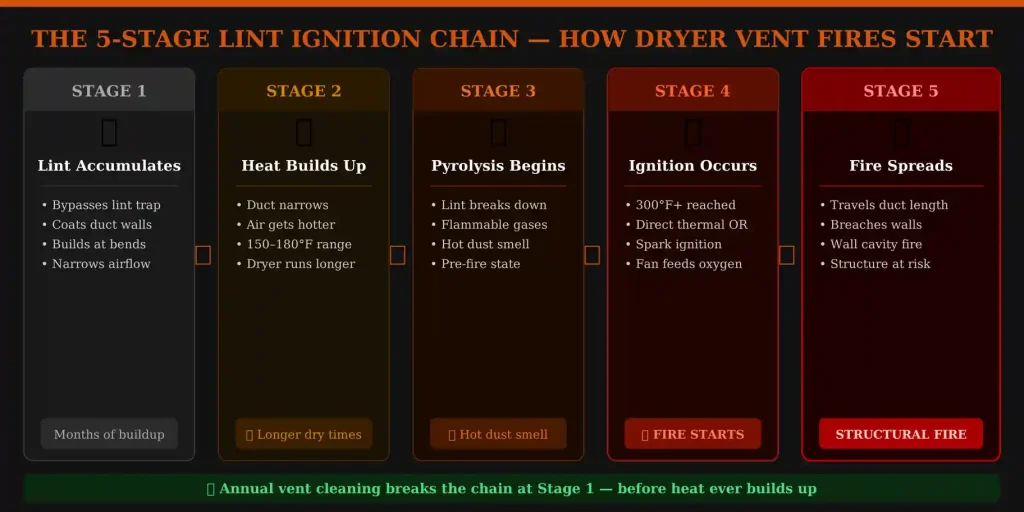
A dryer vent fire doesn’t happen all at once. It follows a chain of events that begins long before any flame appears.
Stage 1 — Lint Accumulates in the Duct
Every dryer cycle pushes warm, moist air through the vent duct along with a small amount of lint that bypasses the trap. Over weeks and months, this lint coats the interior walls of the duct and begins to accumulate at bends, at the exterior cap, and at any point where airflow slows.
A single cycle deposits a tiny amount. But over a year of regular use — say six loads per week — the cumulative buildup becomes significant. The duct narrows. Airflow decreases. And here’s the critical part: reduced airflow means the hot air has less room to move. The air inside the duct gets hotter.
Stage 2 — Heat Builds Up
A standard electric dryer operates with an internal drum temperature of around 125–135°F for normal cycles. The air being expelled through the duct is typically 120–130°F when the vent is clear. As the duct narrows with lint buildup, the expelled air temperature rises because the same heat is concentrated in a smaller airflow volume.
At moderate clog levels, duct temperatures can reach 150–180°F. At severe restriction levels, temperatures inside a clogged section can approach or exceed 200°F. Lint’s ignition temperature can be as low as 300°F, but pre-heated dry lint in prolonged contact with hot surfaces needs less activation energy than fresh lint at room temperature.
Stage 3 — Pyrolysis Begins
Pyrolysis is the chemical process that happens before combustion — it’s when a material breaks down under heat and releases flammable gases without yet catching fire. Lint undergoing pyrolysis releases hydrogen, methane, and carbon monoxide, among other gases. These gases are themselves flammable.
This is the stage that produces that “hot dust” smell my brother-in-law noticed. That smell is pyrolysis gases escaping through gaps in the duct. It’s a warning sign that the lint in the vent is already under serious thermal stress — ignition is a possibility, not just a distant risk.
Stage 4 — Ignition Occurs
Ignition can happen in two ways in a dryer vent context:
- Direct thermal ignition: The lint surface temperature reaches its ignition point through sustained contact with superheated air. No spark required — just enough sustained heat.
- Spark ignition: Dryer motors and heating elements can produce small sparks during normal operation. In a clear duct, these sparks cool before reaching any significant lint accumulation. In a clogged duct, they may encounter lint close to the heat source.
Once ignition occurs in any part of the duct, the fire has access to a continuous fuel supply — the lint coating the entire length of the duct — and a forced-air delivery system providing oxygen. The dryer’s fan is literally blowing air into the fire.
Stage 5 — Fire Spreads
A dryer vent duct runs through walls, floors, or ceilings to reach the exterior of the home. Once the duct itself is on fire, the heat transfers to surrounding building materials. In homes with older construction or non-metal ducts, the duct itself can burn through rapidly.
The critical danger point is when the fire breaches the duct and reaches the wall cavity. From there, it can travel through insulation, wooden framing, and wall materials with no obstruction. A dryer fire that stays in the machine or duct is a manageable emergency. One that reaches a wall cavity becomes a structural fire within minutes.
The key insight: A dryer vent fire is not a random event. It follows a predictable sequence with observable warning signs at stages 2 and 3. The smell of hot dust, increased drying times, and a hot exterior vent cap are all indicators that you’re somewhere in this chain — before ignition.
Why Colorado Makes This Worse
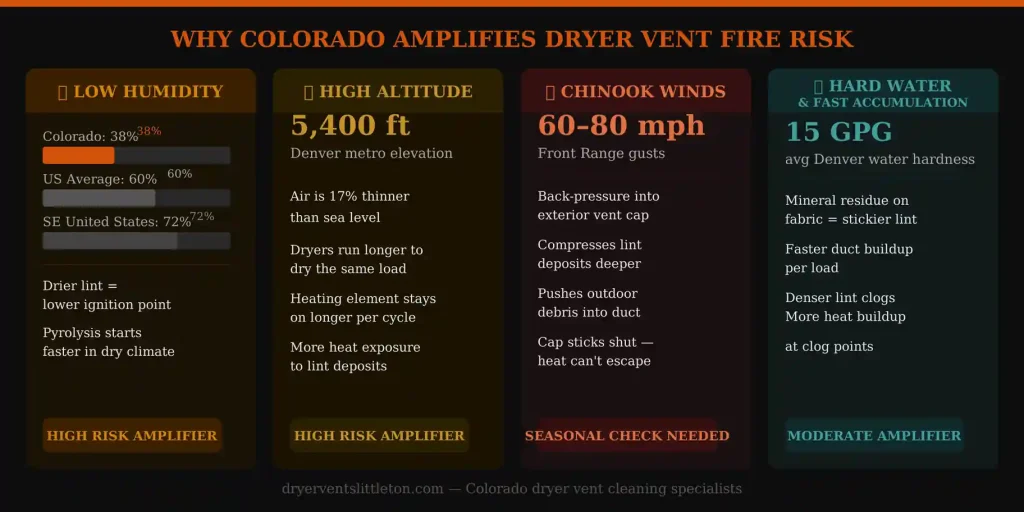
Colorado’s Front Range environment affects every stage of this chain in ways that amplify risk compared to national averages.
Low Humidity Means Drier Lint
The Denver metro area averages around 38% relative humidity — well below the national average of 60%+. Lint that forms in a dry environment has less residual moisture than lint in a humid climate. The drier the lint, the lower the effective ignition threshold and the faster pyrolysis begins.
Think of it this way: wet wood is hard to light. Dry wood lights easily. The same principle applies to lint. Colorado’s climate consistently produces the dryer version.
Altitude Affects Air Density and Combustion
At 5,400 feet, air is roughly 17% less dense than at sea level. This has two relevant effects:
- Dryers work harder: With thinner air, dryers must move more volume to achieve the same drying effect. The heating element runs longer. More cycles of heating mean more sustained elevated temperatures in the duct.
- Combustion dynamics change: While thin air means slightly less oxygen per cubic foot, the natural draft in a duct is also reduced. This means hot air lingers longer in a restricted section, increasing the duration of thermal stress on lint deposits.
Chinook Winds Push Lint Back
Colorado’s Chinook winds — the warm, dry downslope winds common on the Front Range — can reach 60–80 mph. These wind events create positive pressure against exterior vent caps that can push air backward through the duct. This compresses existing lint deposits, makes caps harder to open, and in some cases deposits outdoor debris inside the duct opening.
Homes on the western edge of Littleton, Ken Caryl, and similar Front Range communities are particularly exposed to Chinook pressure events. After a major wind event, a duct that was partially restricted can become significantly more so.
Dry Climate Speeds Up Accumulation
Hard water in the Denver metro area — averaging around 15 grains per gallon in many areas — leaves mineral deposits in washing machines that affect how clothes rinse. Fabric with residual mineral content tends to shed more aggressively during drying. More lint shed per load means faster accumulation in the duct.
What a Dryer Vent Fire Actually Looks Like
Most people imagine a dramatic explosion or visible flame. The reality is often quieter and more insidious.
Dryer vent fires frequently begin with:
- A smell of hot, acrid dust coming from the laundry area — the pyrolysis stage
- The dryer running but not drying effectively — restricted airflow
- The top or side of the dryer feeling unusually hot to the touch
- The exterior vent cap feeling very hot or not opening freely during operation
- A visible discoloration or smoke near the exterior vent cap
The fire itself often starts inside the duct wall where it’s not visible. By the time smoke is visible inside the home, the fire may already be in a wall cavity.
This is why fire professionals consistently emphasize that a dryer vent fire is a prevention problem, not a detection problem. Smoke detectors help, but they detect a fire that’s already burning. The goal is to eliminate the conditions that allow ignition in the first place.
The Role of Duct Material in Fire Risk
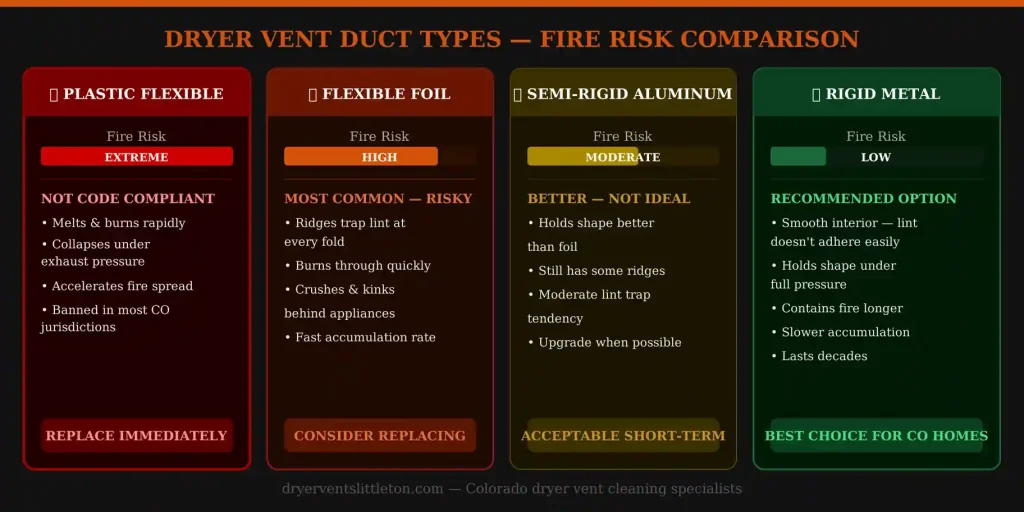
Not all dryer vent ducts carry equal fire risk. The material matters significantly.
Flexible Foil Duct — Highest Risk
The silver accordion-style flexible duct is still found in many older Colorado homes. It has several fire-risk problems:
- The ridges inside the duct trap lint at every fold — accumulation is faster than in smooth duct
- The thin foil burns through quickly once a fire starts inside
- Many flexible foil products are not rated for dryer use at all despite being sold in hardware stores
- Foil duct can be crushed or kinked behind appliances, creating restriction points where heat builds
Flexible Plastic Duct — Not Acceptable
Plastic flexible duct is not code-compliant for dryer venting in most jurisdictions, including Colorado. It melts and burns rapidly, can collapse under normal dryer exhaust pressure, and accelerates fire spread dramatically. If your home still has plastic dryer duct, this is a priority replacement.
Semi-Rigid Aluminum — Better
Semi-rigid aluminum duct is an improvement over foil — it holds its shape better and doesn’t have as many lint-trapping ridges. However, it still has some corrugation and is not as effective as smooth rigid duct.
Rigid Metal Duct — Best Option
Rigid galvanized steel or aluminum duct with a smooth interior is the safest option. Lint does not adhere as readily to smooth surfaces, the duct maintains its diameter under pressure, and it can withstand fire for significantly longer than flexible alternatives, containing spread.
If your home has flexible foil or plastic duct, having it replaced with rigid metal duct is worth considering as a one-time upgrade. Visit dryerventslittleton.com to learn more about duct assessment and replacement services in the Littleton area.
What Actually Prevents Lint Ignition
The ignition chain has several clear intervention points. Each one represents something a homeowner can do.
Intervention 1: Regular Duct Cleaning
Removing the fuel source is the most direct intervention. A professionally cleaned duct removes the accumulated lint that undergoes pyrolysis and eventually ignites. For most Colorado households, annual dryer vent inspection and cleaning addresses the buildup before it reaches dangerous levels. Pet owners and large families may need more frequent service.
Intervention 2: Lint Trap Cleaning Every Cycle
The trap catches the majority of lint before it enters the duct. A clogged trap doesn’t just reduce efficiency — it allows more lint to bypass into the duct. Cleaning the trap before or after every cycle is the single easiest preventive step.
Intervention 3: Check the Exterior Cap
The exterior cap should open freely during operation and close fully when the dryer is off. A stuck cap creates back pressure that slows exhaust air — exactly the condition that elevates duct temperatures. Check it seasonally and especially after Chinook wind events.
Intervention 4: Know the Warning Signs
The warning signs of stage 2 (elevated heat, longer drying times) and stage 3 (hot dust smell) are observable. Treating them as urgent signals rather than minor annoyances is the difference between a service call and a fire claim.
Intervention 5: Upgrade the Duct Material
If your home has flexible foil or plastic duct, replacing it with rigid metal eliminates the fastest-burning fuel source in the system. Homeowners in Ken Caryl and similar Front Range communities with older housing stock often find this upgrade worthwhile for both fire safety and long-term efficiency.
The goal isn’t to be afraid of your dryer. It’s to understand that a simple, predictable chain of events leads to dryer vent fires — and that the chain has multiple easy intervention points most homeowners never use because they don’t know they exist.
Frequently Asked Questions
At what temperature does lint ignite?
Lint’s ignition temperature varies depending on the fiber composition and moisture content, but dry lint can ignite at temperatures as low as 300°F. Cotton lint tends to ignite at 320–400°F. Synthetic fibers vary but are generally in a similar range. Dryer ducts with significant restriction can reach temperatures approaching this range during normal operation.
How much lint buildup does it take to become dangerous?
There’s no precise threshold — risk is a spectrum rather than a binary. What matters is the combination of buildup and restricted airflow. A duct with moderate buildup but good airflow carries lower risk than one with less buildup at a restriction point where heat concentrates. Annual professional cleaning removes the uncertainty.
Can the lint trap alone prevent vent fires?
No. The lint trap catches approximately 70–80% of lint produced during a cycle. The remaining 20–30% enters the duct system. Even a meticulously maintained lint trap won’t prevent duct accumulation — it only slows it. Both trap cleaning and duct cleaning are necessary.
Is a gas dryer more dangerous than an electric one?
Gas dryers introduce an additional risk factor: incomplete combustion due to restricted airflow can produce carbon monoxide. From a lint fire perspective, both types carry similar risk from accumulation. Gas dryers have the added urgency of CO risk at clog levels that wouldn’t yet cause an electric dryer fire.
Does my dryer have a built-in safety that prevents fires?
Modern dryers have thermal fuses and cycling thermostats designed to shut the machine down if internal temperatures exceed safe thresholds. These help prevent fires inside the machine itself. They are less effective at preventing fires that start in the duct — the fuse may not trip before lint in the duct reaches ignition temperature, because the fuse measures internal drum temperature, not duct temperature.