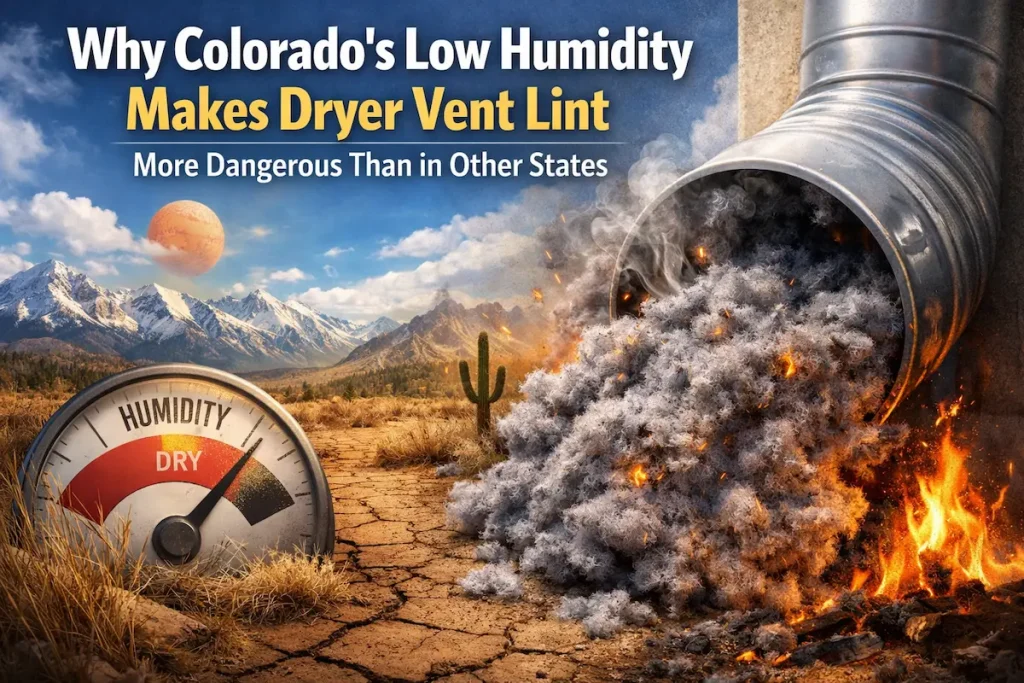
Colorado’s low humidity makes dryer vent lint more dangerous because dry lint ignites at a lower temperature, burns faster once ignited, and accumulates more aggressively due to static electricity than lint exposed to the higher moisture levels found in most other states. This is not a marketing talking point. It is a combination of basic combustion science and atmospheric conditions that genuinely sets Littleton and the broader Front Range apart from places like Florida, Louisiana, or Ohio when it comes to dryer vent fire risk.
If you have read other local articles that mention Colorado’s dry climate in passing and move on, this guide is going to actually explain the mechanism, put real numbers behind it, and tell you what it means for how you maintain your dryer vent.
The Humidity Numbers: Colorado vs. the Rest of the Country
To understand why this matters, it helps to see the actual gap.
Average relative humidity across much of the eastern and southeastern United States typically sits between 60 and 75 percent for much of the year. States like Florida, Georgia, and Louisiana regularly experience humidity levels above 70 percent, sometimes climbing into the 80s and 90s during summer months.
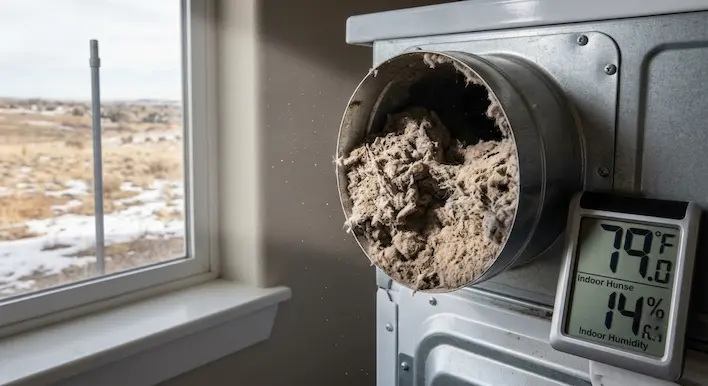
Colorado’s Front Range, including Littleton, sits in a semi arid climate zone. Average relative humidity here commonly ranges between 30 and 45 percent for much of the year, and during winter months, indoor humidity in heated homes can drop below 15 percent. That is roughly half the humidity level of a typical humid climate state, and during the driest periods, it can be a third or less.
This is not a small difference. It is the difference between an environment where airborne fibers retain some moisture content and an environment where those same fibers dry out almost completely.
The Combustion Science: Why Dry Lint Is More Dangerous
Lint is composed primarily of cotton, polyester, and other textile fibers, along with dust and skin cell particles. All of these materials are combustible, but their ignition behavior changes significantly based on moisture content.
Moisture acts as a natural fire retardant at the molecular level. Water molecules absorbed into fiber material require additional energy to vaporize before the fiber itself can reach ignition temperature. In a humid environment, lint particles retain trace moisture from the air around them, which means a spark or hot surface contacting that lint must first expend energy driving off that moisture before the fiber itself can begin to combust. This creates a buffer, however small, between a heat source and ignition.
In Colorado’s dry air, that buffer is largely absent. Lint inside a dryer vent in Littleton reaches a moisture equilibrium with the surrounding air, and at 30 to 45 percent relative humidity, or below 15 percent during winter heating season, that equilibrium moisture content is low. The lint is, in practical terms, bone dry. When a heat source is present, whether that is the dryer’s heating element running hotter than normal due to restricted airflow, a spark from an electrical connection, or friction from a malfunctioning component, dry lint reaches its ignition point faster and with less energy input than moist lint would require.
Once ignition occurs, dry lint also burns faster and spreads more readily through a duct system. Lint that has absorbed moisture tends to clump and mat together, which can actually slow the spread of fire because the burning front has to work through denser material. Dry lint, by contrast, is often lighter, fluffier, and more loosely packed, allowing flame to propagate through the accumulated material more quickly once it starts.
Static Electricity: The Accumulation Multiplier
Beyond ignition risk, Colorado’s dry air affects how quickly lint accumulates in the first place, and this is where the static electricity factor comes in.
As clothes tumble and rub against each other and against the dryer drum, friction generates static electric charge on both the fabric and the lint particles that shed from it. In a humid environment, the moisture in the air provides a degree of natural conductivity that allows static charge to dissipate relatively quickly. The charge does not build up as significantly, and lint particles are less likely to be electrostatically attracted to surfaces.
In Colorado’s dry air, that natural dissipation does not happen as readily. Static charge builds up on lint particles and persists longer. Charged lint particles are then attracted to and cling to the interior surfaces of the dryer vent duct, particularly at metal seams, joints, and any rough surface texture. This means that for the same volume of laundry processed, a dryer vent system in Littleton’s climate tends to accumulate lint on its interior walls more readily than the same system would in a humid state, simply because of how the lint behaves electrostatically as it travels through the duct.
The practical result is that lint buildup in Colorado dryer vents tends to form as a clinging layer along duct walls rather than loose debris that might travel more freely toward the exterior exit. This clinging layer is exactly the kind of accumulation that narrows the effective diameter of the duct, restricts airflow, and over time becomes the fuel source for a vent fire.
The Seasonal Picture: It Is Not Just Winter
Most articles that mention Colorado’s climate and dryer vents focus heavily on winter, and for good reason. Winter brings its own distinct problem.
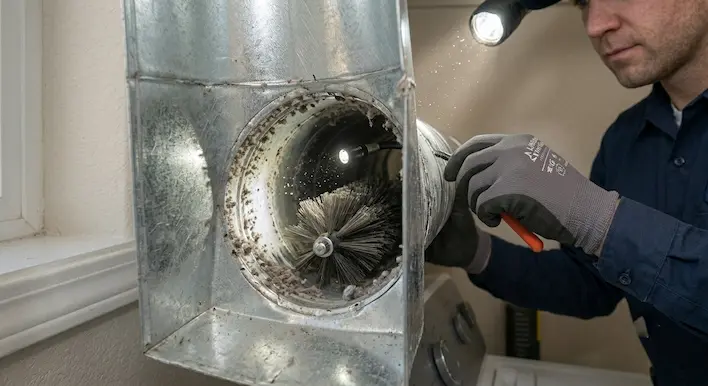
During Colorado winters, indoor heating systems run continuously, and indoor relative humidity in many homes drops to extremely low levels, sometimes below 15 percent. At the same time, when warm, moist exhaust air from the dryer hits a duct section running through a cold attic, crawl space, or exterior wall cavity, the temperature differential can cause condensation to form on the duct’s interior surface. That condensation mixes with dry lint to create a dense, sticky residue that adheres to duct walls far more aggressively than dry lint alone. Over a winter season, this can create a thick, compacted blockage that is significantly harder to remove than typical dry lint accumulation.
But the dry season risk, which spans late spring through early fall, is arguably the more direct fire hazard. During these months, there is no condensation factor moderating the dryness of accumulated lint. The lint inside the duct is simply dry, increasingly so the longer it sits, and increasingly receptive to ignition from any heat source. Combined with Colorado’s wildfire season awareness, during which many homeowners are already attentive to fire risk around their property, it is worth recognizing that one of the more significant fire risks in a Colorado home during these months is sitting inside the dryer vent rather than outside in the landscaping.
The honest takeaway is that Colorado’s climate creates elevated dryer vent risk essentially year round, just through different mechanisms depending on the season. Winter brings condensation driven dense clogging. The rest of the year brings accelerated dry lint accumulation and elevated ignition risk for whatever lint is present.
How Altitude Compounds the Issue
Littleton sits at approximately 5,351 feet above sea level. At this elevation, air is thinner, meaning it has lower density than air at sea level. This affects dryer vent performance in a way that is separate from but related to the humidity issue.
A dryer’s exhaust fan moves a certain volume of air per minute, but at altitude, that same volume of air contains less mass and therefore carries less actual airflow capacity in terms of moving lint particles out of the duct system. Dryers operating at Littleton’s elevation are working with thinner air to begin with, which means the airflow margin between a fully clear duct and a duct that is beginning to show restriction is narrower here than it would be at sea level.
When you combine thinner air with the static electricity driven accumulation described earlier, the result is a duct system that both accumulates lint more readily and has less airflow margin to compensate for that accumulation before performance noticeably degrades. This is part of why dryer vent systems in Littleton and across the Front Range tend to show symptoms of restriction, such as increased drying time, sooner than the same system might in a humid, low altitude location.
What This Means for Your Maintenance Schedule
Given everything above, here is the practical implication for Littleton homeowners.
The standard national recommendation for dryer vent cleaning is once every 12 months for an average household. In Colorado’s climate, that baseline recommendation deserves to be treated as a firm commitment rather than a flexible guideline, because the consequences of deferring past that interval compound faster here than the national average data might suggest.
For households that fall into higher risk categories, such as those with pets that shed heavily, those running 8 or more loads of laundry per week, or those with longer duct runs that already accumulate lint faster due to length and elbow count, the combination with Colorado’s climate factors makes a 6 month cleaning interval a genuinely reasonable choice rather than an overly cautious one.
It is also worth paying closer attention to the warning signs of vent restriction here than you might in a different climate. If your dryer is taking noticeably longer to dry a standard load, if the laundry room feels warmer or more humid than usual during operation, or if you notice a burning smell at any point, these signs warrant a faster response in Littleton’s climate than they might elsewhere, simply because the material sitting in your duct is drier and more readily combustible than the same accumulation would be in a humid state.
What a Professional Cleaning Addresses in This Climate
A professional dryer vent cleaning in Littleton’s climate context is not fundamentally different in process from a cleaning anywhere else, but the urgency and the condition of what technicians typically find reflects these climate factors.
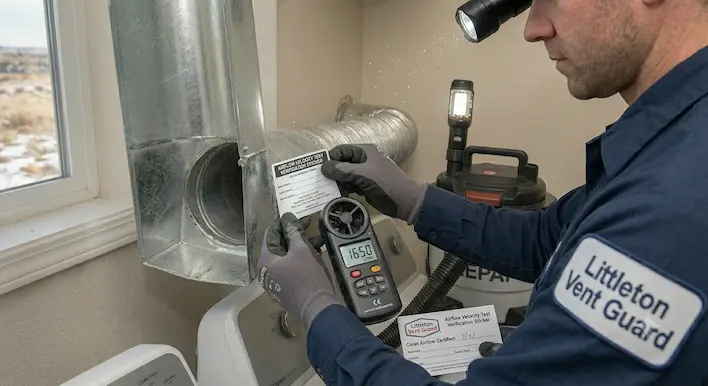
A thorough service begins with a full inspection of the duct system, evaluating not just current lint accumulation but also the duct material, length, and configuration, since systems with longer equivalent lengths or multiple elbows are the ones where Colorado’s static electricity driven accumulation has the most surface area to work with. The cleaning itself uses rotary brush systems paired with HEPA vacuum extraction to remove accumulated lint, including the clinging layer along duct walls that static electricity tends to produce in this climate. After cleaning, an airflow velocity test using an anemometer confirms the system is performing at an adequate rate, accounting for the altitude factor described above.
Our Residential Dryer Vent Cleaning service is built around these considerations, with technicians who understand what Colorado’s climate does to lint accumulation patterns and what to look for during inspection.
For homeowners in Highlands Ranch, Southglenn, Ken Caryl, Sterling Ranch, Heritage Village, Parker, Castle Rock and Columbine Valley, these climate factors apply across the board, since elevation and humidity levels are consistent throughout the area we serve in Arapahoe County.
Frequently Asked Questions
Does Colorado’s dry climate actually increase the number of dryer fires compared to other states?
The mechanism described in this article, dry lint igniting more readily and burning faster, is well established combustion science. While comprehensive state by state dryer fire statistics that isolate humidity as a variable are limited, fire investigators and the NFPA consistently identify lint accumulation as the leading cause of dryer fires nationally, and the conditions that accelerate that accumulation and increase its flammability are more pronounced in low humidity climates like Colorado’s.
Can I do anything to add moisture back into my dryer vent system to reduce this risk?
No, and you should not attempt to. Introducing moisture into a dryer vent system intentionally would create the conditions for mold growth, corrosion, and the dense sludge type clogging described in the winter condensation section. The correct response to Colorado’s dry climate risk factors is more frequent and thorough cleaning, not attempting to alter the moisture environment inside the duct.
Does running a humidifier in my home affect dryer vent lint risk?
A whole home humidifier affects indoor air humidity in living spaces, but it has minimal practical effect on the lint that has already accumulated inside your dryer vent duct, which is exposed to hot exhaust air from the dryer far more than ambient room air. The most effective response remains regular professional cleaning.
Is this climate risk worse for gas dryers or electric dryers?
The lint accumulation and ignition risk factors described here apply equally to gas and electric dryers, since both produce lint from the laundry being dried and both rely on a duct system that experiences the same climate exposure. Gas dryers carry an additional consideration in that a severely restricted vent can affect combustion gas venting, which is a separate but related safety issue.
How can I tell if static electricity buildup is affecting my specific dryer vent?
There is no simple at home test for this, since it relates to how lint adheres to interior duct surfaces rather than something visible from outside the system. The most reliable way to understand the condition of your duct is a professional inspection, which can assess accumulation patterns along the duct walls during cleaning.
Colorado’s low humidity is not just a footnote in dryer vent maintenance conversations. It is a genuine factor that affects how quickly lint accumulates, how that lint behaves once it has accumulated, and how dangerous that accumulation becomes if a heat source is present. Understanding this is not meant to be alarming. It is meant to give Littleton homeowners a clear, accurate reason why the standard maintenance recommendations matter here, and why staying ahead of your cleaning schedule is one of the more straightforward ways to manage a risk that is genuinely shaped by where you live.
If it has been more than a year since your last professional cleaning, or if you are noticing any of the warning signs described above, you can reach us through our contact page or explore our complete range of services at our services overview.