I burned my hand once. Not badly, but enough to remember it. I was doing a teaching demonstration, holding a small amount of lint above a lighter to show a new homeowner what I was about to clean out of his duct. The lint caught before I expected it to. It was January in Littleton, indoor humidity was probably around 20 percent, and that lint was as dry as paper.
He got the point.
That demonstration has stuck with me as the clearest way to explain why Colorado is different from everywhere else I’ve worked. The lint itself isn’t different. The clothes are the same. The dryer is the same. What changes is the air the lint has been sitting in — and in Colorado, that air is dry enough to turn ordinary laundry lint into something that ignites with alarming ease.
Most homeowners have heard that dryer lint is flammable. What almost nobody has been told is that flammability isn’t a fixed property of lint — it changes dramatically based on how much moisture the lint holds. And in Colorado, lint holds almost none.
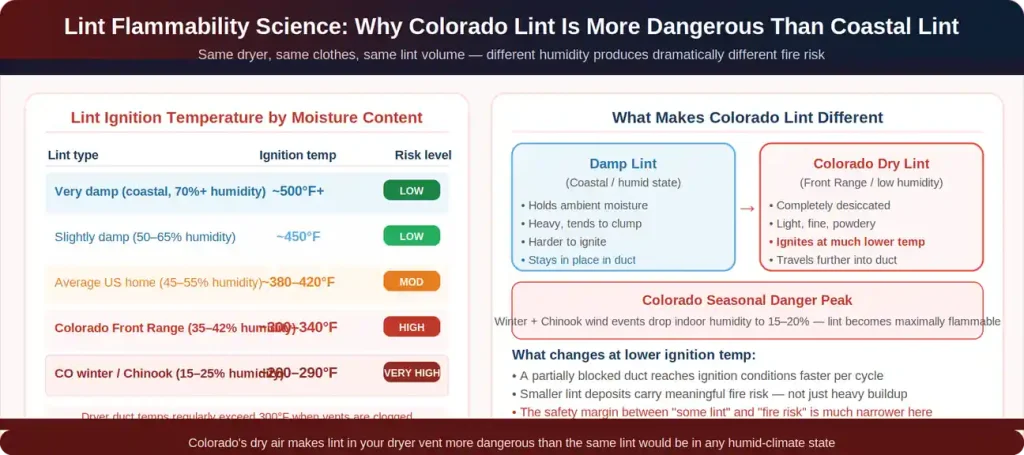
| 150°F lower ignition temperature for bone-dry Colorado lint vs damp coastal lint. Damp lint (coastal states, 65%+ humidity) ignites at approximately 450°F. Dry Colorado lint ignites at approximately 300°F. Dryer duct temperatures regularly exceed 300°F when vents are partially blocked. |
The Chemistry: Why Moisture Changes Everything
Lint is essentially a collection of fine cellulose and synthetic fibers that shed from fabric during tumbling. By itself, it’s combustible material — there’s no mystery there. What determines how readily it ignites is how much water those fibers are holding when they encounter a heat source.
Water absorbs heat before it converts to steam. A fiber that holds even a small amount of moisture requires more energy input before it reaches ignition temperature — the heat goes into evaporating the water first. This is why damp wood is notoriously hard to start a campfire with, while kiln-dried wood catches quickly. The same principle applies to lint.
What the Humidity Numbers Mean
Coastal states like Georgia, South Carolina, or New Jersey regularly see average relative humidity between 60 and 75 percent. Lint produced in laundry rooms in these states absorbs ambient moisture. It stays slightly damp — heavy, prone to clumping, and with an ignition temperature somewhere above 400 degrees Fahrenheit.
The Colorado Front Range — Littleton, Highlands Ranch, Denver, Castle Rock — averages around 38 percent relative humidity annually. In winter, that number drops further. During Chinook wind events, indoor humidity can fall to 15 or 20 percent. Lint in these conditions is completely desiccated. It’s bone dry, light, brittle, and its ignition temperature drops toward 300 degrees Fahrenheit or below.
That gap — roughly 150 degrees Fahrenheit — is the difference between lint that’s a maintenance concern and lint that’s a genuine fire hazard. And that 150-degree gap exists entirely because of where in the country the home happens to be located.
Where Lint Meets Heat: Inside Your Vent Duct
Understanding lint flammability means understanding what temperatures your duct system actually reaches during operation — because that’s where the lint is, and that’s where ignition happens.
Normal Operating Temperatures
A properly functioning residential dryer with a clean, clear vent exhausts air at roughly 120 to 135 degrees Fahrenheit for gas dryers and 135 to 155 degrees for electric models. With a clean vent and good airflow, the heat exits efficiently, temperatures stay controlled, and the lint that does accumulate over time sits in temperatures well below its ignition point.
What Happens When the Vent Restricts
Partial blockage changes the math quickly. When lint accumulates at an elbow or restriction point, airflow slows. Heat that would normally exit through the vent begins backing up. Duct temperatures in the restricted section climb — sometimes to 200, 250, or 300 degrees Fahrenheit in severe cases.
In a humid-state home, lint sitting at 280 degrees in a partially blocked duct is still below its ignition threshold. Uncomfortable, but not igniting.
In a Colorado home in January, lint sitting at 280 degrees in the same partially blocked duct may be at or above its ignition point. Same dryer, same duct, same blockage — different air, different lint, different outcome.
This is not a hypothetical scenario. NFPA data shows Colorado and other low-humidity western states with higher dryer fire rates per household than the national average. The mechanism is exactly this: dry lint plus elevated duct temperature plus any blockage creates ignition conditions that simply don’t exist in the same way in more humid climates.
| ⚠️ Think about this: The NFPA recommends annual dryer vent cleaning for all US homes. That recommendation was written as a national average. For a home in Georgia with 65% humidity and a 12-foot straight vent run, annual cleaning is genuinely sufficient. For a home in Highlands Ranch with 35% humidity and a 22-foot vent run with three elbows — annual cleaning is the minimum, not the target. The humidity factor alone shifts where Colorado homes fall on the risk curve. |
The Seasonal Pattern: When Colorado Lint Is Most Dangerous
Humidity in Colorado isn’t constant. It follows a predictable seasonal pattern that homeowners can use to time their maintenance strategically.
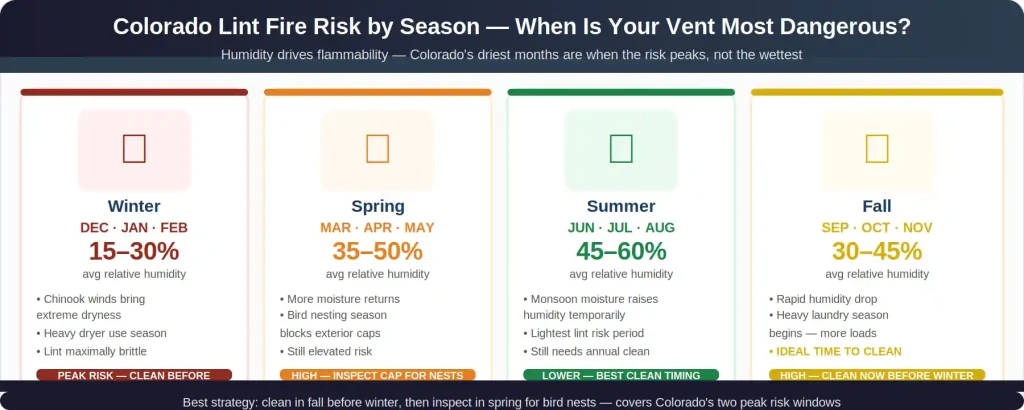
Fall: The Critical Window
September and October are when the window for smart timing opens. Humidity is dropping from its summer peak, heavy laundry season is starting, and the really dangerous period — Colorado winter — is approaching. A vent cleaned in October enters the high-risk winter months with a clear duct. That’s the objective.
I tell every customer the same thing: if you can only clean your vent once a year, do it in fall. Not because fall lint is uniquely different, but because it sets you up well for the months that matter most.
Winter: Peak Danger
December through February is when Colorado homes are doing the most laundry and the lint in the duct is at its most flammable. Shorter daylight hours, colder temperatures, more time indoors — laundry load frequency goes up. At the same time, indoor humidity, already low from Colorado’s dry air, drops further because heated air holds even less moisture than outdoor air at the same temperature.
Chinook wind events are particularly striking. I’ve been in houses during Chinooks where my hygrometer was reading 12 or 13 percent indoor relative humidity. At that point, the lint in an uncleaned dryer vent isn’t just flammable — it’s almost eager to ignite. A vent that might have been fine at 38 percent humidity needs attention at 13 percent.
Spring: A Different Risk
Spring brings higher humidity and lower flammability — but it introduces a different problem. Sparrows, starlings, and other birds nest inside dryer vent caps starting in March, sometimes earlier. A nest at the exterior cap creates a blockage that backs up heat and lint regardless of how clean the interior duct is. Spring is the right time for an exterior cap inspection, even if the full cleaning was done in fall.
Which Fabrics Create the Most Dangerous Lint in Colorado
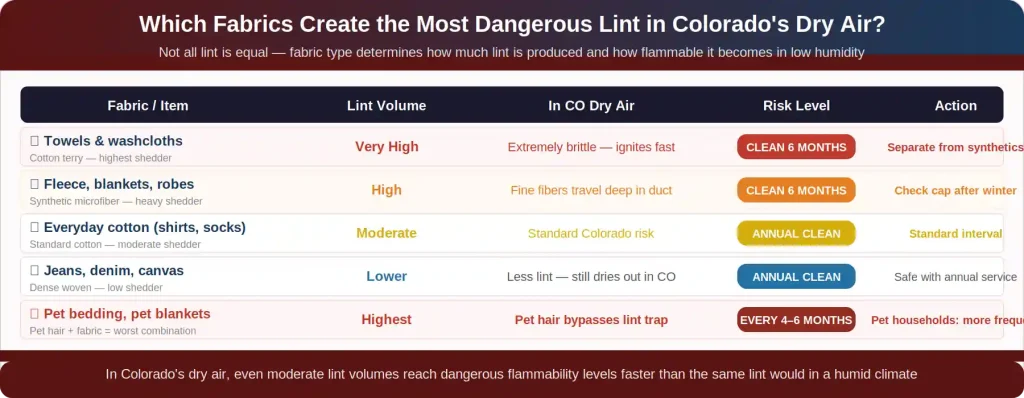
Not all lint is the same. The fabric determines how much lint is produced per load and what the fiber characteristics look like under dry Colorado conditions.
Towels: The Worst Offender
Cotton terry cloth — the material used for bath towels and washcloths — sheds more lint per load than almost any other fabric. It’s a high-pile weave specifically designed to be absorbent, and those loose surface fibers detach easily during tumbling. A single load of towels deposits significantly more lint in the duct than the equivalent weight of shirts or pants.
In Colorado, that towel lint dries out quickly and completely. It’s light, fine, and ready to ignite at the lower end of the ignition temperature range. Households that dry a lot of towels — gyms, families with young kids, households that do frequent laundry — need to account for this in their cleaning interval.
Fleece and Synthetic Fabrics
Fleece, microfleece, and synthetic blanket materials shed fine microfibers that behave differently from cotton lint. They’re even lighter, don’t clump, and travel further into the duct system before depositing. In Colorado’s dry air, they’re extremely flammable and they end up in parts of the duct that a consumer brush kit might not reach.
The combination of a synthetic fleece comforter or blanket plus dry Colorado air plus a vent that hasn’t been cleaned in 14 months is one of the patterns I see most often in service calls that should have been booked sooner.
Pet Hair: The Hidden Contributor
Fine pet hair from dogs and cats passes through the lint trap easily. Unlike the fibers that lint traps are designed to catch, pet hair is thin enough to slip past and enter the duct. In the duct, it combines with lint and creates dense, difficult-to-clean deposits at elbow points.
In Colorado’s dry climate, pet hair in the duct dries out the same way lint does. A pet household doing frequent laundry in Colorado is genuinely in a four-to-six month cleaning interval situation, not an annual one.
| 💡 Simple rule for Colorado households: If you regularly dry towels, fleece, or pet bedding — and your vent hasn’t been cleaned in the last eight months — the risk level in your duct right now is higher than most homeowners assume. You don’t need visible symptoms. The lint is there and it’s dry. |
What This Means for How Often You Should Clean
The national “clean once a year” recommendation is a reasonable baseline for homes in average-humidity states. Colorado is not an average-humidity state. The adjustment isn’t dramatic, but it’s real.
- Standard Colorado household (1–2 people, normal laundry): Once a year, ideally in fall before winter season.
- Family of 3–4 with kids: Every 9–10 months. Kids’ sports laundry adds volume.
- Heavy towel use or lots of fleece: Every 6–8 months. These fabrics generate more lint and it dries faster here.
- One or more pets: Every 6 months minimum. Pet hair bypasses the trap.
- Castle Rock, Parker, or higher elevation: Shorter interval than Littleton or Denver — drier air means faster risk accumulation.
- Vent run over 18 feet or multiple elbows: Already discussed elsewhere, but it compounds the humidity factor significantly.
The drying time test is still the most reliable self-check: time a standard mixed load. If it’s over 50 minutes, something is wrong regardless of when the vent was last cleaned. The humidity factor can accelerate lint accumulation fast enough that a vent cleaned six months ago can have meaningful buildup in Colorado conditions.
Get Your Colorado Vent Cleaned Before the Risk Builds
Littleton Vent Guard serves the South Denver metro. We measure CFM airflow before and after every service call — so you know objectively how clean the vent was when we arrived and how it flows when we leave. Flat-rate pricing confirmed before we start. Same-day availability most days throughout Littleton, Highlands Ranch, Ken Caryl, and the surrounding communities.
👉 Book your Commercial & Multi-Family cleaning:
Commercial Dryer Vent Cleaning — Littleton, CO
What You Can Do Right Now
Three things, starting immediately.
First — check your indoor humidity. If you have a hygrometer (they cost about $10 at any hardware store), look at it. If you’re under 30 percent, the lint in your dryer vent is in its most dangerous state. If it’s been over eight months since a cleaning, book one.
Second — run a load of towels and time it. Towels are the most lint-intensive load most households run. A clean vent on a Colorado home finishes a full towel load in 50 to 60 minutes. Over 70 minutes means airflow is restricted. Over 80 means it’s significantly restricted and the accumulation at the restriction point is sitting in elevated-temperature air every time the machine runs.
Third — clean the lint trap every load. This is worth repeating in the context of Colorado specifically. In dry air, lint that makes it past the trap is as flammable as it gets. The trap is your first line of protection. Don’t let it fill up between loads.
About Littleton Vent Guard
We’re locally owned and work only in the South Denver metro. We’ve seen the Colorado lint problem up close in enough homes — from the mild cases to the ones that clearly came close to something serious — to know that the humidity factor is real and underappreciated. Every service call we do includes airflow measurement. We don’t guess at whether the vent is clear. We measure it.
🏠 Homepage and free quote:
Littleton Vent Guard — Colorado Dryer Vent Specialists
Questions About Colorado Lint and Dryer Vent Flammability
Is Colorado lint actually more dangerous than lint in other states?
Yes, measurably. Lint flammability is directly related to moisture content, and moisture content is directly related to ambient humidity. At Colorado’s average Front Range humidity of around 38 percent — dropping to 15 to 20 percent in winter — lint in a dryer duct is significantly drier than the same lint would be in a coastal or southeastern state. That dryness lowers the ignition temperature by approximately 150 degrees Fahrenheit. The same quantity of lint at the same duct temperature is more likely to ignite here than in a humid-climate home.
Does this mean I need to clean my vent twice a year?
For some Colorado households, yes. A family of four with pets doing 10 loads a week in a Highlands Ranch home with a 20-foot vent run should be on a six-month schedule. A single person doing four loads a week in a shorter vent system can reasonably clean once a year. The answer depends on your specific combination of usage, vent geometry, and what types of fabrics you’re drying most frequently. When in doubt, time a towel load. The number tells you where things stand.
My vent was cleaned recently. Should I worry about winter humidity drops?
If you cleaned it in the last three months and your household usage is moderate, you’re in reasonable shape heading into winter. If it’s been six months or more and you’re heading into Colorado’s dry season — especially if you have pets or do a lot of towel laundry — a pre-winter service call is worth considering. The vent doesn’t know what season it is. It just knows how much lint has accumulated since the last cleaning and what temperature the air is at.
What is a Chinook wind and why does it matter for dryer vents?
Chinook winds are warm, dry air masses that descend from the Rocky Mountains across the Front Range, sometimes raising temperatures dramatically and dropping humidity to extreme lows in a matter of hours. During a Chinook event, outdoor relative humidity can drop to single digits and indoor humidity, even in a sealed house, often falls to 10 to 15 percent. At those levels, any combustible material — including lint in a dryer duct — reaches maximum flammability. Chinooks are common in Colorado from late fall through early spring, which overlaps with the period of highest dryer use.
I moved here from the East Coast. Should I change my vent cleaning schedule?
Almost certainly yes. If you were on an annual or 18-month schedule in a humid-climate state, that interval doesn’t translate to Colorado conditions. The same dryer, the same laundry habits, the same vent run length — all of it produces more dangerous lint here than where you came from. I’d recommend either moving to a 9 to 10 month schedule or doing a full service call now to establish a baseline, then going from there based on what the airflow measurement shows.
Serving Littleton, Highlands Ranch, Ken Caryl and the South Denver Metro
We cover the full South Denver metro service area. Whether you’re in a newer Highlands Ranch build with a long vent run or an older Littleton home near downtown, we’re familiar with the construction, the common duct configurations, and the specific lint conditions that Colorado’s climate creates. Same-day service available throughout our coverage area.
📍 Serving Southglenn and nearby: