My phone rang on a Tuesday morning last February. A homeowner in Ken Caryl. Her dryer had been taking over two cycles to dry a single load for the better part of three months. She’d been blaming the machine — it was eight years old, she figured it was just wearing out. She’d been pricing replacements online.
She hadn’t called about her energy bill, which had gone up. She hadn’t connected the musty smell in the laundry room to anything in particular. She definitely hadn’t noticed that the exterior vent cap barely moved when the dryer was running.
Every single one of those things was a warning sign. She had four of the ten, stacked on top of each other, and hadn’t recognized any of them as pointing to the same problem. That’s not unusual. Most homeowners I talk to don’t know what these signs look like until someone walks them through it.
This guide does that. Ten specific signs, what they mean, why Colorado makes each one more urgent than it would be in most other states, and what to do when you spot one.
| 34% of all dryer fires are caused by failure to clean the vent — the single leading cause. NFPA data. Colorado’s dry air lowers lint ignition temperature by ~150°F compared to humid-climate states. The same warning signs here are more urgent than the same signs anywhere with higher humidity. |
The 10 Warning Signs — Ranked by Urgency
Not all ten signs carry the same immediate risk. Some mean you should stop the dryer today. Others mean you should book a cleaning this week. Understanding the difference matters — especially in Colorado, where dry air can turn a moderate problem into a dangerous one faster than most homeowners expect.
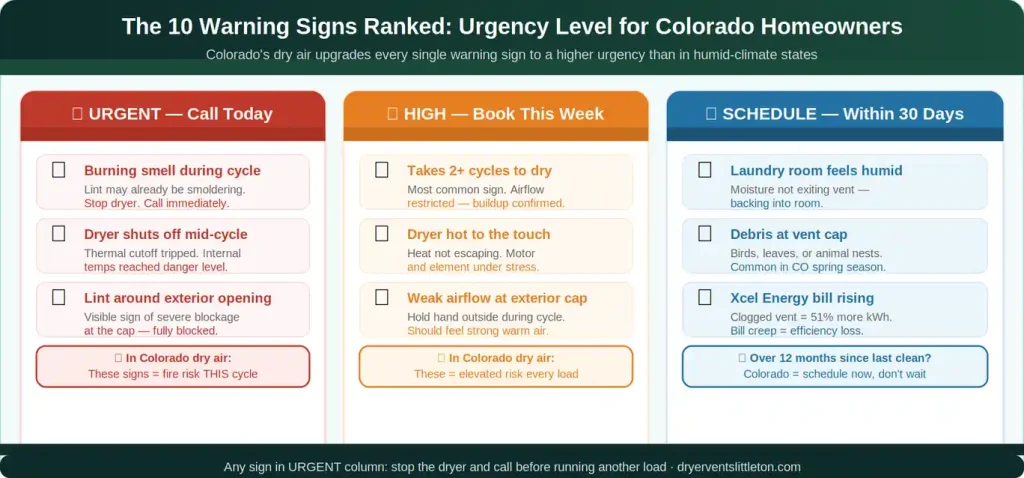
| Warning Sign 1 ⏱ BOOK THIS WEEK Clothes Take More Than One Full Cycle to Dry 🚩 HIGH URGENCY — This is the most common symptom and the one most homeowners dismiss. A standard mixed load on a clear vent finishes in 35 to 45 minutes. When drying time creeps to 60, 70, or 80 minutes — or when you’re running the dryer twice to finish one load — airflow is restricted. The dryer isn’t failing. The vent is. In Ken Caryl and Highlands Ranch homes with 18 to 25-foot vent runs, this symptom shows up faster than in homes with shorter ducts because the accumulation surface area is larger. |
| Warning Sign 2 🌡 BOOK THIS WEEK The Dryer Feels Unusually Hot During or After a Cycle 🚩 HIGH URGENCY — Touch the top panel and door of your dryer while it’s running. Warm is normal. Hot to the point where you pull your hand away is not. Heat that can’t escape through the vent backs up into the appliance cabinet. The motor and heating element run at elevated temperatures. In Colorado’s dry conditions, the lint sitting at the restriction point is also heated to levels approaching its lowered ignition threshold. This sign and a burning smell together constitute a stop-and-call situation. |
| Warning Sign 3 👃 STOP DRYER NOW There Is a Burning or Musty Smell During the Drying Cycle 🚨 URGENT — This is the sign that should make you stop the dryer immediately and not run it again until the vent has been inspected. A burning smell means lint at a restriction point has been heated to temperatures near or at its ignition point. In Colorado’s dry air, lint ignites at approximately 300°F — significantly lower than in humid-climate states. A burning smell isn’t a warning that something might happen. It’s a warning that something is actively happening. The homeowner in Ken Caryl had this symptom. She thought it was the detergent. |
| Warning Sign 4 🔄 STOP — INSPECT BEFORE NEXT USE The Dryer Shuts Off Before the Cycle Finishes 🚨 URGENT — If your dryer stops mid-cycle without being touched, the thermal cutoff protection tripped. This is a safety mechanism — the machine detected internal temperatures high enough to trigger an automatic shutdown. It did exactly what it was designed to do. The question is: what caused temperatures to get that high? The answer, almost always, is a vent restriction that prevented heat from escaping. Don’t reset the dryer and keep running it. Get the vent inspected first. |
| Warning Sign 5 💨 BOOK THIS WEEK You Feel Weak or No Airflow at the Exterior Vent Cap 🚩 HIGH URGENCY — While the dryer is running, go outside and hold your hand near the exterior cap. You should feel a strong, warm airflow — strong enough that holding your hand directly in front of the opening is slightly uncomfortable. A barely-moving flap, weak airflow, or nothing at all means the duct is significantly blocked. This test takes 90 seconds and costs nothing. It’s one of the most reliable indicators of vent condition available to a homeowner without professional equipment. |
| Warning Sign 6 💧 BOOK WITHIN 30 DAYS The Laundry Room Feels Unusually Humid After a Drying Cycle 📅 SCHEDULE SOON — Moist exhaust air that can’t exit through the vent has to go somewhere. It backs up into the laundry room, raising the humidity in that space noticeably after a cycle. In Colorado — where ambient humidity is already low — this sign is subtle but detectable. The room that should feel dry after the dryer runs instead feels slightly damp. Over time, this moisture can affect drywall and surrounding structure. It also signals that the duct is pressurized from a blockage. |
| Warning Sign 7 🐦 URGENT — INSPECT CAP You Can See Lint or Debris Around the Exterior Vent Opening 🚨 URGENT — Visible lint accumulation around the exterior cap is a sign of a full or near-full blockage at that point. When the duct is significantly blocked, lint that can’t travel further starts depositing around the exit point. If you can see it from the outside, the interior condition is worse. In Colorado spring and summer, also check for nesting material — sparrows and starlings frequently nest inside louvered vent caps, and the nest itself can block airflow completely regardless of how clean the interior duct is. |
| Warning Sign 8 ⚡ BOOK WITHIN 30 DAYS Your Xcel Energy Bill Has Increased Without an Obvious Explanation 📅 SCHEDULE SOON — A clogged dryer vent forces the dryer to run longer cycles, consuming approximately 51% more electricity per load than a clear vent allows. Over a month of typical household laundry, this adds $5 to $8 to your Xcel Energy bill. If your consumption has been creeping up and you’ve ruled out other causes — new appliances, rate increases — pull up your last three Xcel bills and look at the kWh totals. A steady upward trend without an obvious explanation points to an appliance working harder than it should. The dryer is the most likely culprit. |
| Warning Sign 9 📅 SCHEDULE INSPECTION The Dryer Has Never Been Professionally Cleaned 📅 SCHEDULE SOON — If you can’t remember when the vent was last professionally cleaned, or if you’ve moved into a home and don’t know the cleaning history, book an inspection before assuming the system is fine. I’ve opened vents in Colorado homes that had never been cleaned since construction — some of them 10 to 12 years old. The duct was functionally blocked. Colorado’s dry air means lint accumulates faster and becomes more flammable at every stage of buildup. No visible symptoms doesn’t mean no problem. |
| Warning Sign 10 📅 BOOK NOW It’s Been Over 10 Months Since the Last Cleaning 📅 SCHEDULE NOW — The national NFPA recommendation of annual cleaning is a minimum for average US conditions. Colorado is not average. At the Front Range’s 35 to 42 percent relative humidity — dropping further in winter — lint dries out faster and accumulates more danger per deposit than in humid-climate states. For most Colorado households, 10 to 12 months is the outer edge of a safe interval. Pet owners, families doing heavy laundry, or homes with longer vent runs should clean every 6 to 8 months. If you’re at or past 10 months, schedule now rather than waiting for symptoms. |
The 5-Minute Self-Check — Do This Right Now
Before you call anyone, these five quick tests will tell you where things actually stand. You don’t need any tools. You need five minutes and the willingness to go outside once.

The most important test is the airflow check at the exterior cap. It’s the one that gives you the most direct information about duct condition. The drying time test is second — because it accounts for the full system from the machine to the exit point. Together, these two give you a reliable read on whether something needs attention.
If you get a red result on any test — stop the dryer and call. In Colorado’s dry air, warning signs don’t have the buffer that humid-climate homes do. The ignition threshold is lower. The accumulation rate is higher. The margin between “concern” and “problem” is narrower here than anywhere with higher humidity.
Three Colorado-Specific Signs Most Homeowners Miss
National dryer safety guides cover the universal warning signs. They rarely mention the ones specific to Colorado’s climate and construction patterns. These three are among the most common things we find in Colorado homes — and among the least expected.
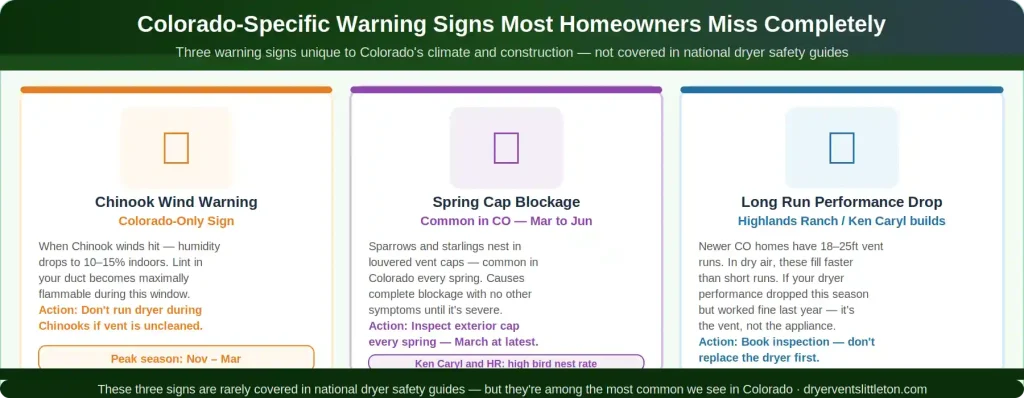
The Chinook Window
Chinook wind events — warm, dry air masses descending from the Rockies across the Front Range — can drop indoor humidity to 10 or 15 percent in a matter of hours. During a Chinook, lint in an uncleaned dryer vent reaches its maximum flammability. The ignition temperature drops even further than the already-lower Colorado baseline. I tell homeowners with uncleaned vents not to run the dryer during active Chinooks in winter or early spring. It’s a specific Colorado risk that simply doesn’t exist in other states.
The Spring Bird Nest Problem
Between March and June, sparrows, starlings, and house finches actively nest inside louvered dryer vent caps — particularly in Ken Caryl, Highlands Ranch, and the older Littleton neighborhoods where the original vent caps are still in place. A nest can block 80 to 100 percent of airflow within a single nesting season. The homeowner inside the house notices slower drying and weaker exterior airflow. They rarely connect it to a bird nest. A spring exterior cap inspection, separate from the annual full cleaning, is something every Colorado homeowner should make a habit.
The Long-Run Performance Drop
Homes built in Highlands Ranch and Ken Caryl between 1995 and 2015 frequently have laundry rooms in the center of the floor plan, resulting in vent runs of 18 to 25 feet. In Colorado’s dry air, these longer runs fill with lint faster than shorter systems. If your dryer performance has dropped noticeably from one season to the next — but the machine itself seems mechanically fine — the vent geometry combined with Colorado conditions is almost certainly the explanation. Before pricing a new dryer, book a vent inspection. It’s a fraction of the cost and solves the actual problem.
| ⚠️ One warning that applies to ALL ten signs: In Colorado, don’t use visible symptoms as the only indicator of vent health. Lint buildup is dangerous well before it causes obvious performance problems. A vent that’s 40 to 50 percent blocked may not yet affect drying time noticeably — but in Colorado’s dry air, that lint is already at elevated flammability. Annual professional inspection catches buildup before it becomes symptomatic. |
Book a Dryer Vent Inspection in Colorado
Littleton Vent Guard serves the full South Denver metro including Ken Caryl, Highlands Ranch, Littleton, Columbine, Southglenn, and the surrounding communities. Every inspection includes a CFM airflow measurement — so you get an objective number, not just a visual assessment. If a cleaning is needed, we do it the same visit. Flat-rate pricing confirmed before we start.
👉 Schedule your dryer vent inspection:
Dryer Vent Inspection — Littleton, CO
What to Do Right Now If You See Any of These Signs
For any URGENT signs — burning smell, dryer shutting off mid-cycle, visible lint at the cap: stop the dryer. Do not run another load. Call for a same-day or next-day inspection.
For HIGH urgency signs — over 65-minute drying times, very hot exterior, weak exterior airflow: don’t wait for more symptoms to appear. Book a cleaning this week. In Colorado conditions, these signs tend to worsen faster than in humid-climate homes.
For SCHEDULE signs — humidity in the laundry room, rising Xcel bill, overdue cleaning date: put it on the calendar within 30 days. Set a reminder. This is the category where people intend to do something and then forget until a more urgent sign appears.
About Littleton Vent Guard
We are locally owned and serve only the South Denver metro. We have serviced enough Colorado homes to know the specific patterns — the long Ken Caryl vent runs, the spring bird nest season, the Chinook-window risk, the Highlands Ranch two-story configurations. Every service call includes airflow measurement. We don’t guess at vent condition. We measure it.
🏠 Homepage and free quote:
Littleton Vent Guard — Colorado Dryer Vent Specialists
Questions About Dryer Vent Warning Signs
How many of the 10 signs need to be present before I should call?
One. Any single sign from the urgent or high-urgency category warrants a same-week call. A burning smell or dryer shutting off mid-cycle warrants stopping the dryer immediately. You don’t need to check all ten boxes before taking action. These signs appear individually before they stack, and waiting for more symptoms in Colorado conditions means allowing more lint to accumulate at higher temperatures.
My dryer is fairly new. Can it still have a vent problem?
Yes, and this surprises people. The dryer’s age has no relationship to the vent’s condition. A brand-new dryer connected to a duct that was installed improperly, kinked, or simply hasn’t been cleaned since the previous owner lived in the home will show every warning sign on this list. The vent and the appliance are separate systems. New machine, same duct problem.
I cleaned my vent six months ago and drying times are already slow again. What’s wrong?
A vent that becomes symptomatic again within six months of a professional cleaning usually has a physical restriction — a kink, a crushed section, or a disconnected joint — that the cleaning addressed the lint around but couldn’t fix structurally. Cleaning removes lint; it doesn’t repair duct geometry. An inspection that specifically looks for physical restrictions is the next step, not another cleaning.
My dryer is in the basement. Does that affect which signs I should watch for?
Basement laundry rooms — common in older downtown Littleton homes — often have longer vent runs simply because of the distance from the basement floor to an exterior wall or roof exit. The energy bill sign is particularly relevant in this configuration because longer runs mean more electricity consumed when airflow is restricted. The exterior cap check is also essential because basement vents sometimes exit at ground level where debris, vegetation, and snow blockage are more likely.
Is there a way to test airflow at home without professional equipment?
Partially. The exterior cap test — holding your hand near the opening while the dryer runs — gives you a qualitative sense of airflow. Strong and warm means the system is moving air. Weak or nothing means it isn’t. What it can’t give you is a CFM number — the objective measurement that tells you whether airflow is within safe operating parameters. Professional testing with a flow meter is the only way to get that number. The hand test rules out obvious problems; it doesn’t confirm the system is operating correctly.
Serving Ken Caryl, Littleton, Highlands Ranch and All of South Denver
We cover Ken Caryl Valley, Littleton, Highlands Ranch, Columbine, Southglenn, Sterling Ranch, Heritage Village, Lone Tree, Parker, Castle Rock, and the surrounding South Metro communities. Same-day inspection and cleaning available throughout our service area.
📍 Serving Ken Caryl Valley and nearby: