A few years ago, a friend of mine put solar panels on his roof, switched his car lease to a hybrid, and started composting. He was genuinely committed to reducing his environmental footprint, and I respected it. One evening we were talking about it and he mentioned his electricity consumption still seemed higher than he expected, despite the panels.
I asked when he’d last had his dryer vent cleaned.
He had no idea what I was talking about.
I explained it. A week later he called me — the vent cleaning had just been done and the before-and-after airflow numbers were dramatic. His dryer had been running nearly double the time it should have for years, quietly burning extra electricity every single cycle. He’d installed solar to reduce his carbon footprint and hadn’t noticed that one of his biggest hidden energy drains was right there in the laundry room.
This is a conversation I think more Colorado homeowners deserve to have. The environmental case for dryer vent cleaning is real, it’s measurable, and it doesn’t require any lifestyle change, major investment, or philosophical commitment. You clean the vent. The dryer uses less electricity. Less electricity means less carbon. It’s genuinely that direct.
| 225–285 lbs of CO₂ eliminated per Colorado home per year with a clean dryer vent. Based on Colorado’s electricity grid carbon intensity (0.44 lbs CO₂/kWh) and documented performance difference between clean and clogged dryer vents — 5 loads per week average. |
How a Dryer Vent Connects to Carbon Output
Most people think of carbon emissions in terms of cars, flights, and industrial processes. The household appliance sitting in the laundry room doesn’t usually enter the picture. But residential electricity consumption is responsible for a significant portion of Colorado’s total carbon output, and the dryer is one of the three highest electricity consumers in a typical home.
Every kilowatt-hour of electricity used in Colorado comes with a carbon cost. Xcel Energy, which supplies electricity to most of the Front Range, has been moving toward cleaner generation — currently around 38 percent renewable. But the remaining generation still produces real carbon emissions. The Colorado grid currently averages approximately 0.44 pounds of CO₂ per kilowatt-hour consumed. Every time your dryer runs an unnecessarily long cycle, that carbon math applies to every extra minute.
The Clogged Vent Multiplier
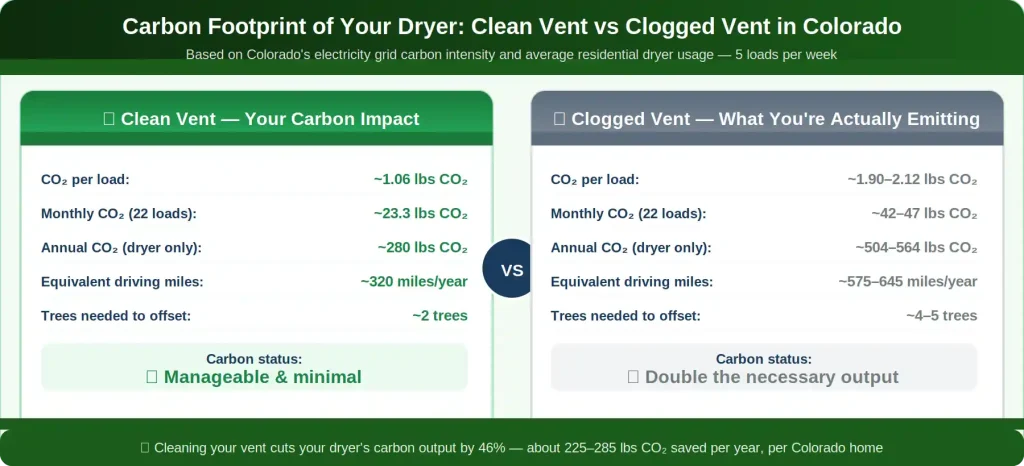
A standard electric dryer running a normal load on a clean, clear vent uses roughly 2.4 kilowatt-hours per cycle. At Colorado’s grid carbon intensity, that’s about 1.06 pounds of CO₂ per load.
When the vent is clogged, that same load takes 65 to 75 minutes instead of 38. The dryer consumes 4.3 to 4.8 kilowatt-hours — nearly double. Per load, that’s 1.9 to 2.1 pounds of CO₂. Over a year at five loads per week, the difference between a clean vent and a clogged one is 225 to 285 pounds of CO₂. Just from the dryer. Just from the vent being dirty.
That’s not a rounding error. That’s the equivalent of driving an additional 250 to 320 miles in an average gasoline car. Coming entirely from one maintenance task that costs $110 to $150 and takes less than two hours.
Why This Matters More in Colorado Than Most States
Colorado has a specific combination of factors that make dryer vent maintenance unusually relevant from an environmental perspective.
The Altitude Effect on Efficiency
At the elevations where most Front Range residents live — 5,280 to 5,830 feet — air is about 17 percent less dense than at sea level. A dryer at this altitude is already working against a natural efficiency disadvantage. The heating element has to run longer to remove the same amount of moisture because the air carries less heat per cubic foot.
Add a clogged vent to that baseline disadvantage and the dryer is compounding two separate inefficiencies simultaneously. The carbon output per load is higher at altitude than the same machine would produce at sea level, even before a dirty vent enters the picture. A clean vent can’t change the altitude, but it eliminates the additional burden the clog adds — which at Colorado elevations is meaningful.
Colorado’s Dry Air and Lint Combustibility
Colorado’s low humidity — averaging around 40 percent relative humidity on the Front Range, dipping significantly lower in winter — creates a secondary environmental risk from clogged vents beyond just energy waste. Dry, brittle lint is highly flammable. Dryer fires in Colorado are more likely to ignite from the same quantity of lint than in humid coastal states.
A dryer fire in a residential home releases not just the material value of the structure but a concentrated carbon pulse — the combustion of building materials, furnishings, and stored goods in a compressed event. The environmental cost of a residential fire is enormous relative to the prevention cost. A clean vent prevents that event.
| 💡 For Colorado homeowners who have already made sustainability investments — solar, EVs, composting, water conservation — a dryer vent cleaning is one of the easiest additional reductions available. Unlike most sustainability improvements, it also pays back financially through lower Xcel Energy bills, typically $68–$88 per year for an average household. |
The Collective Picture: What Colorado Could Achieve
Individual action matters. But it’s worth stepping back to see what this looks like at scale — because Colorado has roughly 2.3 million households, and most of them have a dryer.
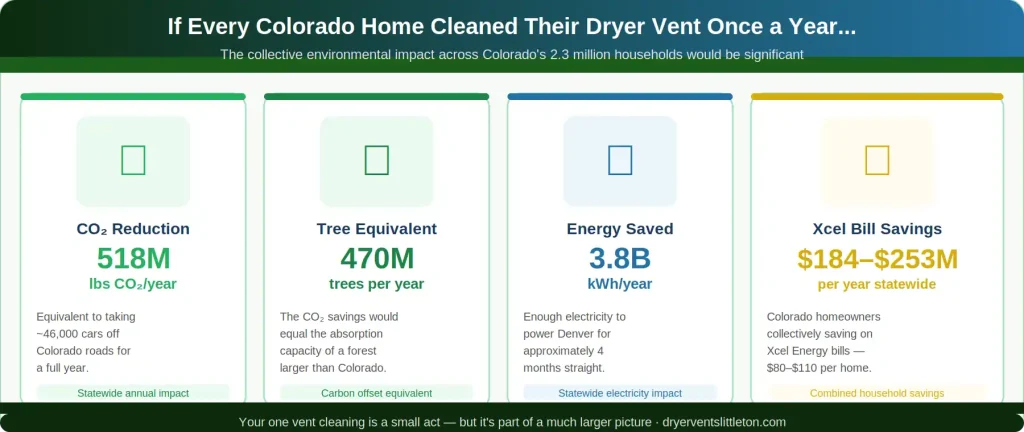
The numbers at scale are significant. If every Colorado household with a dryer cleaned the vent once a year, the combined energy savings would approach 3.8 billion kilowatt-hours annually. The CO₂ reduction would exceed 500 million pounds — the equivalent of removing roughly 46,000 cars from Colorado roads for an entire year.
None of this requires new infrastructure, government programs, or behavioral change beyond booking a service call. The technology already exists. The service is available. The impact is there to be had. It just requires homeowners knowing that the connection exists.
This is the part my solar-panel friend found most striking when I explained it to him. He’d been thinking about carbon reduction in terms of major investments and visible changes. A dryer vent cleaning felt invisible — until he saw what it did to his electricity meter.
The Practical Environmental Argument
I want to be honest about what a dryer vent cleaning is and isn’t in environmental terms. It’s not a substitute for renewable energy or transportation choices. The carbon reduction from one household — 225 to 285 pounds per year — is a real number but a modest one in the context of a typical American’s total carbon footprint.
What makes it compelling is the ratio. The environmental benefit comes at essentially zero marginal effort for the homeowner. You’re already paying for the service for safety and appliance longevity reasons. The carbon reduction is a free bonus that comes automatically when the vent is clear. There are very few sustainability actions with this favorable an effort-to-impact ratio.
Compare it to other common household carbon reductions. Switching from incandescent to LED lighting saves approximately 300 pounds of CO₂ per year — but requires replacing lights throughout the house and the savings are spread over the life of the bulbs. Reducing shower time by two minutes per day saves roughly 180 pounds of CO₂ per year — but requires a daily behavioral discipline. A clean dryer vent saves a comparable amount with one service call per year and no ongoing behavior change whatsoever.
| 🌿 Colorado context: Xcel Energy has committed to 80% carbon reduction by 2030. As the grid gets cleaner, every kilowatt-hour saved has less carbon attached to it. But right now, at today’s grid mix, the savings from a clean dryer vent are real and immediate. Reducing consumption is always the most reliable path to lower emissions, regardless of where the grid is heading. |
Book Your Vent Cleaning — Good for Your Home and for Colorado
Littleton Vent Guard serves the South Denver metro — Littleton, Highlands Ranch, Ken Caryl, Columbine, Southglenn, and the surrounding Front Range communities. Every service call includes a CFM airflow measurement so you can see exactly how much the cleaning improved your system. Flat-rate pricing confirmed before we arrive.
👉 Book your residential service:
Residential Dryer Vent Cleaning — Littleton, CO
The Colorado Green Laundry Checklist
Beyond the vent cleaning, several simple habits reduce your laundry room’s carbon output further — most require no investment and no significant lifestyle change.
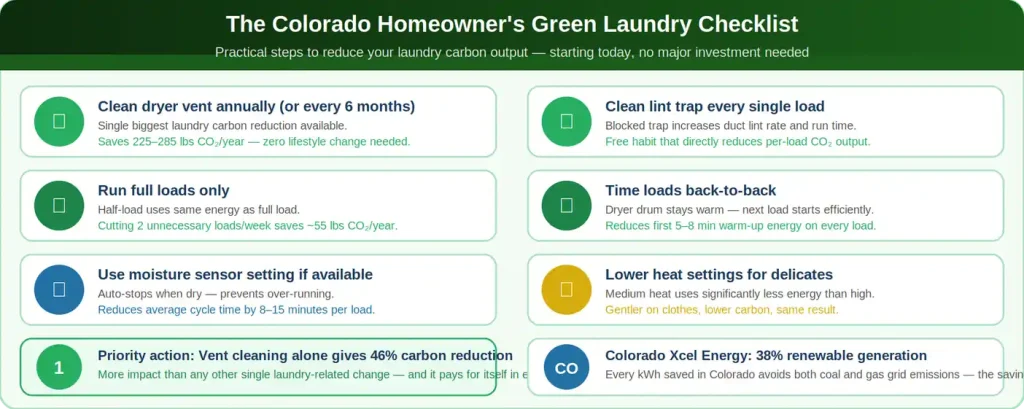
The vent cleaning sits at the top of that list for a reason. It delivers more carbon reduction per dollar and per unit of effort than anything else on the list. The others are genuinely helpful additions, but they build on a foundation that the vent cleaning establishes. You can run full loads and use moisture sensing all you want — if the vent is clogged, the system is still operating at a fraction of its environmental efficiency.
About Littleton Vent Guard
We’re locally owned, South Metro only. We care about Colorado — we live here, we serve here, and we want the homes we service to run as efficiently as possible. A clean vent is good for your safety, good for your Xcel bill, and good for the environment. All three benefits come from the same service call.
🏠 Homepage and free quote:
Littleton Vent Guard — Colorado Dryer Vent Specialists
Questions About Dryer Vents and Carbon Output
Is the carbon savings from cleaning my dryer vent actually meaningful?
Yes, within context. Saving 225 to 285 pounds of CO₂ per year is a modest but real contribution — comparable to switching your home entirely to LED lighting, or eliminating about 300 miles of driving per year. What makes it particularly compelling is that you get this reduction with a single service call per year, no behavioral change, and a financial payback through lower electricity bills. Most sustainability actions don’t pay you back financially at the same time.
Does the type of dryer affect the carbon math?
Yes, significantly. Electric dryers draw directly from the grid, so every extra minute of runtime has the carbon cost attached to Colorado’s grid mix. Gas dryers use natural gas for heat and much less electricity — their carbon output is tied to natural gas combustion rather than grid carbon intensity. Both benefit from a clean vent in terms of fuel efficiency and appliance stress, but the CO₂ calculations in this article apply specifically to electric dryers. For gas dryer households, the savings show up on the gas bill instead of the Xcel bill.
I have solar panels — does a clean vent still matter environmentally?
Absolutely, and possibly more so. If your panels generate enough electricity to cover your usage, a clogged dryer vent that doubles your dryer’s energy consumption may push you off the solar offset and onto grid power for those excess kilowatt-hours. A clean vent helps your solar investment go further by keeping your largest electricity consumer running efficiently. The environmental case is actually stronger for solar households than for those purely on grid power.
How does Colorado’s grid compare to other states for this calculation?
Colorado’s grid is cleaner than the US average but not as clean as states with very high renewable penetration like California or the Pacific Northwest. Xcel Energy has been retiring coal plants and adding wind and solar, so the carbon intensity per kilowatt-hour is improving over time. The CO₂ calculations in this article use current grid data — as the grid gets cleaner, the per-kilowatt-hour carbon cost drops, but the proportional relationship between a clean and clogged vent remains the same.
How often should I clean the vent to maintain the environmental benefit?
Once a year is the minimum for most Colorado homes. The carbon savings reset when the vent is cleaned — a vent that gradually accumulates lint over 12 months starts the efficiency decline slowly and ends the year significantly clogged. Annual cleaning keeps the system closer to peak efficiency throughout the year. Households with heavy usage, pets, or longer vent runs should clean every six months to maintain both the environmental and energy efficiency benefits.
Serving the Colorado Front Range — South Denver Metro
Our service area includes Littleton, Highlands Ranch, Ken Caryl Valley, Columbine, Southglenn, Lone Tree, Parker, Castle Rock, and the surrounding communities. Every home we service runs a little more efficiently after we leave — and that matters at any scale, individual or collective.
📍 Serving Highlands Ranch and the South Metro: