Last fall I was at a neighbor’s house helping move a chest freezer to the garage. His wife mentioned the Xcel bill had been creeping up — nothing dramatic, just $15 to $20 higher than it used to be, month after month. They’d called Xcel. Rates had gone up slightly but not enough to explain the full increase. Nobody could figure it out.
I walked into the laundry room and asked when they’d last had the dryer vent cleaned. She looked at me like I’d asked when they last cleaned the inside of the walls.
Never. The house was eight years old. The vent had never been touched.
We booked the service. Three weeks later she texted me: the dryer was finishing loads in 40 minutes instead of 70, and the Xcel bill had dropped noticeably. Not dramatically — but consistently, every month since.
That’s the story most Colorado homeowners haven’t heard. The dryer is the third-highest energy consumer in a typical home after the HVAC system and water heater. When the vent is clogged, the dryer works significantly harder than it needs to — and every extra minute it runs shows up on your Xcel Energy bill. This article breaks down exactly what that costs and what you can do about it.
| $168–$264 extra paid to Xcel Energy per year by Colorado homeowners with a clogged dryer vent. Based on average residential dryer usage (5 loads/week), Xcel Energy Colorado rates, and documented performance difference between clean and clogged vents. |
Why a Clogged Vent Makes Your Dryer Use So Much More Power
The connection between a blocked duct and a higher electricity bill is direct — but most people have never had it explained in plain terms. Here it is.
A residential electric dryer pulls in air, heats it, pushes it through a drum of wet clothes, then exhausts the moisture-laden air out through the vent duct. When the duct is clean and clear, this cycle moves efficiently. Hot moist air exits. The drum temperature stays controlled. The heating element cycles on and off as designed. A standard load is done in 35 to 42 minutes.
What Happens When the Duct Is Blocked
When lint accumulates in the duct — at elbows, at partial blockage points, at the exterior cap — the exhaust air has nowhere to go. It backs up into the drum. The temperature inside the dryer rises because the heat can’t escape. The moisture from the clothing stays trapped in the drum rather than exiting through the vent.
The thermostat senses the rising temperature and cycles the heating element off for safety. The drum keeps tumbling, but without heat. Then the temperature drops slightly and the element cycles back on. This on-off cycling is less efficient than steady operation, and it takes dramatically longer to remove the same amount of moisture from the same load.
End result: a load that should take 38 minutes takes 65 to 75 minutes. Your dryer used nearly double the electricity. And Xcel Energy got paid for every extra kilowatt-hour.
The Colorado Altitude Factor
This problem is worse in Colorado than it would be in most states, and the reason comes back to altitude. At 5,400 feet, air is about 17 percent less dense than at sea level. That means the dryer is already moving less heat per cubic foot of airflow than the manufacturer assumed when designing the appliance. Add a restricted duct and the system compounds two separate disadvantages at once — thin air and blocked airflow — neither of which your Xcel bill distinguishes from each other. Both just show up as higher consumption.

The Numbers: What a Clogged Vent Costs on a Colorado Xcel Bill
Let’s put real numbers on it. These figures are based on average Colorado residential dryer usage, Xcel Energy’s current Colorado rates, and documented performance data from before-and-after airflow measurements.
A Typical Colorado Household — 5 Loads Per Week
At five loads per week with a clean, clear vent, a standard electric dryer runs about 38 minutes per load. That’s roughly 2.4 kilowatt-hours per load, or about 53 kWh per month for the dryer alone. At Xcel’s Colorado residential average rate, that comes to around $7.30 per month in dryer electricity costs.
With a moderately clogged vent, the same dryer on the same household running the same loads takes 65 to 75 minutes per cycle. That’s 4.3 to 4.8 kWh per load — nearly double. Monthly dryer consumption climbs to 95 to 106 kWh. At Xcel rates, that’s $13 to $14.60 per month.
The difference: $5.70 to $7.30 per month. Every month. For every month the vent goes uncleaned. Over a year, that’s $68 to $88 extra paid to Xcel for electricity that accomplished nothing except running a dryer longer than it needed to.
Larger Families Run These Numbers Higher
Five loads a week is conservative for a family of four. Families with kids doing sports, households with pets, anyone running 8 to 10 loads per week — the extra cost scales proportionally. At 10 loads per week with a clogged vent, you’re looking at $14 to $18 extra per month, or $168 to $216 per year. Just on the dryer. Just from the vent being dirty.
| ⚠️ This is worth looking up right now: pull up your last three Xcel bills and compare the kWh totals. If there’s been a gradual increase that you can’t explain by rate changes or new appliances, the dryer vent is one of the first things worth checking. It’s one of the most common hidden energy drains in a Colorado home. |
Signs Your Dryer Vent Is Already Costing You Money
The problem with a clogged vent is that it develops gradually. There’s no single moment where it suddenly stops working. The drying times creep up a few minutes per load, per month, and you adapt to the new normal without realizing the baseline shifted.
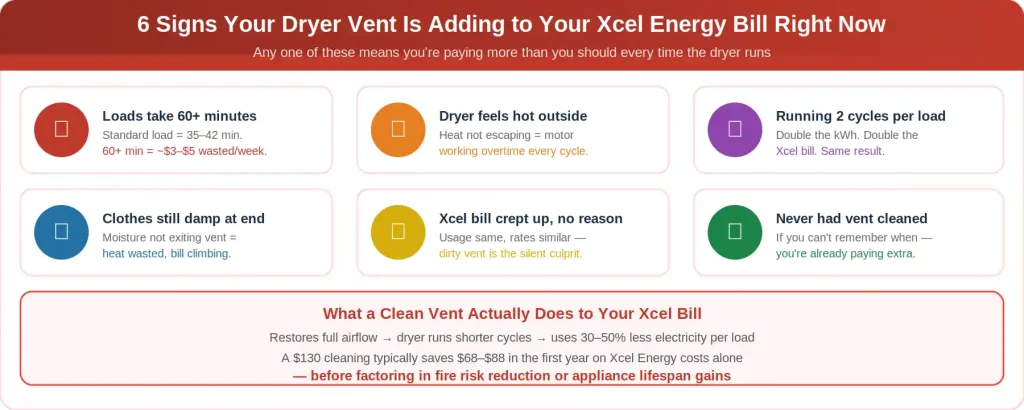
The most reliable signal is drying time. Get a feel for how long your dryer actually takes right now with a typical mixed load — not a full heavy load of towels, just a standard mix. Time it. If it’s consistently over 50 minutes, something is restricting the system. If it’s over 65 minutes, the restriction is significant.
The second signal is the exterior vent cap. While the dryer is running, go outside and hold your hand near the cap. You should feel a strong, warm airflow — strong enough that you wouldn’t comfortably hold your hand directly in front of it for more than a few seconds. Weak airflow, a cap that barely moves, or any visible debris around the cap means the duct is restricted enough to be affecting performance and your energy bill.
The third one catches people off guard: the dryer that stops mid-cycle. If the machine shuts itself off before the load is done, that’s the thermal overload protection tripping. The internal temperature got high enough that the safety mechanism kicked in. That’s not a machine failing — that’s a machine telling you something is wrong with the airflow. And every time it happens, the energy used in that partial cycle was wasted.
The ROI: Does Cleaning the Vent Actually Pay for Itself?
I get this question a lot. Someone is looking at a $110 to $160 service call and wondering whether the energy savings actually justify it. The honest answer is: yes, but the payback period is longer than people expect if you’re only counting electricity savings.
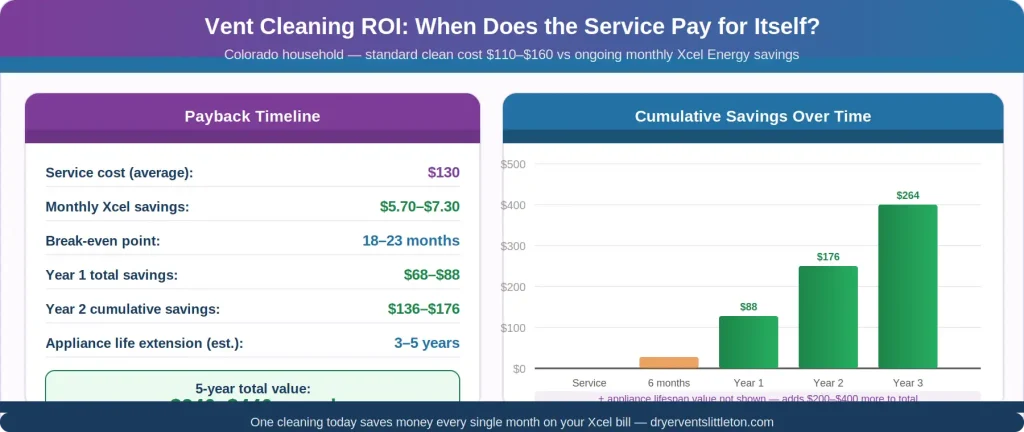
Electricity savings alone — at the $68 to $88 per year estimate for an average Colorado household — puts the break-even point at 18 to 23 months after a $130 cleaning. That’s not an immediate payback. But it’s also not the complete picture.
The Full Value Calculation
The electricity savings are the most conservative estimate of value. A clean vent also extends the life of the dryer itself — the heating element and motor run at their designed load instead of working constantly at elevated stress. Dryer repair calls in Colorado run $150 to $350 on average. A new dryer runs $600 to $1,200. If a clean vent adds two or three years to an appliance that would otherwise have needed replacement, the value of that extension exceeds the cleaning cost many times over.
Then there’s the fire risk reduction. A dryer fire in a Colorado home causes an average of $35,000 in property damage according to USFA data. The probability is hard to quantify for any individual home, but lint buildup is the leading cause of dryer fires nationally. A clean vent removes that risk entirely. What’s that worth? For most homeowners, more than the service call.
Put it all together — electricity savings, appliance lifespan, fire risk reduction — and the case for a $130 cleaning becomes straightforward. The payback on the electricity alone takes under two years. The total value delivered over five years is several times the service cost.
Get Your Vent Cleaned and Start Saving on Your Xcel Bill
We serve Littleton, Highlands Ranch, Ken Caryl, Columbine, Southglenn, and the surrounding South Denver metro. Every service call includes a CFM airflow measurement before and after — so you can see exactly how much the cleaning improved your vent performance. Flat-rate pricing confirmed before we arrive.
👉 Book your vent cleaning:
Residential Dryer Vent Cleaning — Littleton, CO
What You Can Do This Week Without Calling Anyone
Three things, all free, all take less than ten minutes combined.
One — time your dryer on a standard mixed load. Not towels, not jeans, just a regular mix of shirts and lighter items. Write the time down. If it’s over 50 minutes, you have a problem worth addressing. If it’s under 45, your vent is probably in reasonable shape.
Two — check the exterior vent cap while the dryer runs. Strong warm airflow = good. Weak airflow or a barely-moving flap = restriction. This takes 90 seconds and gives you real information.
Three — clean the lint trap. After every load, not occasionally. In Colorado’s dry air, lint that makes it past the trap is bone dry and light — it travels further into the duct and sticks more readily at restriction points. The trap is your first line of defense against duct accumulation. Don’t skip it.
About Littleton Vent Guard
We’re locally owned and work exclusively in the South Denver metro. We don’t use sea-level service intervals or national franchise pricing schedules. We know Colorado homes, Colorado altitude, and Colorado Xcel Energy rates. Every service includes airflow measurement so you know objectively what the vent was doing before and what it’s doing after.
🏠 Homepage and free quote:
Littleton Vent Guard — Colorado Dryer Vent Specialists
Common Questions About Dryer Vents and Xcel Energy Bills
How much can I actually save on my Xcel bill by cleaning the vent?
For an average Colorado household running five loads per week, the energy savings from restoring clean vent airflow typically runs $68 to $88 per year. Larger families running 8 to 10 loads per week can save $140 to $200 annually. These are conservative estimates — actual savings depend on how blocked the vent is, your specific dryer model, and how your usage patterns compare to the average.
My Xcel bill went up but I assumed it was the rate increase — how do I know the vent is the issue?
Compare your kWh consumption, not just the dollar total. Xcel bills show your monthly usage in kilowatt-hours. If your consumption has increased without a corresponding change in appliances or habits, the dryer vent is a strong candidate. You can also time a typical dryer load right now — if it’s running over 50 to 55 minutes, performance is degraded regardless of what the bill shows.
Does the type of dryer matter — gas vs electric?
For the Xcel Energy bill specifically, only electric dryers draw power directly from the grid. Gas dryers use gas for heat and only a small amount of electricity for the motor and controls. But a clogged vent affects gas dryers too — they run longer, use more gas, and put more stress on the machine. If you’re on Xcel’s gas service as well, a clogged vent raises both utility costs.
How often should I have the vent cleaned to keep my energy costs under control?
In Colorado, once a year is the minimum for most households. At altitude, lint dries out and accumulates faster than in lower-elevation states. Families with pets or heavy laundry usage should consider every six months. The drying time check is a reliable in-between indicator — if loads are creeping past 50 minutes before the scheduled cleaning, book earlier.
Can I clean it myself instead of hiring someone?
You can clean the first few feet of the transition duct behind the dryer with a consumer brush kit — available at hardware stores for $20 to $30. This helps but has real limits. A brush kit typically reaches 4 to 6 feet. Most Colorado homes have vent runs of 12 to 25 feet with multiple elbows. The sections deep in the duct and at the elbows are where significant lint accumulates and where airflow is most restricted. Professional cleaning with a rotary brush system and commercial HEPA vacuum is the only way to clear the full run and confirm airflow with measurement.
Serving Littleton, Highlands Ranch, Ken Caryl and the South Denver Metro
We cover the full South Metro service area — every neighborhood where Xcel Energy is the utility provider and where Colorado altitude is making dryer vents work harder than manufacturers designed them to. Same-day appointments available most days.
📍 Serving Highlands Ranch and surrounding areas: