A few years back I serviced a house in Ken Caryl where the homeowner had gone through three carbon monoxide detector replacements in two years. Every time, the detector eventually alarmed, she replaced the batteries, it stopped, and she moved on. Nobody connected it to the dryer.
On my third visit to that house — she’d called about slow drying times — I found the vent partially blocked with lint at an elbow about eight feet inside the wall. The gas dryer had been producing CO during every cycle for who knows how long. The exhaust was backing up slightly into the laundry room, which was open to the rest of the house.
The detector hadn’t been malfunctioning. It had been doing its job. The vent was the problem.
That experience is why I think the gas vs. electric question deserves a more direct answer than most homeowners get. Both types of dryers need their vents cleaned — that’s not the debate. The debate is whether they carry the same risk when the vent is neglected. The honest answer is no. Gas dryers carry a risk category that electric dryers simply don’t have. And in Colorado, where altitude affects combustion efficiency, that difference is worth understanding clearly.
| 2 vs 1 hazard types — gas dryers carry fire risk AND carbon monoxide risk. Electric dryers carry fire risk only. Both types require annual professional vent cleaning. But gas dryer owners need additional safety steps that electric owners don’t — CO detector maintenance and gas line inspection. |
What Both Types Have in Common
Before getting into the differences, the shared ground matters. Both gas and electric dryers use the same physical vent system. They both pull in air, push it through a drum of wet clothes, and exhaust the moisture-laden air out through a duct to the exterior. Lint from the laundry enters that duct system in both cases. In both cases, lint accumulation is the primary cause of dryer fires.
So the vent cleaning itself is the same service regardless of which type of dryer you have. Same rotary brush equipment. Same HEPA vacuum. Same CFM airflow measurement before and after. Same exterior cap inspection. The duct doesn’t know whether it’s attached to a gas dryer or an electric one.
Where the two types diverge is in what else is happening inside a gas dryer that an electric dryer doesn’t do — and what that means when the vent starts to fail.
The Gas Dryer Difference: Carbon Monoxide
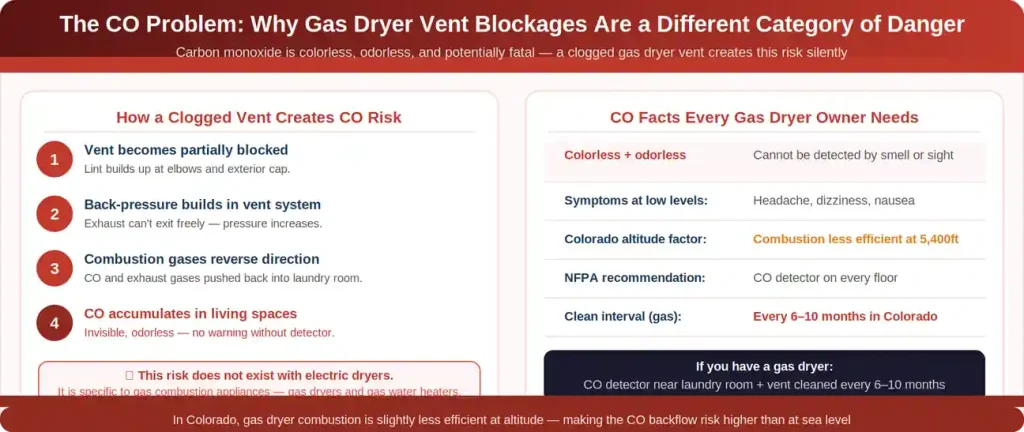
A gas dryer burns natural gas to produce heat. That combustion process produces exhaust gases — including carbon monoxide. Under normal operating conditions, those combustion gases are safely vented out of the home through the dryer vent duct, mixed in with the moisture from the clothes.
When the vent is partially or fully blocked, the combustion gases have nowhere to go. Back-pressure builds in the vent system. The exhaust starts reversing direction. CO — colorless, odorless, and potentially fatal at sufficient concentrations — enters the laundry room and from there, depending on the home’s layout, the rest of the living space.
Why This Risk Is Worse in Colorado
At altitude, combustion is less efficient. Air is thinner at 5,400 feet — there’s roughly 17 percent less oxygen per cubic foot than at sea level. Gas appliances designed for sea level produce slightly more incomplete combustion at Colorado elevations, which means slightly more carbon monoxide per cycle than the manufacturer’s specifications assume.
This is not a dramatic difference under normal operating conditions with a clear vent. But when back-pressure from a blocked duct starts causing exhaust reversal, the CO concentration in that reversed exhaust is somewhat higher at altitude than it would be at sea level for the same dryer in the same blocked condition. The margin between safe and dangerous is narrower here.
What CO Exposure Actually Looks Like
This is the part that makes CO so dangerous: the symptoms of low-level exposure are nonspecific. Headache. Dizziness. Nausea. Fatigue. These are the same symptoms as a hundred other things — a cold coming on, a bad night’s sleep, dehydration from a long workout. People dismiss them.
The homeowner in Ken Caryl had been getting headaches on laundry days for over a year. She’d attributed them to the detergent. It wasn’t the detergent.
Electric dryers produce no combustion. There is no carbon monoxide associated with an electric dryer under any operating condition. If an electric dryer’s vent is completely blocked and the machine overheats, you have a fire risk and a broken appliance. You do not have CO exposure. That’s a meaningful difference.
| ⚠️ Non-negotiable for gas dryer households: A carbon monoxide detector on every floor of the home, with the most critical placement near the laundry room and sleeping areas. Replace batteries every six months. Replace the detector itself every 5 to 7 years — they degrade over time and stop sensing accurately. This is separate from vent maintenance, not a substitute for it. |
The Electric Dryer Difference: Higher Heat
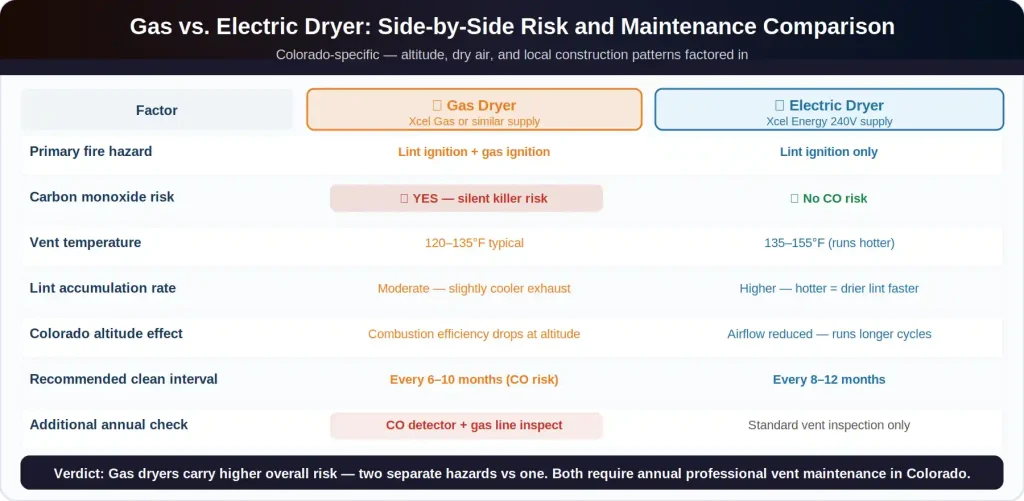
Electric dryers run hotter than gas dryers in a typical residential setting. Gas heat is often described as “gentler” because it cycles on and off more naturally with the combustion process. Electric heating elements maintain more consistent, often higher temperatures — typically 135 to 155 degrees Fahrenheit in the duct during operation, compared to 120 to 135 for most gas dryers.
What This Means for Lint
Higher duct temperatures mean lint in an electric dryer’s vent system dries out faster and more completely than lint in a gas dryer’s vent. In Colorado’s already-dry air, this effect is amplified. Lint in an electric dryer vent in Highlands Ranch can be bone dry before it even reaches the first elbow.
Completely dry lint ignites at lower temperatures than damp lint. In an electric dryer with a blocked vent, the duct temperature can climb significantly beyond normal operating ranges — and the lint sitting at the blockage point is as flammable as it gets. The fire risk in a severely blocked electric dryer is acute.
Gas dryers also create fire risk from lint — that’s not in question. But the slightly lower operating temperatures and the natural on-off cycling of gas combustion mean lint in a gas vent retains slightly more moisture than in an electric vent, all else being equal. Gas has more serious risk overall because of the CO factor, but electric dryers shouldn’t be treated as the safe option — just the single-hazard option.
| 💡 Practical note for electric dryer owners: If your vent run is longer than 15 feet or has more than two 90-degree elbows, the electric dryer’s higher operating temperature makes a shorter cleaning interval worth considering. The combination of higher heat and more lint accumulation surface area creates conditions where the fire risk builds faster than in a shorter or simpler duct system. |
The Colorado Altitude Factor — How It Affects Each Type Differently
Altitude changes the risk equation for both types, but in different ways.
Gas Dryers at Altitude
As covered earlier, thinner air means less complete combustion, which means more CO per cycle than sea-level specifications assume. This is a baseline condition — even with a perfectly clean vent, a gas dryer in Littleton produces slightly more CO per cycle than the same model at sea level. A blocked vent that causes exhaust reversal at altitude is dealing with somewhat higher CO concentrations than the same scenario in a lower-elevation state.
This is why the recommended cleaning interval for gas dryers in Colorado is shorter than the national average. Six to ten months, depending on household usage and vent run length, rather than twelve.
Electric Dryers at Altitude
Electric dryers don’t burn fuel, so altitude doesn’t affect combustion. What it does affect is airflow. Thinner air at 5,400 feet means the dryer moves less heat per cubic foot of exhaust airflow — the same dynamic that affects all dryers at altitude. Electric dryers at altitude run slightly longer cycles and work the heating element harder to achieve the same drying result.
The net effect for vent maintenance: lint accumulates slightly faster in Colorado than it would for the same dryer at sea level, because the machine runs longer per load. The recommended cleaning interval at Colorado elevations — eight to twelve months — reflects this. The national once-a-year recommendation is a minimum, not a ceiling.
Annual Maintenance: What Each Type Actually Requires
Here’s where the practical difference between gas and electric becomes most concrete. The vent cleaning is the same. Everything else diverges.
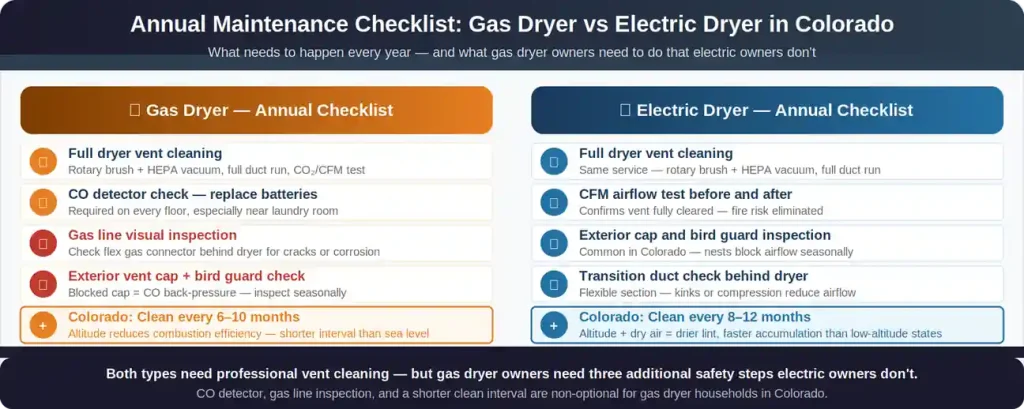
Gas dryer owners have three additional maintenance items that electric owners don’t: the CO detector check, the gas supply line visual inspection, and the shorter cleaning interval.
The gas supply line behind the dryer is the flexible metal connector between the rigid gas pipe coming out of the wall and the dryer itself. These connectors degrade over time — they can crack, corrode, or develop small leaks. A visual inspection once a year, looking for any signs of corrosion, kinking, or damage, is a simple check that most gas appliance owners skip entirely. If anything looks wrong, a licensed plumber or gas service technician should assess it before the dryer runs again.
The CO detector check is not a replacement for vent maintenance — it’s a backup. Even with a perfectly maintained vent, CO detectors are standard safety equipment in any home with gas appliances. If the vent ever develops a problem between cleanings, the detector is what catches it. Think of it as your warning system for the period between professional service calls.
Book Your Gas or Electric Dryer Vent Service in Colorado
Littleton Vent Guard services both gas and electric dryer vents throughout the South Denver metro. For gas dryer households, we specifically include an inspection of the vent for signs of back-pressure and discuss CO detector placement during the service call. Flat-rate pricing confirmed before we arrive, CFM airflow measurement included.
👉 Schedule your vent cleaning:
Residential Dryer Vent Cleaning — Littleton, CO
Questions About Gas vs Electric Dryer Vent Maintenance
My gas dryer has been running fine for years — do I really need to worry about CO?
“Running fine” is harder to assess with CO than with most other problems because the symptom — combustion gas reversal into the living space — doesn’t always show up obviously. The dryer dries clothes. It keeps running. What happens in the background, to the air quality, is invisible without a detector or a service tech specifically checking for it. A vent that’s 40 percent blocked can cause meaningful CO exposure without noticeably affecting drying performance in the early stages. That’s exactly what makes it dangerous.
Does a gas dryer vent need different equipment to clean than an electric dryer vent?
No. The physical duct is the same structure regardless of what’s attached to it. The same rotary brush system and commercial HEPA vacuum that cleans an electric dryer vent cleans a gas dryer vent equally well. The difference is in what the technician pays attention to during and after the service — specifically, any signs of back-pressure, reversal, or CO-related damage at the connection point between the dryer and the duct.
I have a gas dryer. Should I get a CO detector just for the laundry room?
The NFPA recommends CO detectors on every level of the home, including basements. If your laundry room is in the basement or a first-floor interior room — which is common in many Colorado homes — a detector in or near that room is important. The bedroom floor is equally critical, because CO exposure during sleep is when it becomes most dangerous. You want both floors covered.
Does it matter which gas company supplies my home for these calculations?
Not significantly for the CO risk. The combustion characteristics of natural gas are consistent regardless of the local distribution company. Xcel Energy, Black Hills Energy, and other Colorado suppliers all deliver natural gas with the same fundamental combustion properties. The altitude factor affects all gas appliances in the state similarly, regardless of the gas company.
We’re switching from gas to electric. Does the vent need to change?
No, the duct system stays the same. A 4-inch metal duct is a 4-inch metal duct regardless of which appliance it serves. What changes is your maintenance priority list — you can retire the gas-specific checks (CO detector for the dryer, gas line inspection) while keeping the standard annual vent cleaning and airflow testing. If your duct was last cleaned while you still had the gas dryer, have it cleaned after the switch so you’re starting the electric dryer with a fully clear system.
Which type of dryer has more dryer fires overall?
NFPA data on dryer fires doesn’t separate gas from electric in a way that cleanly answers this. What the data consistently shows is that failure to clean the vent is the leading cause for both types — accounting for about 34 percent of all dryer fires. The fire risk from lint is comparable across both fuel types. The additional CO hazard with gas dryers is a separate risk category on top of the shared fire risk, which is why gas dryer households have a longer list of maintenance requirements.
Serving Littleton, Highlands Ranch, Ken Caryl and the South Denver Metro
We service both gas and electric dryers across the South Metro. If you’re not sure what type of dryer you have — look at the back of the machine. A gas dryer will have a flexible metal gas supply line connected to a gas shutoff valve coming out of the wall. An electric dryer will have a large 240-volt power cord plugged into a four-prong outlet. Either way, we can help.
📍 Serving Highlands Ranch and surrounding areas:
Dryer Vent Cleaning — Highlands Ranch, CO
🏠 Homepage and free quote: