Every certified dryer vent technician in Littleton recommends rigid metal duct for the permanent duct run inside your walls, and that recommendation is not a preference or a style choice. It is the outcome of NFPA 211 code requirements, documented fire investigation data, and the practical reality of what happens inside each material type over time. Flexible foil duct, which still occupies a legitimate but strictly limited role in a compliant dryer vent system, is the correct choice only for one short, accessible, visible section. Using it anywhere else is a code violation and a measurably higher fire risk.
This is one of those topics where the hardware store shelf, the YouTube installation video, and the code book tell three different stories, and the gap between them matters to the safety of your home. This guide is going to explain each material type honestly, where each belongs, where each fails, and what the difference means for Littleton homeowners specifically.
Understanding the Three Zones of Your Dryer Vent System
Before the foil versus rigid comparison can make full sense, it helps to understand that a dryer vent system is not one continuous run of the same material. A properly installed system has three distinct zones, each with its own code specification.
Zone one is the dryer outlet collar, which is the port on the back of the appliance where exhaust air exits the dryer cabinet. This is a fixed part of the appliance itself, not a duct you install.
Zone two is the transition hose, which is the short flexible section connecting the back of the dryer to the fixed wall duct entry point. This section exists because the dryer needs to be pulled away from the wall periodically for cleaning, service, and appliance replacement, and a completely rigid connection would make that movement difficult. NFPA 211 and IRC M1502 allow a flexible transition duct in this zone under specific conditions: it must be UL 2158A listed metal, it must not exceed 8 feet in total length, and it must remain visible and accessible at all times, which means it cannot be concealed inside a wall or ceiling.
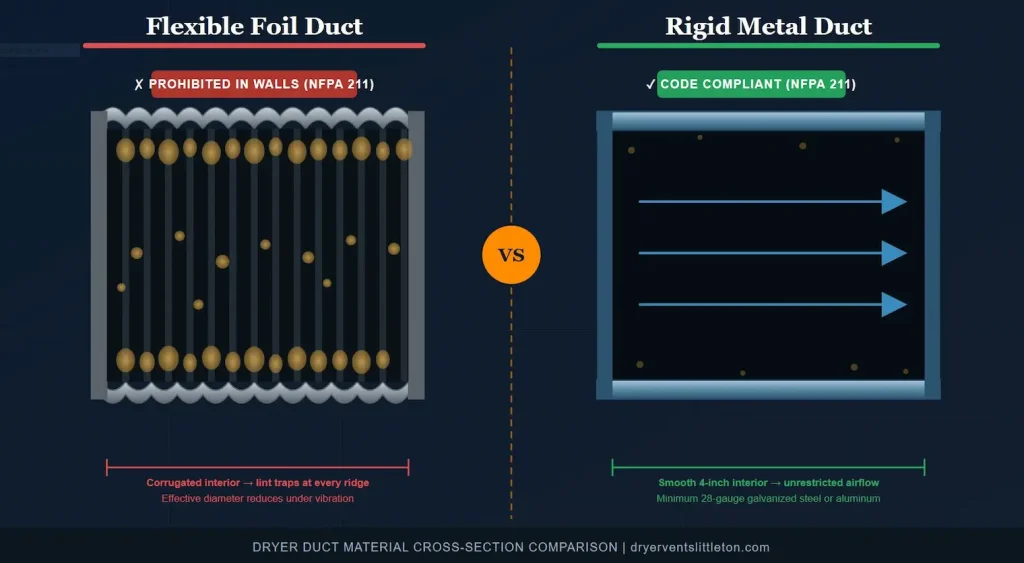
Zone three is the permanent duct run, which covers everything from the wall entry point all the way to the exterior termination. This is the portion that runs through wall cavities, floors, ceilings, and attic or crawl space sections before exiting the building. NFPA 211 is explicit and non negotiable here: this section must be constructed of rigid metal duct with a minimum wall thickness of 0.016 inches (28 gauge), smooth interior walls, and joints running in the direction of airflow.
The confusion that leads to most material compliance issues is that homeowners and sometimes contractors treat the entire duct run as zone two, using flexible foil throughout from dryer to exterior. That is both a code violation and the single most common installation error our technicians encounter across communities we serve in Arapahoe County, from Dryer Vent Cleaning Highlands Ranch homes to Dryer Vent Cleaning Heritage Village properties.
What Flexible Foil Duct Actually Is and Why It Fails
Flexible foil duct, sometimes called accordion foil hose or flexible metallic duct, is constructed from thin aluminum foil wrapped over a helical wire frame. The result is a collapsible, accordion style tube that can be compressed, extended, and bent in virtually any direction without cutting or measuring. That workability is why it became popular in the first place. A plumber, builder, or DIYer can run it through almost any path without specialized tools or precise planning.
The accordion structure that makes it flexible is also exactly what makes it dangerous in dryer vent applications. Each ridge of the corrugation is a physical obstruction inside the airflow path. As warm, slightly moist exhaust air carrying lint particles moves through the duct, the lint does not travel cleanly through a smooth tube. It encounters each ridge, slows slightly at the corrugation, and some percentage of those particles adheres to the ridge surface rather than continuing toward the exterior exit.
In a humid climate, this accumulation happens at a moderate rate. In Littleton’s semi arid environment, where relative humidity averages between 30 and 45 percent and indoor humidity during heating season can drop below 15 percent, the static electricity dynamic described in other articles on this site amplifies the problem. Dry air increases static charge on lint particles, which makes them more adhesive to any surface they contact. Foil duct’s corrugated interior provides far more surface area for charged lint to cling to than smooth rigid metal does, which means accumulation in foil duct accelerates faster in Colorado’s climate than in more humid parts of the country.
Beyond lint accumulation, flexible foil duct has a documented tendency to collapse over time. When the dryer vibrates during operation, it gradually pushes back against the transition connection, and the foil material, which has almost no structural rigidity, compresses under that pressure. A foil duct that measured 4 inches in diameter when installed can compress to an effective interior diameter of 3.25 inches or less after months of operational vibration, which produces a measurable reduction in airflow capacity. Rigid metal duct does not compress under dryer vibration.
Foil duct also tears. The thin aluminum foil construction is vulnerable to any physical contact, whether from the dryer being moved, from a pest gnawing at the material, or simply from the material fatiguing over years of thermal cycling as it repeatedly heats during dryer operation and cools afterward. A torn section of foil duct inside a wall vents hot, lint laden exhaust air directly into the wall cavity, which is both a fire hazard and a moisture problem.

What Rigid Metal Duct Is and Why It Performs Better
Rigid metal duct for dryer vent applications is manufactured from either galvanized steel or aluminum in a smooth walled cylindrical form with a minimum interior diameter of 4 inches and a minimum wall gauge of 28. The smooth interior surface is the fundamental advantage. Lint traveling through the exhaust airstream moves through a tube with no ridges, no corrugations, and no obstructions to slow it down or give it a surface to adhere to.
This does not mean rigid metal duct never accumulates lint. All duct systems accumulate lint over time, which is why professional cleaning is necessary regardless of material. The critical difference is the rate of accumulation and, just as importantly, the cleaning outcome when service is performed.
When a technician runs a rotary brush system through rigid metal duct, the brush maintains consistent wall contact throughout the full circumference of the smooth cylinder. The lint that has settled along the interior surface is dislodged cleanly and extracted by the vacuum system. The surface left behind after cleaning is smooth and essentially lint free until the next accumulation cycle begins.
The same rotary brush run through foil duct encounters a fundamentally different interior geometry. The brush contacts the ridges but cannot fully reach into the valleys between corrugations, where compacted lint tends to be most densely packed. The cleaning result in foil duct is inevitably partial, which means some percentage of accumulated lint remains after every service. Over multiple cleaning cycles, the residual lint in the corrugation valleys gradually compounds.
This cleaning outcome difference is something every technician who works in the field understands from direct experience, and it is one of the practical reasons why material compliance is not just a code checkbox but a genuine service quality issue for homeowners.
The UL 2158A Listing: What It Means and Why It Matters
The transition hose in zone two is permitted to be flexible, but it must carry a UL 2158A listing. This is a specific testing certification issued by UL (Underwriters Laboratories) that confirms a flexible dryer transition duct has been evaluated and found to meet safety standards for dryer exhaust applications, including temperature resistance, structural integrity under operational conditions, and non combustibility requirements.
Standard flexible foil duct sold in bulk rolls at hardware stores is not UL 2158A listed. It is general purpose flexible ducting that happens to be made of aluminum foil. When it is used as a transition hose behind a dryer, it may look similar to a listed product, but it has not been tested to the same performance standard and does not provide the same assurance of safety under the heat and airflow conditions a dryer produces during normal operation.
Products specifically manufactured and listed to UL 2158A include semi rigid aluminum transition duct, the product commonly sold as DryerFlex, and other metal transition hoses explicitly labeled with the UL 2158A certification. These products are what NFPA 211 requires in zone two, and they are meaningfully different from unlisted foil duct even when they look similar to a homeowner unfamiliar with the distinction.
For homeowners in Dryer Vent Cleaning Ken Caryl, Dryer Vent Cleaning Southglenn, and Dryer Vent Cleaning Sterling Ranch who are unsure whether their transition hose carries a UL 2158A listing, a quick check of the manufacturer’s label on the hose itself will show the certification mark. If no listing information is present, the hose should be treated as unlisted and replaced with a certified product.
The Signs That Your Transition Hose Needs Replacement Now
Flexible transition hoses have a finite service life even when properly installed, and several visual and functional indicators suggest immediate replacement is warranted regardless of the hose’s age.
Visible tears, holes, or separations in the foil material are the most urgent. Any breach in the hose wall means exhaust air is escaping directly into the space behind your dryer before it reaches the wall duct, which introduces both heat and lint into the concealed space behind the appliance.
Compression or crushing of the hose, visible when you look behind the dryer, indicates the dryer has been pushed back against the hose to the point where the diameter has been compromised. A compressed hose restricts airflow in exactly the same way a kinked garden hose restricts water flow, and restoring the dryer to its original position rarely restores the hose to its original diameter if the material has been compressed for an extended period.
Extreme accordion extension, where the hose has been stretched to near its maximum length to bridge the gap between the dryer outlet and the wall entry, suggests the dryer is positioned too far from the wall for the connection to function properly. An overstretched foil hose develops tension on the foil material that accelerates tearing and creates an increasingly restricted airflow path.
Any hose that has been in service for more than 5 years should be evaluated during a professional visit regardless of visible condition, since the thermal cycling effects on the foil and wire frame construction accumulate over time in ways not always visible from the exterior of the hose.
Our Professional Vent Repair and Rerouting service includes a transition hose evaluation as part of every site visit, and we stock UL 2158A listed replacement hoses so that any identified material issue can be addressed the same day without requiring a second appointment.
What Upgrading From Foil to Rigid Metal Actually Involves
This question comes up frequently from homeowners in Dryer Vent Cleaning Foxfield and Dryer Vent Cleaning Greenwood Village properties who discover during a professional inspection that their existing duct run uses foil material throughout. Understanding what the upgrade involves helps set realistic expectations about the scope of work.
For homes where the flexible foil duct is only in the transition hose zone (zone two), the upgrade is straightforward and typically takes under an hour. The existing foil hose is disconnected at both ends, discarded, and replaced with a UL 2158A listed semi rigid metal transition duct of appropriate length. This is among the most cost effective safety improvements a dryer vent system can receive.
For homes where flexible foil was run through the wall as the permanent duct (zone three), the upgrade is more involved because it requires access to the duct run inside the wall cavity, removal of the existing foil material, and installation of rigid metal sections sized and connected to form a compliant permanent run. The complexity depends on how long the run is, how many directional changes are present, and what access points are available in the existing structure.
In some cases, the routing path used for the original foil duct is not ideal for rigid metal installation due to too many bends or excessive equivalent length, and the upgrade involves both material replacement and modest rerouting to achieve a compliant configuration. Our Comprehensive Safety Inspection and Diagnostics service evaluates the full existing run before any upgrade work begins, so homeowners receive an accurate assessment of what the complete solution involves before committing to a scope of work.
How Colorado’s Climate Makes Material Choice More Consequential
Everything discussed above is relevant to dryer vent safety anywhere in the country. In Littleton and the broader Front Range area, the stakes are modestly but genuinely higher for two specific reasons.
The first is the static electricity driven lint adhesion that Colorado’s dry air produces. The corrugated interior of foil duct is a more effective lint trap in a dry climate than in a humid one, because static charged lint clings more aggressively to surfaces in low humidity conditions. The accumulation rate in foil duct in Littleton is meaningfully faster than the same foil duct would experience in a humid climate, which compresses the safe service interval and increases the probability of reaching dangerous accumulation levels between cleaning visits.
The second is altitude. At Littleton’s elevation of approximately 5,351 feet, the thinner air means airflow velocity through any duct system carries slightly less mass per cubic foot than at sea level. The additional flow resistance created by foil duct’s corrugated interior, which is already a problem at sea level, produces a larger proportional reduction in effective airflow performance at altitude because the system has less airflow margin to absorb the additional resistance.
These two factors together are why our technicians serving Dryer Vent Cleaning Cherry Hills Village, Dryer Vent Cleaning Heritage Village, Dryer Vent Cleaning Parker, Dryer Vent Cleaning Ken Caryl, and Dryer Vent Cleaning Lone Tree consistently recommend addressing material compliance issues rather than simply cleaning around them. Cleaning foil duct repeatedly without upgrading it is a maintenance pattern that manages the symptom rather than resolving the underlying performance and safety issue.

The Comparison in Plain Terms
Rigid metal duct for zone three is the code requirement, the professional recommendation, and the better performing material in every measurable category relevant to safety, efficiency, and cleaning effectiveness. It does not compress, it does not corrode under normal dryer exhaust conditions, it does not trap lint in corrugation valleys, and it allows professional cleaning equipment to achieve thorough results throughout the full duct length.
Flexible foil material has one legitimate role: as a short, accessible, UL 2158A listed transition hose in zone two, installed correctly and replaced when it shows wear. Outside of that specific role, it is not an equivalent alternative to rigid metal. It is a code violation that creates measurably higher fire risk over time.
The good news for homeowners who discover their existing installation uses foil duct in zone three is that the upgrade is a solvable problem. It is not a reason to replace the dryer, it is not a sign that the home has failed or that previous owners were negligent, and it is not a complicated project when approached by a technician who performs this type of work routinely.
Our Residential Dryer Vent Cleaning service includes a material compliance assessment as part of every visit, and our Professional Vent Repair and Rerouting team handles the upgrade work when it is needed. If you are in Littleton or anywhere across Arapahoe County and want to know what material your duct system uses, you can reach us through our contact page to schedule an assessment.
Frequently Asked Questions
Can I use flexible foil duct for the transition hose if it is not UL 2158A listed?
No. NFPA 211 and IRC M1502 require that the flexible transition duct in zone two be a listed product under UL 2158A. Standard flexible foil duct from a hardware store is not listed and does not meet this requirement regardless of how short the run is.
How long should the transition hose be?
The maximum allowable length for the flexible transition duct is 8 feet under NFPA 211. Shorter is better. Most installations require only 2 to 4 feet of transition hose to bridge the distance between the dryer outlet and the wall entry point. If your installation requires more than 8 feet of flexible material, the problem is the positioning of the dryer relative to the wall duct entry, not the hose length itself.
Is semi rigid aluminum duct the same as rigid metal duct?
No, and the distinction matters. Semi rigid aluminum duct (the UL 2158A listed product type, including DryerFlex) is acceptable for zone two as a transition hose. It is not the same as the rigid galvanized steel or aluminum duct required for zone three. Semi rigid material still has some flexibility and a slightly less perfectly smooth interior surface than fully rigid duct. It meets the code requirement for the transition zone but should not be substituted for rigid metal in the permanent duct run.
Does replacing foil duct with rigid metal reduce how often I need professional cleaning?
It extends the effective interval between cleanings slightly, since lint accumulates less aggressively in smooth rigid duct and is more thoroughly removed during professional service. However, all duct systems require regular professional cleaning regardless of material. The upgrade improves safety, cleaning effectiveness, and performance. It does not eliminate the need for annual service.
Can I do this upgrade myself?
The transition hose replacement in zone two is a task an experienced homeowner can handle if they are comfortable disconnecting and reconnecting the appliance and working in the confined space behind the dryer. The zone three upgrade involving duct inside wall cavities is better handled by a technician who has the tools, materials, and experience to navigate concealed spaces and make code compliant connections throughout.