I got a call last January from a homeowner off Highlands Ranch Parkway near the Community Center. She’d been running her dryer for almost two hours — two full cycles — to dry one load of towels. Not unusual, she figured. The house was built in 2003. She’d never had the vent cleaned.
We found the problem in about twelve minutes after arriving. A 23-foot vent run with two 90-degree elbows, packed from the second turn to the exterior cap. Airflow measured at 14 CFM. It should have been 65. The dryer had been working at roughly 20 percent of normal efficiency for who knows how long.
After the cleaning, she asked me something I hear a lot in this zip code: “Why didn’t anyone tell me about this when I bought the house?”
Nobody does. And the construction specifics of Highlands Ranch 80126 make this a bigger problem here than in most parts of the South Denver metro. This guide explains exactly why — and what to do about it.
| 80126 — one of the highest dryer vent risk zip codes in Arapahoe County. Long vent runs, dry high-altitude air, and two-story construction combine in ways that accelerate lint buildup faster than almost anywhere else in the South Metro. |
Why 80126 Is Different From the Rest of Arapahoe County
Most of the dryer vent problems I see in older Littleton neighborhoods come from aged materials — foil accordion duct that was installed decades ago and never replaced. Highlands Ranch is different. The homes here are newer. The materials are generally better. But the construction layout creates its own set of problems that most homeowners have never been told about.

Three factors that make 80126 homes higher risk than average — all three present at once in most Highlands Ranch builds.
The Long Vent Run Problem
Walk into most Highlands Ranch homes built between 1990 and 2010 and you’ll find the laundry room somewhere in the middle of the house. Second floor, interior wall, centered in the floor plan. That was the design preference of the era — laundry rooms moved out of basements and into the living area for convenience.
Convenient for the homeowner. Less convenient for the dryer vent.
That central placement means the duct has to travel significantly further before it reaches an exterior wall or roof exit. In my experience with 80126 homes, the average run is somewhere between 18 and 25 feet. Some go longer. With two or three elbows along the way, each one adding resistance equivalent to several feet of straight run, these systems are working against themselves from day one.
The math on lint accumulation changes at this scale. A 10-foot vent run in an older Littleton home might need cleaning once a year. A 22-foot run with three elbows in a Highlands Ranch house can need it every six months, especially for a family with kids doing frequent laundry.
Elevation and Humidity — the 80126 Factor Nobody Talks About
Highlands Ranch sits at approximately 5,830 feet. That elevation matters for dryer vent safety in a way that almost nobody ever mentions.
At that altitude, the air holds significantly less moisture than it does at sea level or in lower-elevation states. Average relative humidity in 80126 runs around 40 percent — lower in winter, sometimes lower still during Chinook winds. What this means for lint: it dries out completely.
Lint that stays slightly damp — like lint in a coastal state — is heavier, clumps together, and is less prone to igniting quickly. Completely dry, brittle lint at 5,830 feet is a different story. It’s lighter, it distributes more easily through the duct, and it ignites at lower temperatures. The same quantity of lint represents more fire risk here than in most parts of the country.
This isn’t alarmism — it’s just physics. And it’s why the “clean once a year” recommendation from NFPA is a minimum, not a ceiling, for 80126 homeowners.
Two-Story Construction and Roof Exit Vents
Most 80126 homes are two-story builds. When the laundry room is on the second floor, the vent typically exits through the roof rather than a side wall. That creates three distinct complications that side-wall exits don’t have.
First, roof caps accumulate debris differently. They’re exposed to snow, ice, and blowing organic material in ways that side-wall caps aren’t. A cap that’s partially blocked by compacted debris looks normal from inside the house and only reveals itself when someone gets on the roof and checks.
Second, birds. Roof vent caps — especially the louvered type common in 1990s and 2000s construction — are popular nesting spots for sparrows and starlings. A nest can fully block a cap within one nesting season. I’ve found nests in 80126 homes that had been there for multiple years.
Third, accessing a roof exit vent for cleaning and inspection requires ladder access to the roof. Not every company does this as part of a standard service call. Ask specifically before booking anyone.
| ⚠️ If your 80126 home has a second-floor laundry room with a roof exit vent, and you’ve never had it inspected from the roof — that inspection is more important than the cleaning itself. A blocked roof cap means the duct run is pressurized every time the dryer runs. Lint backs up into the system rather than exiting. |
How Often Should Your 80126 Home Be Cleaned?
One of the most common questions I get from Highlands Ranch homeowners is whether the annual cleaning schedule applies to them. Honestly — it applies as a minimum. Depending on your specific situation, you may need to go more often.

Find your situation in this guide — cleaning frequency for 80126 homes depends on more than just how often you use the dryer.
The two situations that jump most people to a six-month schedule: families doing heavy laundry (8 or more loads a week) and households with pets. Pet hair entering the dryer is a surprisingly significant factor. It doesn’t stay in the lint trap the way cotton fibers do. Fine pet hair moves past the trap and into the duct system, where it combines with lint and creates a denser, harder-to-clear buildup at every elbow and restriction.
If you have two medium-to-large dogs and a family of four in an 80126 home — that’s not a once-a-year situation. Every six months is the right call.
Warning Signs Specific to Highlands Ranch Builds
The symptoms of a blocked dryer vent are broadly the same everywhere. But some symptoms show up earlier in 80126 homes because the system is already working harder. Know what to watch for.
Drying Times
A properly functioning dryer in a correctly vented home dries a standard load of laundry in 35 to 45 minutes. In a 22-foot vent run with two elbows, you might see 50 to 55 minutes and think that’s just how it is. It’s not. That’s a system operating at reduced efficiency, and it’s going to get worse faster than a shorter system would.
The Laundry Room Gets Warm
In a shorter vent run, heat that doesn’t exit properly tends to show up at the dryer itself — the cabinet gets hot, the door gets hot. In a long run, the heat is distributed across the duct. The laundry room itself sometimes gets noticeably warm when the dryer is running. That warmth is heat that should have gone out the vent.
After a Cleaning, Everything Goes Back to Normal Quickly
A homeowner told me once that she had her vent cleaned and it made a big difference for about two months, then it was back to slow drying. That’s a long-run problem, not a cleaning problem. The lint accumulates faster in a longer system — especially at the elbow points — so the cleaning interval needs to match the system, not a generic recommendation.
| ✅ Quick self-check: With the dryer running, go outside and hold your hand near the vent exit cap. You should feel a strong, warm airflow — strong enough that you can’t comfortably hold your hand directly in front of it. Weak airflow, barely open flap, or any visible debris around the cap means something needs attention. |
Book Dryer Vent Cleaning in Highlands Ranch 80126
We service all of Highlands Ranch 80126 — from the neighborhoods near Civic Green Park to the homes along Wildcat Reserve Parkway and everything in between. Every service call includes a CFM airflow measurement before and after, exterior cap inspection (including roof access when needed), and flat-rate pricing confirmed before we start.
👉 Book our Highlands Ranch service:
Dryer Vent Cleaning — Highlands Ranch, CO
What Dryer Vent Cleaning Costs in 80126 — 2026 Rates
80126 homes tend to run slightly higher than our standard pricing because of the longer vent runs and roof exit configurations common here. Here’s what to expect:
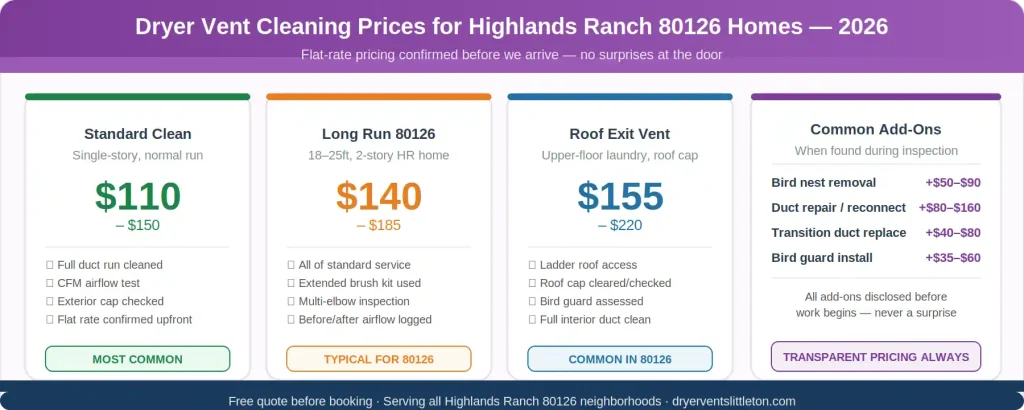
Flat-rate pricing for Highlands Ranch 80126 homes — all prices confirmed before work begins, no surprises.
| 💡 The cost comparison that should matter to every 80126 homeowner: a full service call here runs $140–$220. The average residential dryer fire causes $35,000 in property damage according to USFA data. The service call also pays for itself in lower electricity bills — a restricted dryer uses significantly more energy per load. |
What You Can Check Yourself Between Professional Visits
Two things. Both take five minutes. Neither requires tools.
First — clean the lint trap every single load. Not after every few loads. Every load. In a 22-foot vent system, any lint that bypasses the trap has a long journey ahead of it and a lot of elbow surfaces to collect on.
Second — walk outside every month and look at your vent cap while the dryer is running. If it’s a side-wall exit, you should see the flap swinging open and feel strong warm airflow. If it’s a roof exit, look up at it from the yard — in good weather, you might see heat shimmer above it. In bad weather, that’s what the annual professional inspection is for.
One more thing: if anyone moves your dryer — for any reason, for cleaning behind it, for a repair, for anything — make sure the transition duct behind the machine is in good shape afterward. Flexible duct gets compressed easily. A tech who comes to fix the dryer motor might push it back 6 inches too far without thinking about the duct. It happens constantly and it’s one of the most common causes of restricted airflow we find in 80126 homes.
About Littleton Vent Guard — Serving 80126 Since Day One
We’re not a national franchise. We’re a locally owned operation that works exclusively in the South Denver metro — Littleton, Highlands Ranch, Ken Caryl, Columbine, Southglenn, and the surrounding areas. We know 80126 construction specifically. We know the typical vent run lengths, the common elbow configurations, the roof cap types used in the Shea, Richmond American, and Meritage builds that make up most of this zip code.
CSIA-certified technicians, commercial rotary brush systems, CFM airflow verification on every job, same-day availability most days.
🏠 Free quote and service info:
Littleton Vent Guard — Professional Dryer Vent Cleaning
Questions Highlands Ranch Homeowners Ask Us
My house was built in 2002 — does it still need cleaning?
Yes. The age of the home affects the duct material, not the lint. A 2002 build in 80126 likely has a long vent run that’s been accumulating lint since the day someone first ran the dryer. The materials may be better than an older home, but the length of the run means the cleaning schedule is actually more demanding, not less.
Is a roof exit vent harder to clean than a side-wall exit?
The cleaning itself isn’t harder — the same brush equipment works on both. What’s different is the inspection. A side-wall cap can be checked from the ground during any service call. A roof cap requires someone to get on the roof, which is why we ask about this specifically when you call. Never book a company that says they can service a roof exit vent without going up to the cap. They can’t do it properly from inside the house alone.
How do I know if my 80126 home has a roof exit or a side-wall exit?
Go outside and look at all four sides of the house for a small metallic cap about 4 inches in diameter with a flap or louvered cover. That’s a side-wall exit. If you can’t find one at ground or first-floor level, your exit is on the roof — typically visible as a small raised cap near a soffit or on the slope of the roof above the second-floor laundry area. If you’re still not sure, we can confirm it at the start of your service call.
We have two large dogs. How often should we actually clean?
Every six months, reliably. Large dogs — especially breeds that shed heavily — contribute a significant amount of fine hair to the laundry. Unlike lint, this hair passes through the lint trap easily and enters the duct system. In a 20-foot 80126 vent run, it accumulates at every elbow. Six months is not conservative for this situation — it’s accurate.
The previous owners never cleaned the vent. How bad could it be?
Possibly very bad. I’ve opened vents in 80126 homes that had never been cleaned since construction — 10, 15 years of lint. The duct was functionally blocked. The dryer had been running at drastically reduced efficiency and elevated fire risk the entire time. If you’ve recently bought a home in 80126 and you don’t know the cleaning history, book a service call and inspection before assuming the system is fine. That inspection has saved several of my customers from a fire they didn’t know was coming.
Can the dryer itself cause problems if the vent isn’t cleaned?
Yes. A restricted vent forces the dryer to work harder — the motor runs longer, the heating element cycles more frequently, and internal temperatures climb above design levels. This accelerates wear on every component. Appliance repair technicians in the Highlands Ranch area see this constantly: dryers that fail prematurely because the vent was never maintained. Cleaning the vent doesn’t just prevent fires — it extends the life of a $600 to $1,200 appliance.
Serving All of Highlands Ranch and the South Denver Metro
Our service area covers the full 80126 zip code — including neighborhoods near Civic Green, Backcountry, Westridge, Southridge, Firelight, and every corner of Highlands Ranch. We also serve the adjacent zip codes: 80129, 80130, and the broader Arapahoe and Douglas County areas to the south.
📍 See our full South Metro service area: