I grew up in a 1964 ranch house on West Caley Avenue. My parents ran the same dryer for 22 years and never once thought about the vent. Neither did their neighbors. That was just how it was — you didn’t think about what you couldn’t see.
I think about it now. A lot.
Downtown Littleton is full of homes like that one. Houses built in the 1950s, 60s, 70s — solid construction, real character, actual history. But with that age comes a specific kind of problem that newer homes in Highlands Ranch or Ken Caryl simply don’t have. The vent systems in these older properties weren’t built to today’s fire codes. Some of them use materials that have been banned for decades. And a lot of homeowners have no idea.
This guide is specifically for people living in or near downtown Littleton — the older neighborhoods, the brick bungalows, the mid-century ranches. If that’s you, keep reading.
| 2–3x higher dryer fire risk in homes built before 1980. NFPA data. Older duct materials, longer runs, and no modern safety codes combine to create conditions modern homes don’t face. |
What Makes These Older Homes Different
A newer home in Littleton — built in the 1990s or later — almost certainly has a rigid metal duct running from the dryer to the exterior wall. It’s probably a straight shot, or close to it. Lint passes through. Airflow is maintained. The cleaning interval is manageable.
A home built in 1968 is a different story entirely. Here’s what you’re actually dealing with in the older neighborhoods:

The Foil Accordion Problem
Walk into the laundry room of most pre-1985 homes around downtown Littleton and look behind the dryer. There’s a good chance you’ll see a shiny, ridged, flexible tube connecting the back of the machine to the wall. That’s foil accordion duct. It was standard in residential construction for decades.
It was also banned by updated fire codes in the mid-1990s. The ridges trap lint. The material crimps and crushes easily. Under heat, it can degrade or melt. None of this is a problem in the first year. After five or ten years of use, it’s a genuine hazard.
The irony is that this duct is still in millions of homes. Nobody came around and replaced it. Homeowners just kept using their dryers and never looked.
Long Basement Runs — The Downtown Littleton Special
Here’s something specific to how homes were designed in this era: the laundry was almost always in the basement. Always. It was considered a utility space, tucked away, out of sight.
Which means the vent had to travel up. And across. And sometimes around corners before reaching an exterior wall or roof exit. Runs of 20 to 30 feet with multiple elbows were completely normal. Each elbow is equivalent to about 5 additional feet of resistance. Each foot of run is another surface where lint can collect.
Modern code allows a maximum effective length of 25 feet for a dryer duct. A lot of downtown Littleton basements — honestly — were already at or past that limit when the house was built. And nothing was ever flagged, because the code didn’t exist yet.
The Bird Nest Situation
Original vent caps on homes from this era are typically the louvered type — flat covers with horizontal slats that open when there’s airflow and close otherwise. Birds figured out years ago that the warm air coming from these caps in winter makes them ideal nesting spots. Sparrows especially.
A nest in the cap blocks anywhere from 50 to 100 percent of airflow. The dryer works harder. Temperatures rise. Lint that would normally exit starts accumulating faster. And the homeowner notices their clothes aren’t drying properly and assumes the dryer is wearing out.
It’s not the dryer. It’s usually a nest.
| ⚠️ Important: If you live in a pre-1985 home downtown and you’ve never had the duct material inspected — not just cleaned, inspected — that should happen before anything else. Cleaning a foil accordion duct isn’t the same as replacing it with a code-compliant rigid metal duct. One is maintenance. The other is a safety upgrade. |
The Era Guide: What’s Behind Your Walls by Decade
Not everyone knows exactly when their home was built — or what duct material is installed. Here’s a rough guide based on common construction practices in the downtown Littleton area by decade. Use it to understand your starting point.

Find your home’s era and understand what vent system you likely have — and how urgent the risk is.
One thing worth noting: renovated homes complicate this picture. A house built in 1962 that had its laundry room updated in 2010 might have perfectly compliant rigid duct — or it might have the original foil accordion still in the wall where nobody updated it. Renovation doesn’t automatically mean the whole vent system was brought up to code. The only way to know for sure is to have someone physically inspect it.
Before and After: What a Professional Clean Actually Does
I want to be specific about what changes after a proper professional cleaning, because “your dryer will work better” is not a satisfying answer when you’re trying to decide whether to spend $150.
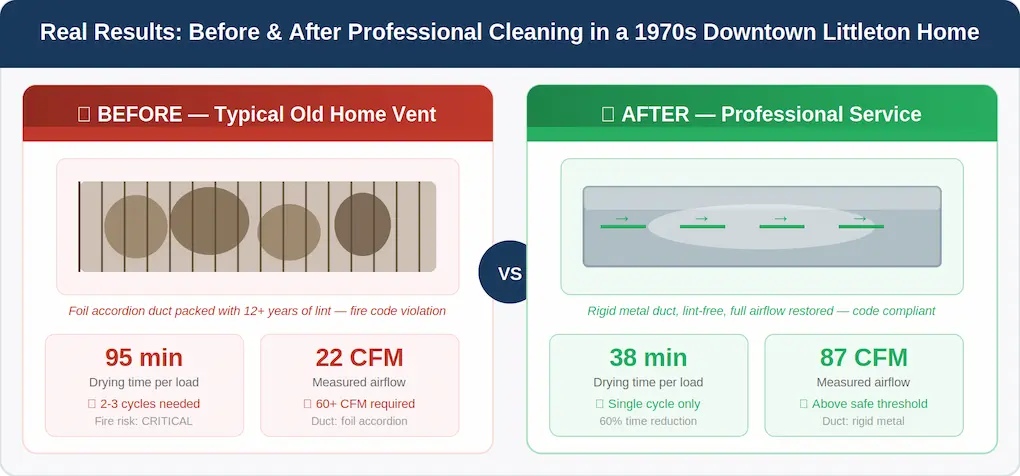
Real numbers from a 1970s downtown Littleton home — before and after professional dryer vent service.
The before-and-after numbers on older homes are often more dramatic than on newer ones. The reason is simple: longer runs, older materials, and sometimes years of accumulation mean the baseline is much worse. Drying times that take two or three cycles drop back to one. Energy bills go down noticeably. And the fire risk — which you can’t measure as easily — drops significantly.
There’s also the issue of duct material. A cleaning company that only cleans and doesn’t flag a foil accordion duct for replacement is doing half a job. A good inspection identifies whether the duct material itself is part of the problem, not just the lint inside it.
| ✅ What to ask for specifically: When you call, mention that your home is pre-1985 and ask whether their service includes a duct material assessment. You want to know whether you have rigid metal, semi-rigid, or foil accordion — and what the recommendation is. That conversation tells you a lot about how thorough the company actually is. |
Book a Vent Inspection for Your Older Littleton Home
Littleton Vent Guard works specifically in the South Denver metro. We see the older downtown homes regularly — the ranch houses on West Alamo, the bungalows near South Nevada, the split-levels off Mineral Avenue. We know what duct systems look like in these properties and we know what to check beyond just the lint.
Flat-rate pricing, confirmed before we arrive. CSIA-certified technicians. Rigid metal replacement available if needed.
👉 Schedule a dryer vent inspection in Downtown Littleton:
Dryer Vent Inspection — Downtown Littleton, CO
What It Costs for an Older Downtown Littleton Home
Older homes typically cost a bit more to service than newer ones — longer runs, more complex systems, and sometimes duct material upgrades factor in. Here’s what to expect:
| Service | Price Range | Notes |
| Standard vent clean (post-1990 home) | $110–$160 | Rigid duct, normal run length |
| Older home full inspection + clean | $140–$200 | Pre-1985, includes duct material check |
| Foil-to-rigid duct replacement | $180–$320 | Full material upgrade, code compliant |
| Bird nest removal + cleaning | $160–$240 | Common in original vent caps downtown |
| Long basement vent run (20ft+) | $150–$220 | Typical in 1960s–70s Littleton builds |
| Disconnected duct repair | $90–$180 extra | If separated joint found in walls |
| 💡 The math: A foil-to-rigid duct upgrade costs $180–$320 once. A dryer fire in a 1960s home with original construction averages $35,000 in damage according to USFA data — and that’s if it stays contained. The upgrade is the obvious choice. |
How Often Should Downtown Littleton Homes Clean Their Vents?
Newer home, standard construction: once a year is the right answer. Older home downtown? The math changes.
If your home was built before 1980, I’d recommend:
- Get a full inspection done first — before booking a routine cleaning. You need to know what you’re working with.
- Pre-1970 homes: Every 6 months, no exceptions. The duct systems in these properties simply accumulate lint faster.
- 1970–1984 homes: Once a year minimum. More if you have foil duct that hasn’t been replaced yet.
- Post-1985 with original duct: Annual cleaning plus a duct assessment every 2–3 years.
- Renovated homes: Depends on what was actually updated. Ask your tech to check the full run.
The dryer itself can tell you a lot. If clothes are taking longer than 45 minutes to dry, or if the dryer feels unusually hot to the touch, or if there’s any burning smell at all — don’t wait for the scheduled date. Call immediately.
About Littleton Vent Guard
We’re local. That’s not a marketing line — we actually work exclusively in the South Denver metro and we’ve been in enough downtown Littleton homes to know exactly what the older construction looks like from the inside. NFPA-compliant service, CSIA-certified technicians, same-day availability most of the week.
🏠 Visit our homepage for a free quote:
Littleton Vent Guard — Professional Dryer Vent Cleaning
What You Can Do Right Now — Before Calling Anyone
Two things that take five minutes and cost nothing:
First — go look behind your dryer. Right now if you want. Is the duct connecting the dryer to the wall shiny, ridged, and flexible? That’s foil accordion. Note it. When you call a service company, mention it. It changes what they need to do.
Second — go outside and find where your dryer vent exits. Run the dryer and watch the cap. It should open clearly and you should feel warm airflow. If the flap barely moves, if there’s debris around it, or if you can see nesting material — that’s your immediate problem and it needs attention before anything else.
Beyond that: clean the lint trap after every single load. Non-negotiable. An older duct system under stress doesn’t need additional lint bypassing the trap and entering the duct.
Questions We Get from Downtown Littleton Homeowners
My house is from 1971 — how do I know if I have foil accordion duct?
Pull the dryer away from the wall and look at the flexible section connecting the dryer to the wall. If it’s shiny and has ridged accordion folds, that’s foil duct. If it’s smooth silver and slightly rigid, that’s semi-rigid aluminum — better but still not ideal for long runs. If it’s a solid smooth metal pipe, you’re in good shape. Take a photo if you’re not sure and a good service company can identify it from that.
My dryer works fine — do I still need a cleaning?
Yes. The problem with dryer vent hazards in older homes is that they build gradually. The dryer “working fine” just means you haven’t hit the threshold yet where performance degrades noticeably. By the time clothes stop drying properly, the lint has been accumulating for a long time. The fire risk exists well before performance gets obviously worse.
Can I just replace the foil duct myself?
The section behind the dryer — the flexible transition piece — is a DIY job many homeowners do themselves. You can buy a code-compliant semi-rigid or rigid transition duct at any hardware store for $20–$40. But the duct running inside your walls is a different matter. Accessing it, inspecting it for disconnections, and replacing it if needed is a professional job. Don’t guess at what’s happening inside the wall.
How long does service take on an older home?
Longer than a newer home, typically. A standard cleaning on a newer property might take 45 to 60 minutes. An older home with a long basement run, a nest removal, and a duct assessment can take 90 minutes to two hours. Don’t book someone who tells you they’ll be in and out in 20 minutes on a pre-1980 home. That’s not enough time to do it right.
Is downtown Littleton specifically at higher risk than other parts of the city?
The downtown core and the neighborhoods immediately surrounding it — South Curtice, West Alamo, South Nevada, West Mineral — have a higher concentration of pre-1980 homes than areas like Highlands Ranch or Ken Caryl. That means a higher concentration of older vent systems. It’s not that downtown is special — it’s that the housing stock is older, and older housing stock has older vent systems. The risk is tied to age, not geography.
Serving Columbine Valley, Downtown Littleton & the Historic South Metro
Our service area covers the full South Denver metro — including the older neighborhoods closest to downtown Littleton. We’re familiar with the construction in Columbine Valley, along South Santa Fe Drive, and throughout the historic residential streets between Mineral and Bowles.
📍 Serving Columbine Valley area: