My brother-in-law moved here from Houston three years ago. He called me a few months in, confused. His dryer — same machine he’d used for six years in Texas — suddenly seemed to be working wrong. Clothes were damp after a full cycle. He figured the appliance was failing. He was ready to buy a new one.
I told him to hold off. I asked him one question: had the vent ever been cleaned since he moved in? He didn’t even know dryer vents needed cleaning. Within a week, we had his vent serviced, airflow tested, and the drying time dropped from 70 minutes back to 42.
The dryer wasn’t broken. The altitude was. Not in a mechanical sense — the machine worked fine. But the physics of what happens to air at 5,400 feet above sea level changes how a dryer performs, how quickly lint accumulates, and how dangerous that buildup gets. And almost nobody who moves here from a lower-elevation state gets told any of this.
This guide explains it clearly, without the physics degree. If you live anywhere on the Colorado Front Range — Littleton, Highlands Ranch, Ken Caryl, Denver, Castle Rock — this is directly relevant to your home.
| 17% less oxygen in the air at 5,400 feet compared to sea level. Thinner air means less heat transfer per cubic foot of airflow. Your dryer works harder, runs longer, and produces drier lint — all of which raise fire risk compared to lower-altitude homes. |
The Basic Physics — Why Altitude Changes Everything
Most people understand altitude in terms of what it does to the human body — you breathe harder, get winded faster, need more water. What’s less talked about is what altitude does to appliances that depend on moving air to function. Dryers are squarely in that category.
A residential dryer works by pulling ambient air into the heating element, warming it to temperatures between 125°F and 135°F, pushing that hot air through the drum to tumble and dry your clothes, then exhausting the moisture-laden air out through the vent duct to the outside. The efficiency of every one of those steps depends on air density.
What Thinner Air Does to That Process
At sea level, air is dense. A cubic foot of it contains a significant mass of molecules that can absorb and carry heat. When a dryer pushes that dense air through a load of wet clothes, it picks up a lot of moisture per cycle. Clothes dry quickly.
At 5,400 feet — which is roughly where Littleton and Highlands Ranch sit — air is about 17 percent less dense. That same cubic foot of air contains fewer molecules. Less mass means less capacity to carry heat and moisture. The dryer has to move more air, run longer, or both to achieve the same result. Manufacturers design dryers for sea level. They acknowledge this difference but rarely publish altitude-specific performance adjustments. The dryer just quietly works harder than it was designed to.

The science behind altitude’s effect on dryer airflow — and what it means in your laundry room.
What This Means for Your Vent
Here’s where it gets practical. Because the dryer runs longer cycles to achieve the same drying result, the vent carries more air volume per load of laundry. More air volume means more lint-carrying capacity — which sounds like a good thing but isn’t, because the longer operating time also means more lint detaches from clothing per cycle.
The net result: lint accumulates in the duct faster than the same dryer would in a lower-altitude state. A house in Georgia might comfortably go 14 months between vent cleanings. The same house, same dryer, same laundry habits in Littleton should be cleaned every 8 to 10 months. In Highlands Ranch at 5,830 feet? Closer to six to eight.
That difference isn’t a sales pitch for more frequent service. It’s a straightforward consequence of physics. The interval has to match the accumulation rate, not a calendar someone printed in a home with different air.
| 💡 Practical test: Next time you run the dryer, note the time from start to when the clothes feel fully dry. If it’s consistently over 50 minutes for a normal mixed load, altitude is a factor. If it’s over 65 minutes, something else is also going on — likely lint accumulation in the duct compounding the altitude effect. |
Dry Colorado Air and the Lint Ignition Problem
The altitude issue has a second component that’s independent of the airflow problem but compounds it in the worst possible way: humidity.
Colorado is one of the driest states in the country. The Denver metro averages around 43 percent relative humidity annually. Highlands Ranch runs slightly drier. Castle Rock and the higher-elevation south suburbs drier still. In winter, particularly during Chinook wind events, indoor humidity can drop to 20 percent or lower.
Why Humidity Matters for Lint
Lint produced in a humid environment absorbs some of that ambient moisture. It stays slightly damp — heavier, more prone to clumping, and significantly harder to ignite. This is why coastal states, despite having their own dryer fire issues, don’t see the same ignition rate per incident of blockage that Colorado does.
Lint in a 40 percent humidity environment — which is average for the Front Range — is almost completely dry by the time it reaches the duct. It’s light, brittle, and distributes easily. When a partial blockage causes a buildup at an elbow or restriction point, that lint is highly flammable. It sits at elevated temperature from the dryer exhaust, and it needs relatively little additional heat to ignite.
Put simply: the same quantity of lint represents more fire risk in Littleton than it would in Charlotte, North Carolina. Not because the lint is different, but because the environment made it more dangerous before it ever left your dryer.
| ⚠️ This is why the NFPA’s “clean once a year” recommendation is a national average, not a Colorado-specific figure. The NFPA itself acknowledges that high-use and high-risk environments should shorten that interval. High altitude, low humidity, and longer vent runs all qualify as high-risk factors. All three are present in most Front Range homes. |
Colorado vs Sea Level: The Numbers Side by Side
My brother-in-law asked me to explain this concretely, because the concept made sense but he wanted to see what it actually meant in numbers. Here’s the comparison I gave him, which I’ve since put together more formally.
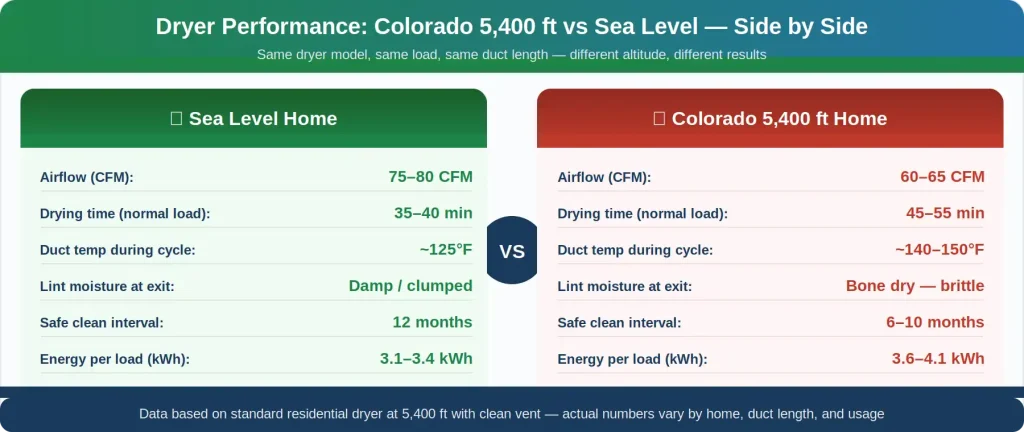
Same dryer, same load, same duct length — different altitude, different results. The gap is real and measurable.
The drying time difference matters because it directly translates to operating cost and wear. A dryer running 45 to 55 minutes per load instead of 35 to 40 uses more electricity — somewhere in the range of 15 to 20 percent more per load, depending on the specific machine. Over a year of average household use, that’s a measurable increase in the utility bill.
The duct temperature difference is the safety issue. A duct running at 140 to 150 degrees Fahrenheit with dry Colorado lint in it is operating much closer to the ignition conditions that cause dryer fires than the same duct at 125 degrees with damp coastal lint. The margin between “safe” and “dangerous” is smaller here.
And the clean interval difference is what most homeowners in the Front Range are getting wrong — not out of negligence, but because nobody told them the standard doesn’t apply to their situation.
Which Colorado Cities Need the Most Frequent Service
Altitude varies significantly across the Front Range. This matters because the effect isn’t uniform — the higher the city, the more pronounced the impact on dryer performance and lint risk. Here’s how the major areas compare.
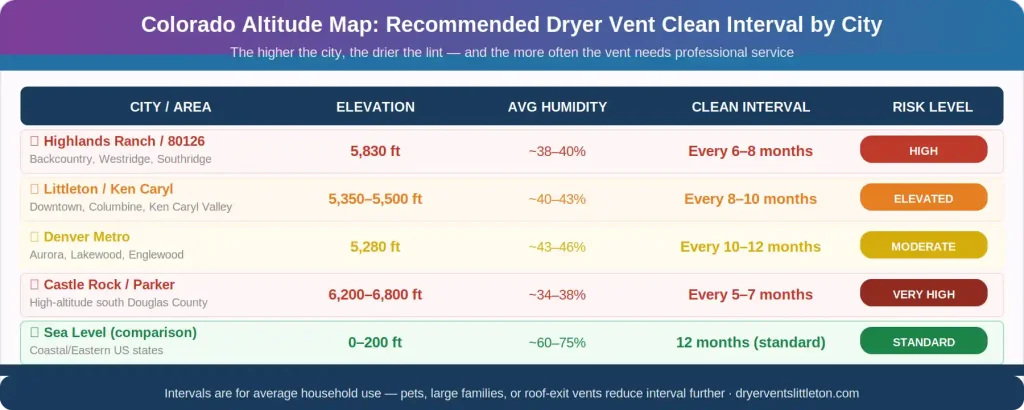
Recommended cleaning intervals by Colorado city — altitude and humidity determine how often your vent actually needs service.
Castle Rock and Parker homeowners often get the same advice as Denver metro residents and follow a once-a-year schedule. Given the elevation difference of nearly 1,500 additional feet, that’s almost certainly not frequent enough for households with heavy dryer use. A family in Castle Rock with kids doing sports laundry three times a week should seriously consider a six-month schedule.
The other factor this table doesn’t show is vent run length. A short, straight vent in a Highlands Ranch home is a different situation from a 25-foot run with three elbows. The city gives you the altitude baseline. Your specific vent geometry adjusts it from there.
Get Your Colorado Home’s Vent Cleaned on the Right Schedule
We work exclusively in the South Denver metro. Every service call we do includes a CFM airflow measurement — that’s the cubic feet per minute reading that tells us objectively how well the vent is performing. We’ve measured enough Colorado homes to know what a clean vent reads at this altitude, what a partially blocked one reads, and what a dangerous one reads. The difference isn’t subtle.
If you haven’t had the vent cleaned in the last 10 months and you live anywhere in Arapahoe or Douglas County — this is worth booking. Not because something is definitely wrong, but because at this altitude, the interval is shorter than most people think and the consequences of waiting are worse.
👉 Schedule your service:
Residential Dryer Vent Cleaning — Littleton, CO
What You Can Do Right Now to Manage the Altitude Effect
A few things that actually help and cost nothing.
Check Your Drying Time Honestly
Set a timer the next three or four times you run the dryer with a typical mixed load. Write the numbers down. If the average is consistently over 50 minutes, something is working against you — altitude, lint, or both. A clean vent can’t change the altitude, but it eliminates the lint factor and brings your times as close to the designed specification as possible.
Clean the Lint Trap Every Single Load
This is the one habit that has the most direct impact on duct accumulation rate. In Colorado’s dry air, lint that makes it past the trap is bone dry and light — it travels further into the duct and deposits more easily at elbows and restrictions. The trap catches the majority of lint before it becomes a duct problem. Don’t give it an opportunity to bypass.
External Vent Cap Check — Monthly
Go outside while the dryer is running and check the exterior cap. In Colorado, two additional things to watch for beyond the standard checks: first, ice. In winter, moisture condensing inside a partially blocked duct can freeze at the cap, creating a blockage that shows up seasonally. Second, blowing debris. Strong Front Range winds push organic material into louvered caps. Check and clear it.
Know Your Vent Run Length
If you don’t know how far your vent travels before it exits the house, find out. Pull the dryer out and look at the transition duct — where does it go from there? Ask whoever services your home. This number combined with your altitude gives you a more precise cleaning interval than any generic guideline can.
About Littleton Vent Guard
We’re locally owned, South Metro only. We don’t use national franchise pricing or generic service schedules that were designed for sea-level homes. Every customer gets a CFM reading specific to their vent system and an interval recommendation based on their altitude, vent length, and household usage — not a corporate pamphlet.
🏠 Homepage and free quote:
Littleton Vent Guard — Colorado Dryer Vent Specialists
Questions About Altitude and Dryer Vents
Does altitude actually affect how my dryer works, or is that just a theory?
It’s measurable, not theoretical. Appliance technicians in Colorado regularly find that dryers are running longer cycles than their specifications say they should — even when the machine is in perfect mechanical condition and the vent is clean. The culprit is air density. Less dense air moves less heat and moisture per unit volume, so the cycle takes longer. Some appliance brands sell altitude adjustment kits for gas dryers to compensate for this. Electric dryers don’t have an equivalent adjustment.
My dryer has worked fine for years in Colorado — does this still apply?
“Fine” is doing a lot of work in that sentence. If the dryer runs and clothes eventually dry, it’s working. But “working” in Colorado often means running longer cycles than the same machine would run at sea level, using more electricity, and generating more heat in the duct. You’ve adapted to the new normal without realizing the baseline shifted when you moved here — or when the vent gradually accumulated enough lint to amplify the altitude effect.
I moved here from Texas. Should I immediately change my cleaning schedule?
Yes. If you were on an annual schedule before, drop it to 8 to 10 months for the Front Range — and closer to 6 if you’re in Highlands Ranch or Castle Rock elevation. The lint accumulation rate is faster here, and the ignition risk from that lint is higher. The interval adjustment isn’t dramatic, but it matters over time.
Does the altitude problem get worse in winter?
In some ways, yes. Colorado winters are drier than summers — humidity drops significantly, sometimes below 20 percent indoors during Chinook periods. Lint produced in these conditions is even more desiccated than usual. Vent systems also face the additional risk of condensation-freeze at the exterior cap when a partial blockage traps moist exhaust air near the exit point. Winter is a good time to make sure the system was cleaned in the fall.
Will a longer or more efficient dryer duct design help offset the altitude effect?
Shorter is better, up to a point. Reducing unnecessary elbows and keeping the duct run as direct as possible improves airflow. It doesn’t change air density, but it reduces the resistance the dryer is working against — which partially compensates for the altitude disadvantage. Rigid metal duct instead of flexible accordion also helps, because smooth-walled duct creates less turbulence and less surface area for lint to catch on. Neither of these eliminates the altitude factor, but they’re meaningful improvements.
Serving Littleton, Highlands Ranch, Ken Caryl and All of South Denver
Our full service area covers Littleton, Highlands Ranch 80126, Ken Caryl Valley, Columbine, Southglenn, Sterling Ranch, Lone Tree, Parker, Castle Rock, and the surrounding communities. Every one of these sits at altitude. Every one of them deserves service intervals calibrated to where they actually are, not where dryer manuals assume they are.
📍 Serving Highlands Ranch and surrounding areas: