
By Admin / June 4, 2026
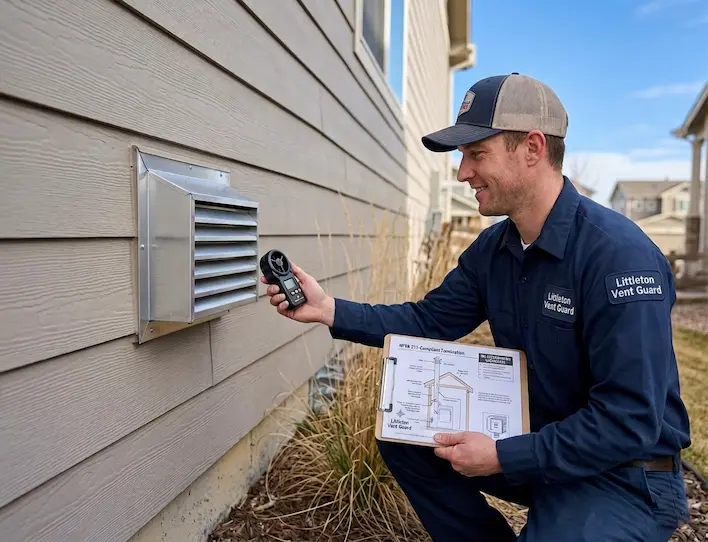
Your residential dryer vent must comply with NFPA 211, the National Fire Protection Association’s standard specifically governing chimneys, fireplaces, vents, and solid fuel burning appliances, which includes detailed requirements for clothes dryer exhaust systems. NFPA 96, by contrast, governs commercial kitchen ventilation systems, not residential dryers. The reason both numbers appear in conversations about dryer vents is that some certified technicians and inspection professionals reference NFPA 96 in the broader context of combustion appliance venting requirements, and some commercial laundry contexts do fall under that standard. For a homeowner in Littleton whose concern is their residential dryer, NFPA 211 is your primary reference document, alongside the International Residential Code Section M1502 and Colorado’s adoption of those codes.
This distinction matters because understanding which standard applies to your home is the starting point for understanding whether your system is actually compliant.
Why These Standards Exist and Why They Have Real Consequences
The NFPA does not create standards for paperwork purposes. Every specific requirement in NFPA 211 traces back to fire investigation data, engineering analysis, or both. The U.S. Fire Administration reports approximately 2,900 residential dryer fires annually in the United States, and the NFPA consistently identifies failure to clean and improper installation as the leading contributing factors.
The standards are the codified response to those findings. They establish the minimum conditions under which a dryer vent system can operate without creating an unacceptable fire risk, regardless of how frequently the homeowner cleans the lint trap or how new the appliance is.
For Littleton homeowners, compliance matters on several levels. First, it is a genuine safety issue. A system that exceeds the maximum equivalent duct length or uses non compliant materials accumulates lint faster, restricts airflow more aggressively, and presents a higher fire risk than a system built to code, even with regular cleaning. Second, it has insurance implications. Colorado homeowner’s insurance policies increasingly reference appliance maintenance and installation compliance in their terms. A fire that occurs in a home where the dryer vent system is found to be out of compliance at the time of investigation can complicate a claim in ways that proper installation would have prevented. Third, it affects property sale. Home inspectors are trained to identify NFPA 211 and IRC M1502 violations, and a flagged dryer vent installation can become a negotiation issue or a required repair before closing.
The Two Standards Explained: What NFPA 211 and NFPA 96 Actually Cover
NFPA 211 is the Standard for Chimneys, Fireplaces, Vents, and Solid Fuel Burning Appliances. Chapter 10 of NFPA 211 specifically addresses vents, and Section 10.7.3 covers residential clothes dryer exhaust systems in detail. This is the primary standard governing dryer vent installations in residential properties across the United States, including Colorado.
NFPA 211 establishes requirements for duct material, wall thickness, interior surface quality, maximum system length, elbow deductions, transition duct specifications, exterior termination requirements, and maintenance intervals. When a certified dryer vent technician references NFPA compliance during a residential service visit, NFPA 211 is the document they are working from.
NFPA 96 is the Standard for Ventilation Control and Fire Protection of Commercial Cooking Operations. This standard governs exhaust systems in commercial kitchens, restaurant hoods, grease duct assemblies, and related cooking equipment ventilation. It does not govern residential dryer vents. However, NFPA 96 is referenced in commercial laundry contexts, such as laundromats, hotel laundry facilities, and multi family building laundry rooms, where the scale and type of equipment may trigger commercial rather than residential standards.
If you have ever seen NFPA 96 cited alongside dryer vent discussions, it is typically in one of three contexts: a technician who works across both residential and commercial equipment and references both standards habitually, a multi family or commercial property where commercial equipment is installed, or a general fire safety conversation in which both standards are mentioned in the broader context of NFPA venting requirements.
For a single family home or condominium in Littleton, NFPA 211 is the governing document. IRC Section M1502 is the residential building code that references and incorporates those requirements. Colorado has adopted the International Residential Code, meaning these standards carry the force of state and local building code in Arapahoe County.
NFPA 211 Requirement 1: Duct Material
The standard is specific and non negotiable on this point. Clothes dryer exhaust ducts installed in walls and ceilings must be constructed of rigid metal with a minimum wall thickness of 0.016 inches, which corresponds to 28 gauge sheet metal. The interior surface must be smooth. Joints must run in the direction of airflow rather than against it, which prevents lint from snagging at joint edges as it travels through the duct.
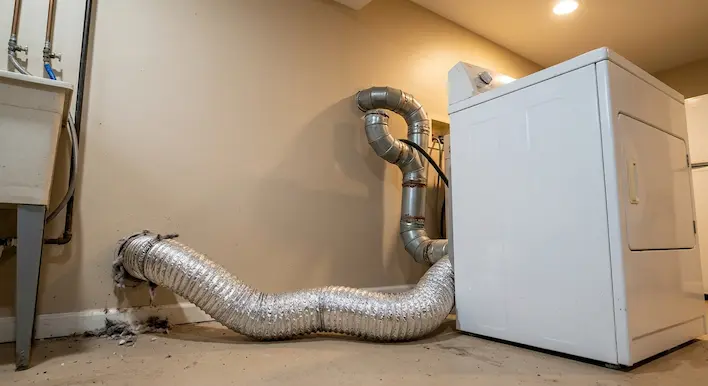
Flexible plastic accordion duct is explicitly prohibited. Flexible metallic foil duct is prohibited for the permanent duct run inside walls and ceilings. Neither material is acceptable under NFPA 211 for the fixed duct system. The reasons are straightforward: ribbed interior surfaces trap lint at every ridge along their length, which accelerates blockage accumulation far more rapidly than a smooth metal duct. Plastic and foil materials have lower ignition thresholds than rigid metal. Flexible materials are easily crushed or kinked, creating flow restrictions that rigid metal does not.
The transition duct, which is the flexible section connecting the back of the dryer to the fixed wall duct, has its own separate specification. This section is allowed to be flexible, but it must be listed to UL 2158A, must be made of metal rather than plastic or foil, must not exceed 8 feet in length, and must not be concealed inside walls or ceilings. The UL 2158A listing means the specific product has been tested and certified for dryer exhaust use, which standard flexible foil duct sold in bulk rolls is not.
This is one of the most common compliance failures in homes across Littleton and Arapahoe County, particularly in homes built before 2000 when flexible foil was widely used and installation standards were less consistently enforced. If your home still has a flexible foil or plastic accordion transition hose behind the dryer, that section of your installation is out of compliance with current standards.
Sheet metal screws are also specifically prohibited inside the duct. A screw tip protruding into the duct interior creates a lint catch point. Every screw inside the ductwork is a location where lint wraps around the protruding tip, accumulates, and eventually contributes to a blockage. Duct connections must be made with smooth interior joints rather than fasteners that intrude into the airflow path.
NFPA 211 Requirement 2: Maximum Equivalent Duct Length
This is the requirement that surprises the most homeowners, particularly those in multi story homes or properties where the laundry room is not adjacent to an exterior wall.
NFPA 211 sets the maximum length of a clothes dryer exhaust duct at 35 feet from the dryer connection to the exterior termination point. That 35 feet is not simply a tape measure distance. It is an equivalent length calculation that accounts for the additional flow resistance created by every directional change in the system.
The calculation works as follows. You start with the actual straight run length of the rigid duct from the wall entry point to the exterior exit. To that number, you add 5 feet for every 90 degree elbow in the system, and 2.5 feet for every 45 degree elbow. The result is the equivalent length. If that number exceeds 35 feet, the system does not comply with NFPA 211 regardless of how clean or well constructed it is.
Here is a worked example. A home in Ken Caryl has the dryer on the second floor in an interior laundry closet. The rigid duct runs 20 feet of straight pipe before reaching the exterior wall exit. Along that run, there are two 90 degree elbows. The calculation is 20 feet of straight run, plus 5 feet for the first 90 degree elbow, plus 5 feet for the second 90 degree elbow, producing an equivalent length of 30 feet. That system is within the 35 foot limit and is compliant. If the builder had added one more 90 degree elbow, the equivalent length would become 35 feet exactly, which is at the limit. One more elbow beyond that would push it to 40 feet of equivalent length, which exceeds the standard.
The transition duct behind the dryer is not included in this equivalent length calculation, which is why that section has its own separate 8 foot maximum. The 35 foot limit begins at the wall entry point where the fixed rigid duct starts.
If your dryer manufacturer’s installation instructions specify a shorter maximum duct length than the NFPA 211 standard, the more restrictive requirement governs. Some manufacturers specify 25 or 28 feet rather than 35. In those cases, NFPA 211 allows the manufacturer’s specification to take precedence.
When a system is found to exceed the maximum equivalent length, cleaning alone cannot make it compliant. The only solution is physical rerouting of the duct to shorten the run, elimination of elbows, or in some cases both. Our Professional Vent Repair and Rerouting service addresses exactly these situations, evaluating the existing run and determining the most practical path to a compliant, shorter configuration.
NFPA 211 Requirement 3: Exterior Termination
The exterior termination point, which is where the dryer duct exits the building and opens to outside air, has specific requirements under NFPA 211 and IRC M1502 that are frequently misunderstood or ignored during installation.
The termination must be to the outside of the building. Dryer exhaust cannot terminate into an attic, a crawl space, a garage, or any enclosed interior space. It must exit to open exterior air. Terminating into an attic or crawl space is a code violation that has caused structural damage and mold contamination in homes across Colorado where it has occurred.
The exterior vent cap must be equipped with a backdraft damper, which is the spring loaded flap that opens under positive airflow pressure when the dryer is running and closes when the dryer stops. This damper prevents outside air, pests, and precipitation from entering the duct when the dryer is not in use.
Critically, the exterior vent cap must not have a screen. This is counterintuitive to many homeowners who assume that a screen keeps birds and insects out while still allowing airflow. The problem is that lint traveling through the exhaust air catches on screen mesh and rapidly creates a dense blockage. A screened vent cap can be completely obstructed within a few months of installation. The code explicitly prohibits screens at the termination point specifically because of this documented lint accumulation hazard. Pest exclusion at the exterior vent, if needed, must be achieved with a properly designed guard rather than a screen mesh.
The termination must also be positioned a minimum of 3 feet from any door, window, or vented soffit, unless the dryer manufacturer’s instructions specify a different clearance. This prevents the hot, humid exhaust air from being drawn back into the building through operable openings.
In Colorado’s spring and summer months, house sparrows and European starlings regularly attempt to nest inside unprotected exterior vent openings. A nest forming inside the vent cap or just inside the duct opening presents both a blockage hazard and a code compliance issue, as it physically obstructs the backdraft damper and prevents it from functioning. Our Bird Nest Removal and Guard Installation service addresses active nesting situations and installs compliant guards that exclude wildlife without creating the lint catch problem that screens create.
NFPA 211 Requirement 4: Duct Supports and Penetration Sealing
Two requirements in NFPA 211 that rarely make it into homeowner facing content are worth knowing.
Duct supports must be installed at intervals that prevent sagging. The practical standard observed in professional installations is a duct support every 4 feet of horizontal run. Sagging ductwork creates low points where condensation collects and lint settles into pools rather than being carried through to the exterior. Over time, a sagging duct section accumulates a dense, moist blockage that is significantly harder to remove than evenly distributed dry lint.
Where the dryer duct penetrates a wall or ceiling assembly, the annular space around the duct must be sealed with noncombustible material, approved fire stop caulking, or a code compliant dryer duct wall receptacle. This sealing requirement exists because an unsealed penetration creates a pathway through which fire can travel from one building assembly to another. It also allows conditioned air to escape and unconditioned air to enter, affecting both energy efficiency and duct performance.
NFPA 211 Requirement 5: System Independence
The dryer exhaust duct must be an independent system. It cannot be combined with any other mechanical exhaust system in the building, which means it cannot share ductwork with bathroom exhaust fans, kitchen range hoods, HVAC return air systems, or any other ventilation equipment.
This requirement exists because combining dryer exhaust with other ventilation systems creates cross contamination risks, back pressure problems that affect all connected systems, and a direct pathway for lint to enter systems where it does not belong. In some older Colorado homes, particularly those built during periods of less rigorous code enforcement, combined exhaust arrangements are occasionally found. If your installation shares any ductwork with another system, it requires separation before it can be considered compliant.
Airflow Performance: The Measurement Standards That Confirm Compliance
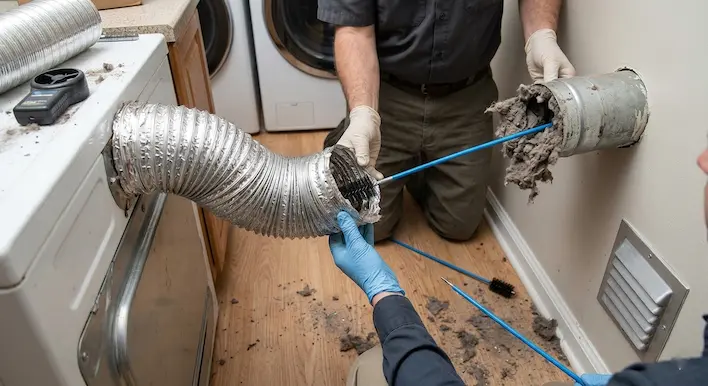
Meeting NFPA 211’s installation specifications is necessary but not sufficient to confirm that a dryer vent system is performing safely. A system can use compliant materials, fall within the maximum equivalent length, and have a proper exterior termination while still underperforming due to accumulated lint, duct damage, or installation defects. This is why airflow measurement is an essential component of a legitimate professional service.
The accepted performance standard for a residential dryer vent system is an airflow velocity at the exterior termination point of at least 1,500 feet per minute, measured with a vane anemometer. Some technicians also measure static pressure inside the duct using a Magnehelic gauge. The acceptable static pressure for a compliant system is less than 0.6 inches of water column. A reading above that threshold indicates restriction, regardless of whether the duct materials and dimensions technically meet code on paper.
These two measurements together tell you whether the system is actually functioning as designed. A duct that measures 28 feet of equivalent length (within the 35 foot limit) but has accumulated two years of lint buildup may produce an airflow velocity well below 1,500 feet per minute. It is installation compliant but operationally non compliant. A proper professional cleaning paired with a post service airflow test confirms both installation compliance and operational performance.
Our Comprehensive Safety Inspection and Diagnostics service includes both pre and post service airflow measurement with documented results, giving you objective confirmation of system performance rather than a verbal assurance.
Colorado Specific Code Context for Arapahoe County Homeowners
Colorado has adopted the International Residential Code, which incorporates the dryer vent requirements of IRC Section M1502. Those requirements align closely with NFPA 211 and in some specifications reference NFPA 211 directly. Arapahoe County and the City of Littleton enforce these standards through the building permit and inspection process for new installations and permitted modifications.
One Colorado specific consideration is the altitude factor. Littleton sits at approximately 5,351 feet above sea level. At this altitude, air is thinner than at sea level, which means that the volumetric airflow moving through the duct at any given velocity contains less mass per cubic foot than the same airflow at sea level. The practical implication is that a duct system performing at the minimum compliant airflow threshold at sea level may be performing somewhat below that threshold at Littleton’s elevation when the same physical conditions are applied. This is not explicitly addressed in NFPA 211, which was developed with sea level conditions as its baseline.
What this means for Littleton homeowners is that duct systems performing close to the minimum airflow threshold are worth watching more carefully than systems with clear airflow headroom. A system that tests at 1,600 feet per minute at sea level might be a comfortable margin above the 1,500 feet per minute standard. The same physical system in Littleton’s thinner air may produce readings closer to the threshold and be more susceptible to performance degradation from partial lint accumulation.
It is one of the practical reasons why dryer vent cleaning in Littleton should not be deferred until problems become obvious. The performance margin is narrower here than the standards were designed to guarantee.
Common Compliance Violations Found in Littleton Area Homes
Based on what certified technicians regularly encounter during inspections across Highlands Ranch, Southglenn, Heritage Village, Columbine Valley, and Ken Caryl, these are the most frequently identified non compliance issues in existing residential dryer vent systems.
Flexible foil or plastic transition hose used for the fixed duct run. This is the single most common violation in homes built between 1980 and 2005. The material was widely available, inexpensive, and easy to install, so many builders and handymen used it for the full duct run rather than only the short transition section where it is permitted.
Equivalent duct length exceeding 35 feet. Multi story homes with interior laundry rooms or second floor laundry closets are particularly vulnerable to this violation. A dryer on the second floor that must vent down through one floor and then horizontally to an exterior wall can accumulate equivalent length quickly, especially if the builder took a convenient rather than optimal routing path.
Screen installed at the exterior vent cap. This is frequently found in homes where pest prevention was prioritized during construction without awareness of the lint blockage hazard that screens create.
Sheet metal screws used inside the duct. Found in homes where the installer used screws to connect duct sections rather than crimped fittings or approved duct tape, leaving protruding tips inside the airflow path.
Duct terminating into a garage or attic. Less common than the above but found occasionally, particularly in basement laundry rooms where a garage or crawl space was the closest accessible exterior route.
Transition duct exceeding 8 feet. Some installations use a longer flexible transition section to accommodate dryer positioning, which keeps the fixed ductwork inside the wall shorter while creating a transition section that itself exceeds code limits.
If any of these conditions describe what you have seen behind your dryer or what was reported during a home inspection, our Residential Dryer Vent Cleaning service includes a full compliance assessment as part of the inspection process, and our repair team handles the physical corrections needed to bring the system into compliance.
What Happens When Your System Is Found Out of Compliance
Finding out that your dryer vent installation does not meet NFPA 211 requirements is not a crisis. It is information that allows you to make the system safer.
The response depends on the specific violation. Material violations, such as non compliant flexible duct in the wall run or a screened exterior cap, are typically addressed by replacing the offending component. The cost is generally modest compared to the safety benefit. Transition hose replacement from flexible foil to a UL 2158A listed metal hose is a straightforward task. Exterior cap replacement to remove the screen and install a proper damper only cap is similarly accessible.
Length violations are more involved because they require rerouting some or all of the duct to shorten the equivalent length to below 35 feet. Depending on the home’s layout and where the excess length exists, this may mean eliminating one or more elbows by taking a more direct routing path, or it may mean extending the duct to a closer exterior exit point rather than the one the original installer chose. For homes in Columbine Valley and Sterling Ranch with multi story layouts, these rerouting projects benefit from a professional evaluation before any work begins to ensure the new routing achieves compliance within the constraints of the home’s structure.
Our Professional Vent Repair and Rerouting service covers these assessments and the physical installation work, with results documented against NFPA 211 and IRC M1502 standards.
For homeowners in Dryer Vent Cleaning Highlands Ranch or Dryer Vent Cleaning Southglenn communities who are preparing a property for sale, addressing any identified compliance issues before listing avoids the situation where a home inspector flags the dryer vent and the buyer requests repairs as a condition of sale. A documented compliant installation with a recent professional cleaning is a stronger position than an unknown system that a buyer’s inspector will scrutinize.
How Often a Code Compliant System Still Needs Professional Cleaning
Meeting NFPA 211 installation standards does not mean the system maintains itself. A fully code compliant dryer vent installation will still accumulate lint over time. The standards set the installation conditions for safe operation. Regular maintenance is what keeps the system performing within those conditions over its service life.
NFPA 211 references the dryer manufacturer’s instructions for maintenance intervals and generally supports annual professional cleaning for systems in regular residential use. The CPSC (Consumer Product Safety Commission) and the manufacturer documentation for most major dryer brands align with the annual service interval for average household use, with more frequent service recommended for high volume use, pet owning households, or duct configurations with longer equivalent lengths.
For the communities we serve across Arapahoe County, including Dryer Vent Cleaning Ken Caryl, Dryer Vent Cleaning Heritage Village, and Dryer Vent Cleaning Columbine Valley, we include a compliance check as part of every service visit. If we identify an installation issue alongside the routine cleaning, we document it and discuss the options with you before any additional work is performed.
Frequently Asked Questions
Does NFPA 96 apply to my home dryer vent?
No. NFPA 96 governs commercial cooking ventilation systems. Your residential dryer vent is governed by NFPA 211, Chapter 10, Section 10.7.3, alongside IRC Section M1502. If someone references NFPA 96 in the context of your home dryer vent, it is worth clarifying which standard they are applying and why.
How do I calculate whether my duct system is within the 35 foot equivalent length limit?
Start by estimating or measuring the straight pipe run of your fixed rigid duct from the wall entry point to the exterior exit. Then count the number of 90 degree elbows and multiply each by 5, and the number of 45 degree elbows and multiply each by 2.5. Add the straight run measurement to the elbow deductions. If the total is 35 feet or less, you are within the NFPA 211 limit. If it exceeds 35 feet, the system requires rerouting to achieve compliance.
My home was built in 1995 and has never had the dryer vent inspected. How likely is it to have compliance issues?
Reasonably likely for at least one issue. Homes built in the early to mid 1990s frequently have flexible foil duct in the fixed run, screened exterior vent caps, and in some cases sheet metal screws inside the duct connections. Code enforcement was less consistent during that period, and materials that are now prohibited were widely used. A professional inspection will identify what is present and what, if anything, requires correction.
Does a code compliant installation mean I do not need to clean the vent?
No. Compliance means the system is installed in conditions that minimize fire risk per NFPA 211 standards. It does not prevent lint accumulation. Annual professional cleaning of a code compliant system is still necessary and is recommended by both the NFPA and most dryer manufacturers.
Can a home inspector require me to bring my dryer vent into compliance before a sale?
A home inspector documents conditions and provides a report. They do not legally require repairs. However, a buyer who receives an inspection report noting code violations in the dryer vent installation can use those findings to request repairs as a condition of the purchase agreement. Whether you are required to comply depends on the terms of your specific purchase agreement and local real estate practice.
Is a commercial laundry in my multi family building subject to NFPA 96 or NFPA 211?
It depends on the equipment type. Residential style dryers in a laundry room serving a residential building are typically governed by NFPA 211 and applicable residential or multi family building codes. Commercial type dryers in a laundry facility may fall under NFPA 96 or specific commercial mechanical code provisions. Our Commercial and Multi Family Vent Maintenance service includes an assessment of which standards apply to your specific equipment and installation, ensuring compliance with the correct governing standard.
Understanding NFPA 211 and its residential dryer vent requirements is not just a technical exercise. It is the foundation for knowing whether your home’s dryer exhaust system is actually as safe as it should be, and for making informed decisions when something is found to be out of compliance. A compliant installation paired with regular professional maintenance is the combination that produces the best safety outcome over the long term.
If you would like a compliance assessment for your Littleton area home, you can reach us through our contact page or review our full service offering at our services overview.