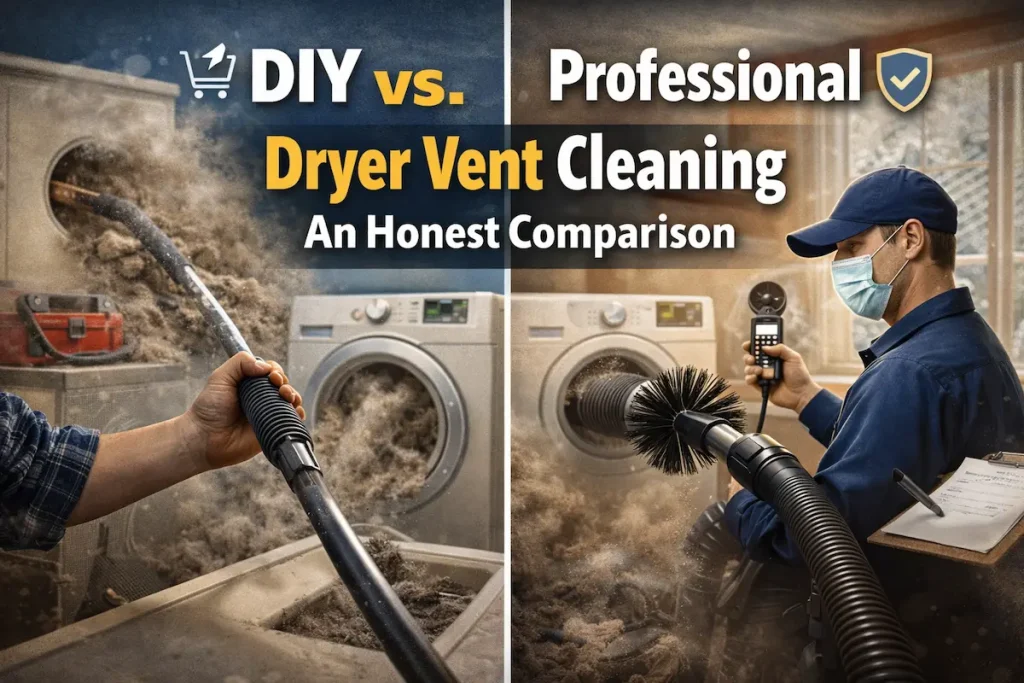
For most Littleton homeowners, DIY dryer vent cleaning is fine for routine surface maintenance but genuinely falls short when it comes to deep cleaning, airflow verification, and identifying hidden duct problems. That is the honest answer. This post is not going to tell you that you absolutely need to hire a professional every single time, and it is not going to pretend that a store bought brush kit does the same job as a trained technician with a rotary brush system and an anemometer. The truth sits somewhere in the middle, and understanding where that middle is will help you make a smart decision for your home.
Let us walk through both approaches properly, side by side, so you know exactly what you are getting with each one.
Why This Decision Actually Matters
Before comparing the two approaches, it is worth spending a moment on what is actually at stake.
The U.S. Fire Administration tracks approximately 2,900 residential dryer fires every year in the United States. The National Fire Protection Association identifies failure to clean as the leading cause of those fires, ahead of mechanical failure, electrical malfunction, and every other factor. The lint that accumulates inside your vent line is not just a performance issue. It is a highly flammable organic material that dries out over time and sits adjacent to an appliance generating sustained heat in every single drying cycle.
In Colorado, the stakes are slightly higher than the national average. Littleton sits at over 5,300 feet above sea level in one of the driest climates in the country. Lint dries out faster here, becomes more brittle, and is more easily ignited at lower temperatures than lint in humid coastal or southern states. That is not an argument against DIY cleaning. It is context for why whatever method you choose needs to actually work.
What DIY Dryer Vent Cleaning Actually Involves
DIY cleaning refers to any approach where the homeowner handles the vent maintenance without professional equipment or certified technicians. In practice, this means one of a few methods.
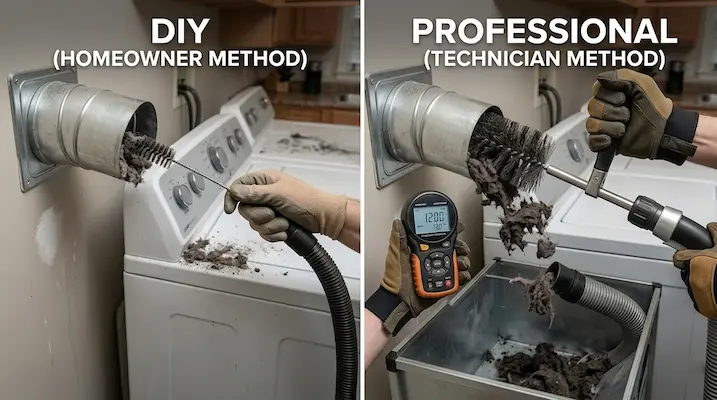
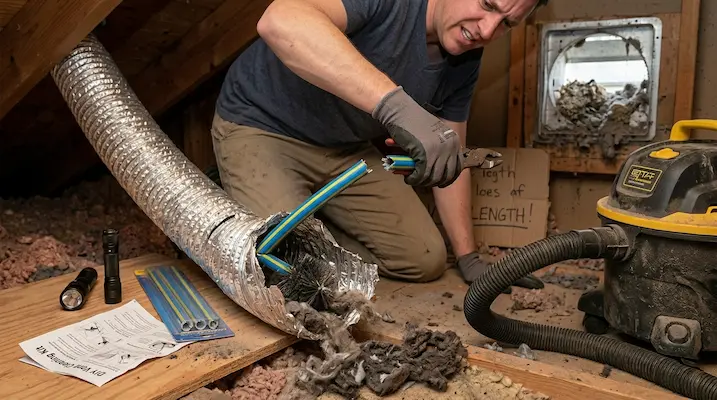
The most common is a consumer dryer vent cleaning kit, which typically includes a set of flexible rod sections that connect together and a brush head sized for standard 4 inch duct diameter. The rod connects to a standard household drill and is fed into the duct from either the dryer end or the exterior termination point, or both. As the drill rotates the brush, it dislodges lint from the interior duct walls. The loosened material falls or is pushed toward one end of the duct, where it can be vacuumed out with a standard shop vacuum or household vacuum.
Some homeowners use a vacuum only approach, inserting a shop vacuum hose into the accessible sections of the duct without any brush. Others use a leaf blower inserted at the dryer end to push debris toward the exterior exit. Both of these methods have significant limitations we will cover shortly.
Beyond the duct itself, DIY maintenance should include cleaning the lint trap before every load, vacuuming the lint trap housing channel periodically, and visually inspecting the exterior vent cap for debris or obstructions every few weeks.
What DIY Cleaning Does Well
For homes with short, straight vent runs under roughly 10 to 12 feet with no bends and a clear exterior exit, a quality DIY kit used correctly can remove a meaningful amount of lint accumulation between professional service intervals. Used as a supplemental habit rather than a replacement for professional cleaning, DIY maintenance adds genuine value.
It is also cost effective in the near term. A quality consumer brush kit runs between $25 and $50 at most hardware stores. For a homeowner who already owns a suitable drill and shop vacuum, the per use cost is minimal.
DIY cleaning also allows you to catch obvious warning signs between professional visits. If you pull out your dryer to check the transition hose and notice the flexible section behind the appliance is visibly packed with lint or showing heat damage, that is information you can act on immediately rather than waiting for your next scheduled service.
Where DIY Cleaning Falls Short
This is the part that most comparison articles gloss over, and it is worth being specific.
Coverage depth is the core limitation. Consumer brush rod systems have a practical working length limit. Most kits top out at 12 to 24 feet of total rod extension, and that assumes a straight run with no binding. In homes with 90 degree elbows, the brush head tends to lose wall contact at the inside of the bend. Rather than scrubbing the elbow interior, the brush simply passes through the center channel. That means the exact locations where lint accumulates most aggressively (the inside corners of directional changes) are precisely where DIY cleaning is least effective.
Vacuum suction is insufficient for long runs. A standard shop vacuum draws adequate suction for accessible sections close to the inlet, but suction force drops dramatically with distance. Lint that is 20 or 25 feet into a duct is not being meaningfully captured by a consumer vacuum. It gets disturbed by the brush, settles further in, or compacts into a denser blockage rather than being extracted.
The leaf blower method is actively counterproductive in many situations. Inserting a leaf blower into one end of the duct and blowing air through pushes loose surface lint toward the exterior, which sounds effective. But for lint that has been compressing against duct walls for months or years, the blower creates enough turbulence to redistribute debris throughout the duct rather than expelling it cleanly. It can also force lint particles back into the dryer cabinet and motor housing, which creates a secondary fire hazard inside the appliance itself.
DIY rods can break inside the duct. This is a practical risk that almost no comparison guide mentions honestly. Consumer flexible rod systems are designed for simple, accessible runs. When a rod meets significant resistance at a bend or a dense blockage, the connection points between rod sections can fail. A broken rod leaves a brush head and partial rod section lodged inside the duct, requiring professional extraction and sometimes wall access to retrieve. This scenario is not rare. It is one of the more common reasons homeowners in Highlands Ranch and Ken Caryl call for emergency service after a DIY attempt.
There is no airflow verification. Even if your DIY cleaning appears thorough, there is no way to confirm the system is actually performing at a safe and efficient airflow rate without measurement tools. An anemometer measuring CFM (cubic feet per minute) at the exterior exit point is the only way to objectively confirm the duct is clear and flowing adequately. Without that verification step, a partial blockage that reduces airflow by 40 percent looks the same as a fully clean duct from the homeowner’s perspective.
Material and code issues go unidentified. A DIY cleaning does not tell you whether your transition hose meets NFPA 211 standards, whether your duct run exceeds the maximum equivalent length allowed by code, or whether a section of rigid duct inside the wall has come apart. These are issues that affect safety regardless of how clean the interior surfaces are, and they are only identified during a proper inspection.
What Professional Dryer Vent Cleaning Actually Involves
A professional service starts with a pre cleaning inspection that covers the full duct run from the dryer connection to the exterior termination point. The technician evaluates duct material compliance, run length and configuration, the condition of the transition hose, and the exterior vent cap. In many cases, a baseline airflow reading is taken at the exterior exit point before cleaning begins so the post cleaning result can be compared against it.
The cleaning itself uses a professional rotary brush system with the drive power of industrial equipment rather than a consumer drill. The brush heads are matched to the duct diameter and maintain consistent wall contact through bends and directional changes in a way consumer kits cannot replicate. Simultaneously, HEPA rated vacuum extraction draws loosened lint out of the duct rather than redistributing it. HEPA filtration matters because fine lint particles are small enough to become airborne during cleaning, and a standard vacuum simply releases them into the laundry room air.
After the duct is cleared, the exterior cap receives dedicated service: debris and nesting material removed, the flap mechanism tested, and the cap housing inspected for damage. The transition hose is reinstalled with properly secured connections, and the dryer is powered on for a final airflow velocity test. The post cleaning CFM reading is compared against the baseline and documented.
If the technician finds material compliance issues, duct damage, excessive run length, or any other condition that affects safety independently of cleaning, those are flagged in a written service summary.
For homeowners in Southglenn or Heritage Village with older homes that may still have flexible foil transition hoses or extended duct runs through multiple floors, our Residential Dryer Vent Cleaning service covers all of these scenarios with equipment appropriate to each configuration.
Side by Side Comparison
Cleaning Depth DIY: Effective for accessible sections within 10 to 12 feet of a straight run. Loses effectiveness at bends and in longer duct systems. Professional: Full duct length coverage from connection to exterior exit regardless of run length or number of directional changes.
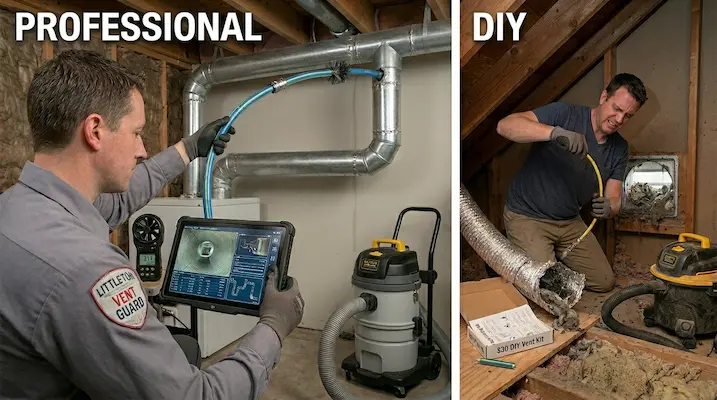
Tools Used DIY: Consumer brush kit ($25 to $50), household or shop vacuum, optional drill. Professional: Industrial rotary brush system, HEPA vacuum extraction, anemometer for airflow measurement, inspection camera where needed.
Airflow Verification DIY: None. No measurement capability to confirm the system is actually clear and flowing adequately. Professional: Pre and post cleaning CFM measurement with documented results.
Code and Material Inspection DIY: Not included. Homeowner has no reliable way to assess NFPA 211 compliance, run length limits, or duct integrity. Professional: Full assessment of duct material, transition hose compliance, run configuration, and exterior termination condition.
Risk of Damage DIY: Moderate. Rod breakage inside the duct is a real risk in longer or more complex systems. Professional: Minimal. Equipment is designed for the full range of residential duct configurations.
Cost Per Service DIY: $25 to $50 for tools, one time purchase, reusable. Professional: Typically $100 to $175 for a standard residential cleaning in the Littleton area, depending on vent length and configuration.
Time Required DIY: 30 to 90 minutes depending on accessibility and duct length, plus time to pull the dryer, reconnect, and clean up. Professional: 45 to 90 minutes from arrival to departure, including inspection, cleaning, and verification.
Peace of Mind DIY: Limited. You know the accessible portion is cleaner. You do not know the condition of the full system or whether it is performing at a safe airflow rate. Professional: Complete. Documented before and after results, code compliance assessment, and a written summary of any conditions requiring attention.
The Cost Argument: Is DIY Really Cheaper?
On paper, a $30 brush kit looks like a clear win over a $130 to $150 professional service. Over time, the math is less straightforward.
A thorough professional cleaning annually costs roughly $130 to $175 per year. A compromised DIY cleaning that leaves 40 to 60 percent of the duct still restricted forces your dryer to run longer cycles, which increases electricity or gas consumption. Studies on dryer energy efficiency show that a fully clean vent can reduce drying time per load by 20 to 40 percent compared to a significantly restricted vent. At 8 to 10 loads per week, that reduction in run time translates to meaningful monthly energy savings that partially offset the professional service cost.
The other financial consideration is appliance lifespan. Most clothes dryers are designed to last 10 to 13 years with proper care. A chronically restricted vent causes the heating element, thermal limiter, and motor to work under sustained stress in every cycle. Early component failure and reduced appliance life are documented consequences of persistent airflow restriction. Replacing a dryer 4 to 5 years ahead of its natural life span costs $600 to $1,400 depending on model, which is several times the cumulative cost of annual professional cleaning over the same period.
Then there is the insurance angle. Several homeowner’s insurance carriers in Colorado include language about appliance maintenance in their policy conditions, particularly regarding dryer vent upkeep and fire prevention. A fire that occurs in a home where documented maintenance records do not exist can complicate a claim. Professional cleaning services provide documentation. DIY cleaning does not.
For homeowners in Highlands Ranch or Sterling Ranch who own premium properties and want to protect both the appliance and the home itself, our Comprehensive Safety Inspection and Diagnostics service provides documented proof of system condition that is useful for both insurance purposes and real estate transactions.
When DIY Cleaning Is Genuinely Appropriate
There are specific situations where DIY maintenance is not just acceptable but genuinely sensible.
If your dryer vent is a straight run of 10 feet or less with a direct exterior exit and no elbows, a quality consumer brush kit used correctly will reach the full duct length and produce results comparable to a professional cleaning for that specific configuration. These are relatively rare in modern construction but not uncommon in older homes where the dryer is positioned directly against an exterior wall.
DIY maintenance is also appropriate as a between service habit. If you schedule professional cleaning annually, doing a quick accessible section clean with your brush kit every six months is a reasonable way to manage lint between those visits without replacing the professional service entirely.
Finally, inspecting the exterior vent cap and the transition hose behind the dryer every few months is a DIY task that adds genuine value. You are not cleaning the full system, but you are catching visible problems early.
When Professional Cleaning Is Not Optional
There are situations where DIY cleaning is genuinely inadequate regardless of how carefully it is done.
Any duct run longer than 15 to 20 feet requires professional equipment to clean thoroughly. The rotary brush system that reaches and scrubs the full interior of a 30 foot duct with three directional changes simply does not exist in a consumer kit.
Roof terminated vents, which are more common in certain neighborhoods like Columbine Valley and Ken Caryl where multi story homes push the duct run further and higher, require both extended equipment reach and exterior access at the roofline. Our Dryer Vent Cleaning Columbine Valley and Dryer Vent Cleaning Ken Caryl services are specifically equipped for these roof terminated configurations.
If you have not had a professional service in more than 18 to 24 months regardless of your DIY habits, a full professional cleaning and inspection is appropriate. Lint builds up in sections that consumer kits do not reach, and at some point the cumulative accumulation in those areas becomes a risk that no amount of accessible section cleaning addresses.
If you are buying or selling a home in Littleton, a professional dryer vent inspection and cleaning is standard due diligence. Our Comprehensive Safety Inspection and Diagnostics service provides the documented condition report that home inspectors and buyers increasingly expect to see.
If your dryer is showing symptoms of restriction (clothes still damp after a full cycle, excessive heat in the laundry room, burning smell during operation, or the dryer shutting off mid cycle) a professional inspection is the appropriate first response rather than another DIY attempt. These symptoms can indicate conditions beyond simple lint buildup, including disconnected duct sections, crushed rigid duct inside the wall, or a failed transition hose. Cleaning alone will not resolve those problems. Our Professional Vent Repair and Rerouting service handles both diagnosis and repair in a single visit.
If your home has a history of bird nesting in the exterior vent cap, a standard cleaning is not sufficient. Active or prior nests involve compacted organic material that is fundamentally different from lint in both texture and removal requirements. Our Bird Nest Removal and Guard Installation service addresses nest removal safely and installs a suitable guard to prevent recurrence, which is an especially relevant service in Southglenn and Heritage Village where spring nesting activity is consistent. Our Dryer Vent Cleaning Southglenn and Dryer Vent Cleaning Heritage Village teams are familiar with the specific vent configurations and wildlife patterns in those communities.
If the vent checks out clean but the dryer still isn’t heating or keeps shutting off, the problem may be the appliance itself, such as a failed heating element or thermal fuse, in which case you’ll need a professional dryer repair service .
The Honest Recommendation: A Hybrid Approach
The binary framing of DIY versus professional misses the most practical answer for most homeowners.
Use DIY maintenance as a supplemental habit between professional service visits. Clean the lint trap before every load. Inspect the transition hose and exterior cap every couple of months. Run a brush kit through the accessible section of the duct every six months if your run is short enough and straightforward enough for it to be effective.
Then schedule professional cleaning annually, or every six months if you have pets that shed heavily, run more than 10 loads per week, have a duct run longer than 20 feet, or fall into any of the higher frequency categories that make lint accumulation faster than average in your specific home.
The professional service is not a substitute for good habits between visits. The good habits are not a substitute for a professional service. They work together, and the combination produces the best outcome in terms of safety, appliance longevity, and energy efficiency.
Colorado Specific Considerations for Littleton Homeowners
One thing that rarely comes up in national comparison guides is the specific context of Colorado’s climate for dryer vent maintenance.
At Littleton’s elevation and in the consistently low humidity environment of the Front Range, lint dries out significantly faster than it does in humid climates. Dry lint has a lower ignition temperature than moist lint and is more easily disturbed by airflow changes inside the duct. What this means practically is that lint that has been sitting in your duct for 12 months in Littleton is more combustible than lint that has been sitting in a Florida home for the same period.
This is one of the genuine reasons why homeowners in the Arapahoe County area should take their dryer vent cleaning schedule seriously and why a professional cleaning that actually reaches and removes all accumulated material matters more here than the national average suggests.
It also matters for the DIY versus professional question in a specific way. In a humid climate, lint that gets partially dislodged by a DIY cleaning and settles back into the duct is a performance problem. In Colorado’s dry climate, it is more directly a fire risk. The stakes for incomplete cleaning are slightly higher here, which is an honest argument for erring toward professional service rather than relying solely on consumer kit maintenance.
For the communities we serve across Arapahoe County, including Highlands Ranch and Sterling Ranch, this climate context is part of why we approach every service visit with a complete process rather than a quick pass through.
Common Questions Homeowners Ask
Can I damage my dryer vent by cleaning it myself?
Yes, in specific circumstances. The most common DIY related damage is rod breakage inside the duct, which leaves equipment lodged in the ductwork and requires professional extraction. Consumer brush kits can also snag on interior duct seams and damage the duct lining in older metal systems. For short, straight runs, the risk is low. For longer or more complex systems, it is real enough to factor in.
How do I know if my DIY cleaning actually worked?
Honestly, without measurement tools, you cannot know with certainty. The most practical indicators are whether your drying time returns to normal (35 to 45 minutes for a standard load), whether the exterior vent cap opens fully and stays open during operation, and whether you can feel a strong, consistent rush of warm air from the exterior exit while the dryer is running. These are reasonable but not definitive checks.
Does professional cleaning damage the duct?
A properly executed professional cleaning using correctly sized equipment does not damage the ductwork. Industrial rotary systems are designed to clean without abrasion. The pre service inspection also identifies any pre existing duct damage so the technician can adjust their approach accordingly.
Is dryer vent cleaning different for gas versus electric dryers?
The vent cleaning process itself is identical. However, gas dryers carry an additional safety consideration: a blocked or restricted vent can cause combustion gases to back up into the laundry room rather than venting to the exterior. For gas dryer owners, the safety case for thorough, verified cleaning is even stronger than for electric dryer owners.
What if my vent has not been cleaned since the house was built?
This is more common than most people expect, particularly in homes in Heritage Village and older Littleton neighborhoods where the original builder installed the vent and subsequent owners never addressed it. If your vent has never been professionally cleaned or has not been serviced in several years, the appropriate response is a professional inspection and cleaning rather than a DIY attempt on an unknown accumulation level.
The honest answer is that DIY and professional dryer vent cleaning are not competing options. They are complementary approaches that serve different purposes. Use them accordingly, understand the limits of each, and your dryer will run efficiently, last longer, and present less fire risk to your home.
If you are ready to schedule a professional cleaning in Littleton or across Arapahoe County, you can reach us directly through our contact page or review the full range of services we offer at our services overview.