Clean your dryer vent at least once every 12 months. That is the standard recommendation from the National Fire Protection Association, the U.S. Fire Administration, and virtually every certified dryer vent technician in the country. But here is the thing most articles do not tell you: for a significant number of households, once a year is not enough. The right frequency for your home depends on how you use your dryer, how your vent is built, and yes, even where you live.
If you are in the Littleton, Colorado area and wondering whether your vent is overdue, this guide is going to give you a complete, honest answer. We will cover the baseline rules, the factors that change everything, the warning signs you cannot afford to ignore, and what actually happens inside your vent when cleaning gets put off for too long.
Why Dryer Vent Cleaning Frequency Actually Matters
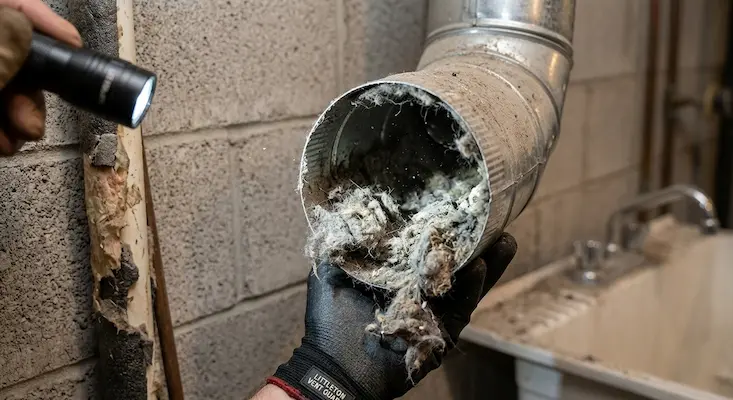
Most people focus on the lint trap. You pull it out, swipe off the fuzz, and feel like you have done your part. The problem is that roughly 25 to 35 percent of the lint your dryer generates bypasses the trap entirely and travels directly into the vent line. That lint does not disappear. It sticks to the inner walls of the duct, builds up over time, reduces airflow, and at a certain point becomes a serious fire hazard.
According to the U.S. Fire Administration, clothes dryers are responsible for approximately 2,900 residential fires per year in the United States. The leading cause of those fires is not a mechanical failure or a faulty electrical component. It is lint accumulation that was never cleared. The NFPA formally classifies failure to clean as the number one cause of dryer fires in the country.
That is not a small risk. That is a documented, preventable danger that sits inside the walls of your home right now.
The frequency at which you address it makes all the difference.
The Standard Rule: Once a Year for Most Homes
For an average household, professional dryer vent cleaning once every 12 months is the appropriate baseline. This applies to a home with two to four occupants, moderate laundry habits (roughly six to eight loads per week), a vent run under 20 feet, and no pets that shed heavily.
The annual schedule is also what most dryer manufacturers build their warranty conditions around. Several major appliance brands now include vent maintenance language in their product documentation, meaning that neglecting to clean your vent could technically void your warranty coverage if a fire or mechanical failure occurs.
Annual cleaning is the floor, not the ceiling. Depending on your specific situation, you may need to schedule service more frequently, and in some cases significantly more frequently.
Factors That Require More Frequent Cleaning
This is where most guides fall short. They hand you the one year rule and move on. But the reality is that a single mother of four doing 15 loads a week lives in a completely different dryer vent reality than a retired couple doing four loads a week. Here is a breakdown of the factors that should push your schedule forward.
Household Size and Laundry Volume
The more laundry you generate, the more lint your dryer produces, and the faster your vent fills up. Families running 10 or more loads per week should consider cleaning every six months rather than waiting for the calendar year to turn. If you regularly wash and dry bulky items like comforters, towels, or work uniforms, those materials shed significantly more fiber than lighter clothing and accelerate buildup even further.
Pet Ownership
Dog hair and cat fur are particularly problematic for dryer vent systems. Pet hair does not break down the way cotton fiber does. It weaves into lint and creates dense, clumped blockages that restrict airflow faster than standard lint buildup. Pet owners, especially those with heavy shedders like golden retrievers, huskies, or long haired cats, should plan for cleaning every six months as a matter of routine.
Vent Length and Configuration
Every foot of vent line beyond the first few creates another surface for lint to accumulate. Every 90 degree elbow in the duct adds the resistance equivalent of several additional feet of straight pipe. A home with a 30 to 35 foot vent run and three elbows fills up dramatically faster than a home with a 10 foot straight run to an exterior wall. If your dryer vent travels through multiple floors, runs through an attic or crawl space, or exits through the roof rather than a side wall, your vent requires more frequent attention.
Type of Transition Hose in Use
Flexible foil and plastic accordion hoses behind the dryer trap lint aggressively due to their ribbed interior surfaces. Homes still using this type of transition hose instead of rigid or semi rigid metal duct accumulate blockages faster and should be serviced more often. Your technician may also recommend upgrading the hose material during service as a long term solution.
Colorado’s Climate and Altitude
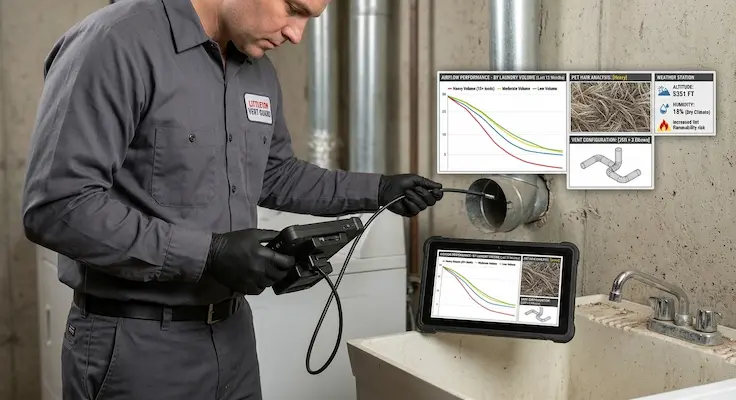
This matters more than most people realize. Littleton sits at roughly 5,351 feet above sea level. The air here is drier, thinner, and lower in humidity than most of the country. That combination causes lint to dry out rapidly inside your vent, making it lighter, more airborne, and more flammable than lint in humid coastal climates. Dry lint ignites at lower temperatures than moist lint. It also travels deeper into the vent before settling, meaning blockages tend to form further in and are harder to detect visually. For Littleton homeowners, this is a genuine reason to take your vent cleaning schedule seriously, even if your laundry habits are otherwise moderate.
Cleaning Schedule by Household Type
Here is a practical reference guide for how often you should be scheduling professional service based on your situation:
Single person or couple, light laundry use: Every 18 to 24 months, though annual is still a sound habit.
Average family (3 to 4 people), moderate use: Every 12 months without exception.
Large family (5 or more people), heavy use: Every 6 months.
Pet owners with heavy shedding breeds: Every 6 months.
Home with a long vent run (over 25 feet) or roof exit: Every 6 to 12 months depending on use.
Rental properties and multi family units: Every 6 to 12 months per unit, with documentation for liability purposes.
Commercial laundry facilities, laundromats, gyms, and hotels: Every 3 to 6 months, as high volume use creates dangerous buildup extremely quickly.
8 Warning Signs Your Dryer Vent Needs Cleaning Right Now
Regardless of when your last service was, your dryer and your laundry room will often tell you when something is wrong before a problem escalates. Do not wait for your scheduled appointment if you notice any of the following:
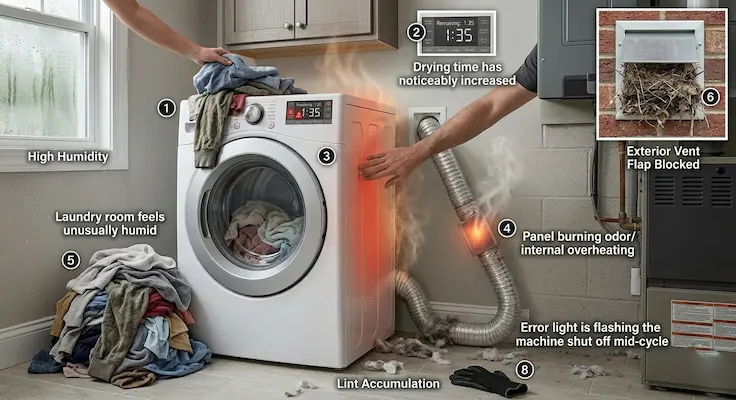
1. Clothes are still damp after a full cycle. This is one of the clearest signals. When airflow is restricted, hot moist air cannot escape the drum efficiently, leaving clothes partially wet even after a standard drying time.
2. Drying time has noticeably increased. If loads that used to finish in 35 to 40 minutes now take 60 to 90 minutes, your vent is likely partially blocked and working against your dryer.
3. The dryer or your clothes feel excessively hot. A properly vented dryer releases heat outward. When the vent is obstructed, heat backs up into the drum and the exterior cabinet. Clothes that feel scalding hot coming out are a warning that the system is overheating.
4. You can smell something burning. Lint is highly flammable organic material. A burning odor during a drying cycle is a serious alert that lint inside the vent may be approaching ignition temperature. Turn the dryer off and call a professional the same day.
5. The laundry room feels unusually warm or humid. Heat and moisture that should be venting to the outside are instead accumulating in your laundry room. This is a sign of significant airflow restriction.
6. The exterior vent flap is not opening during operation. When you run your dryer, the exterior vent hood flap should move freely and stay open. If it remains closed or barely opens, there is not enough airflow reaching the exit point.
7. Your dryer is shutting off mid cycle. Most modern dryers have a built in thermal limiter that automatically cuts power if the appliance overheats. If your dryer repeatedly stops before a load is finished, a blocked vent is the most likely culprit.
8. You see lint around the vent opening or behind the dryer. Visible lint accumulation around the transition hose or exterior vent cap is a surface indicator that conditions inside the duct are likely worse.
If you are experiencing any of these symptoms, scheduling a dryer vent cleaning in Littleton with a certified technician should be your immediate next step, not something to add to next month’s to do list.
What Happens When You Go Too Long Without Cleaning
Skipping dryer vent maintenance does not just reduce efficiency. The consequences escalate over time and can become extremely costly or dangerous.
In the short term, restricted airflow forces your dryer to run longer cycles and work harder to accomplish the same task. This increases your energy consumption, drives up your monthly utility bill, and puts mechanical stress on the heating element, motor, and drum bearings. Most dryers are designed to last 10 to 13 years with proper care. A chronically blocked vent can reduce that lifespan to 5 to 7 years, costing you hundreds or thousands of dollars in early appliance replacement.
In the medium term, the excess moisture that cannot escape through a clogged vent gets pushed back into your laundry room and the surrounding wall cavity. This creates the conditions for mold and mildew growth behind the walls and inside the ductwork itself, which presents both structural and indoor air quality problems.
In the long term, the fire risk becomes the central concern. Lint that has been compressing and drying inside a vent for two or three years is not a mild hazard. It is a highly combustible material sitting inside the walls of your home adjacent to an appliance that generates sustained heat. The NFPA’s data makes clear that this is not a theoretical risk. Thousands of real homes burn every year because of it.
What a Professional Dryer Vent Cleaning Actually Involves
Understanding the cleaning process helps explain why professional service is so different from a quick DIY attempt with a vacuum attachment.
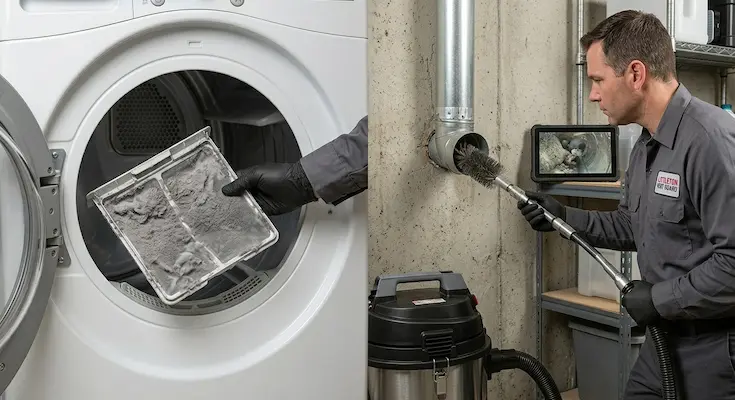
A trained technician starts with a full system inspection, often using a camera or diagnostic tools to assess the condition of the duct from the dryer connection all the way to the exterior exit. This tells them how severe the buildup is, whether there are any disconnected sections, crushed areas, or bird nests, and what tools will be required.
The cleaning itself involves rotary brushes specifically designed for the diameter and length of your duct, combined with high powered vacuum extraction that pulls lint and debris out rather than pushing it further in. This matters because improper DIY cleaning using leafblowers or standard vacuum hoses can compact lint into tighter blockages rather than removing them.
After the duct is clear, the technician performs an airflow velocity test to confirm that air is moving through the system at an adequate rate. A before and after comparison using CFM (cubic feet per minute) measurements gives you a documented result rather than just a verbal assurance that the job is done.
Finally, a certified technician will flag any code compliance issues they find, such as the use of prohibited duct materials, vent runs that exceed the maximum allowable length under NFPA 96 standards, or exterior vent caps that need replacement.
Lint Trap Cleaning vs. Vent Cleaning: Understanding the Difference
These are two entirely separate maintenance tasks that serve different purposes and cannot substitute for one another.
Cleaning the lint trap or lint screen before or after every load is a basic habit that every dryer owner should maintain. It keeps surface lint out of the dryer drum and helps the appliance operate properly on a day to day basis. This task takes about 10 seconds and should be non negotiable.
Professional vent cleaning addresses the ductwork itself. No household vacuum, no store bought brush kit, and no amount of lint trap maintenance can replicate what a trained technician does to the interior of a 15 to 35 foot vent line. These are complementary habits, not interchangeable ones.
A Note for Littleton Homeowners Specifically
If you live in any of the neighborhoods we serve across Arapahoe County, whether that is Highlands Ranch, Ken Caryl, Southglenn, Sterling Ranch, Heritage Village, Columbine Valley, or downtown Littleton, the combination of Colorado’s dry air and the building styles common in this area creates specific considerations worth knowing.
Many homes in Littleton built between 1985 and 2005 still use flexible foil duct as the transition hose behind the dryer. That material is no longer code compliant under modern NFPA standards, and its ribbed surface traps lint aggressively. If your home has this type of hose and you have never had the duct system inspected, a dryer vent cleaning in Littleton that includes a materials assessment is genuinely worthwhile.
Homes in multi story layouts, particularly those where the dryer is on an upper floor or in a second floor laundry closet, often have longer vent runs that travel down through interior walls before exiting at ground level. These configurations require more frequent attention than a dryer venting through a nearby exterior wall.
How to Stay on Schedule
The single most effective thing you can do is treat your dryer vent like any other recurring home maintenance task: put it on the calendar.
Set a reminder once a year in your phone or home maintenance app for spring or fall, both of which are ideal service windows before heavy seasonal use. If you fall into one of the higher frequency categories described above, set two reminders six months apart.
Between professional cleanings, get in the habit of checking the exterior vent cap every few weeks while the dryer is running. The flap should be moving freely. If it is not, or if you notice visible debris around the opening, that is a cue to call ahead of schedule.
The cost of an annual professional cleaning is a fraction of what it costs to replace a dryer, repair smoke or fire damage, or deal with a mold remediation job inside your walls. It is one of the highest return maintenance investments available to a homeowner, and it takes less than 90 minutes from start to finish.
Frequently Asked Questions
Can I clean my dryer vent myself?
You can perform a surface level cleaning of the transition hose and the area immediately behind the dryer. However, for vent runs longer than a few feet or those with bends, professional equipment is necessary to clean the full length of the duct without compacting debris further in. DIY brush kits frequently break inside the vent or miss large sections of buildup entirely.
What time of year is best for dryer vent cleaning?
Spring and fall are ideal. Cleaning in spring removes any lint accumulation from winter heavy use. Cleaning in fall prepares the system before the cold weather months when dryers run most heavily. Either window works well, and scheduling either one is far better than not scheduling at all.
How long does a professional cleaning take?
Most residential dryer vent cleanings take between 45 and 90 minutes depending on vent length, configuration, and the amount of buildup present.
Does dryer vent cleaning reduce my energy bill?
Yes, measurably. A clean vent allows your dryer to complete a standard load in 35 to 45 minutes rather than 60 to 90 minutes. That reduction in run time directly translates to lower energy consumption and a lower monthly utility bill.
How will I know if my vent is clean after service?
A qualified technician should perform an airflow velocity test at the exterior exit point and walk you through the results. You should also be able to feel a strong, consistent rush of warm air from the exterior vent cap while the dryer is running.
The answer to how often you should clean your dryer vent is not complicated, but it is not one size fits all either. Start with once a year as your baseline. Adjust upward based on your household size, pet situation, vent configuration, and how heavily you use your dryer. Pay attention to the warning signs your appliance gives you, and do not wait for a problem to force the issue.
If your last cleaning was more than 12 months ago, or if you have never had it done at all, that is where to start.